
Sovereign AI Explained: Data Control for the 2026 Enterprise
Discover what sovereign ai means, why it matters in 2026, and how enterprises reduce data risk while keeping AI infrastructure under local control.
 Written by Lajos NAGY
 Investment in nationally controlled artificial intelligence has moved from ambition to budget line across the G20. Yet a striking gap persists between political intent and deployed capital, and enterprises are caught in the middle. If your systems still assume that sensitive data must travel to a foreign cloud, you are inheriting rules written by others. Rethinking that assumption starts with our Zero Data Architecture approach, which questions whether the data even needs to exist in the first place.
The concept of sovereign AI describes a shift from renting artificial intelligence to owning it: keeping data, models, and compute inside a defined legal perimeter. According to MarketsandMarkets, the global market was valued at approximately USD 40 billion in 2025, one of the fastest-growing segments of the broader AI landscape. Understanding this movement is now essential for any architect designing resilient digital systems.
What the term sovereign AI actually means
At its core, sovereign AI represents independently owned and operated infrastructure across the full AI lifecycle. This spans the accelerators and graphics processing units, the large language models, and the inference servers that host them locally. The goal is that training and inference both remain within a specific jurisdiction, subject only to local laws.
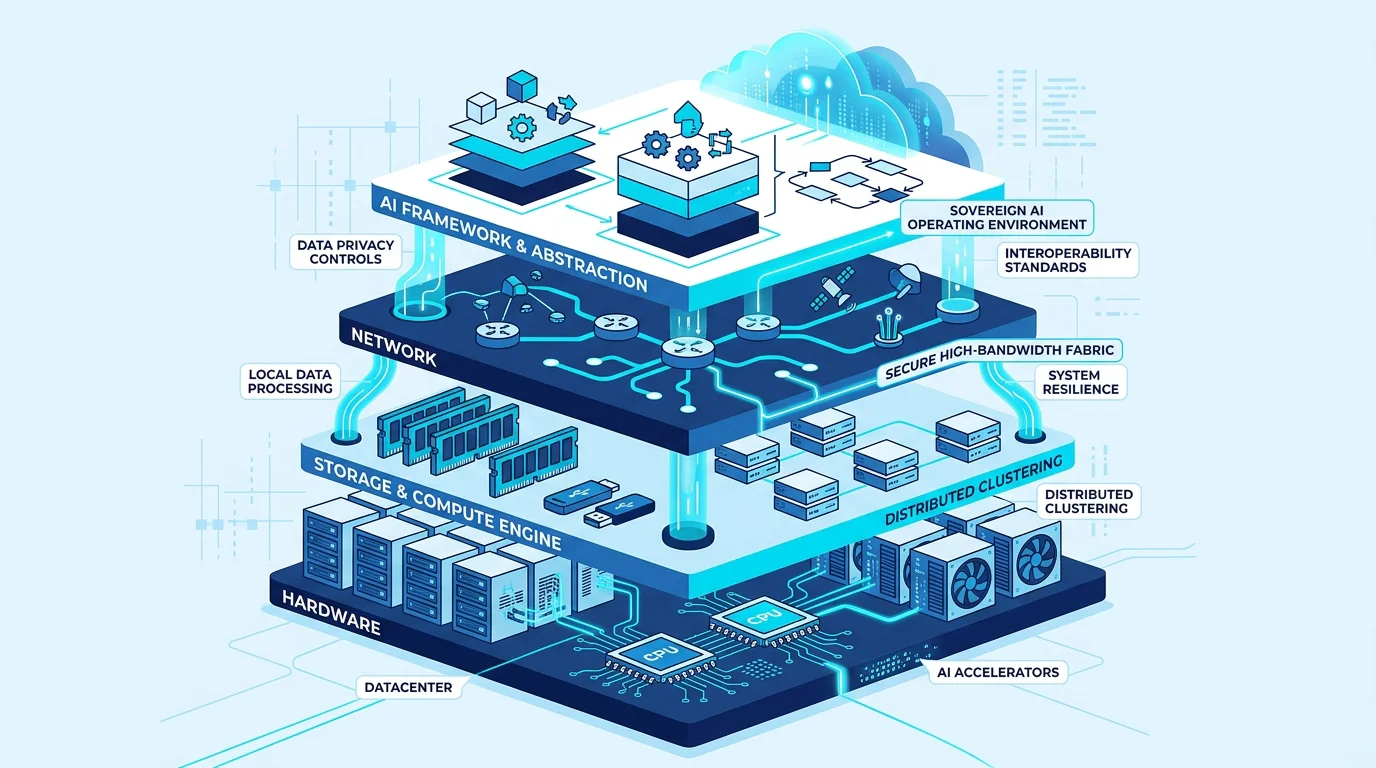
The definition, however, remains contested. Analysts describe sovereignty as a position across four interdependent layers: compute infrastructure, foundation models, platform and middleware, and applications. A nation or enterprise rarely controls all four at once. Instead, sovereignty exists on a spectrum, and every organization must decide which layers matter most for its risk profile and its regulatory obligations.
It is useful to separate two related ideas. Data sovereignty concerns where information is collected, processed, and stored. Operational sovereignty concerns who runs the system and whether a foreign entity could remotely disable or alter it. Both feed the larger objective of controlling AI infrastructure rather than merely consuming it.
Why enterprises and nations are investing now
Why has this become urgent in 2026? The pressure is partly geopolitical and partly structural. Export controls on advanced semiconductors reframed access to compute as conditional rather than guaranteed, prompting anticipatory diversification across Europe, the Gulf, and Asia.
The money follows a concentrated pattern. According to the CNAS Sovereign AI Index, the Middle East and East Asia together account for more than 80 percent of all tracked and publicly disclosed sovereign AI investment worldwide. Investment elsewhere rarely exceeds a few hundred million dollars, revealing a substantial gap between declared priorities and deployed capital.
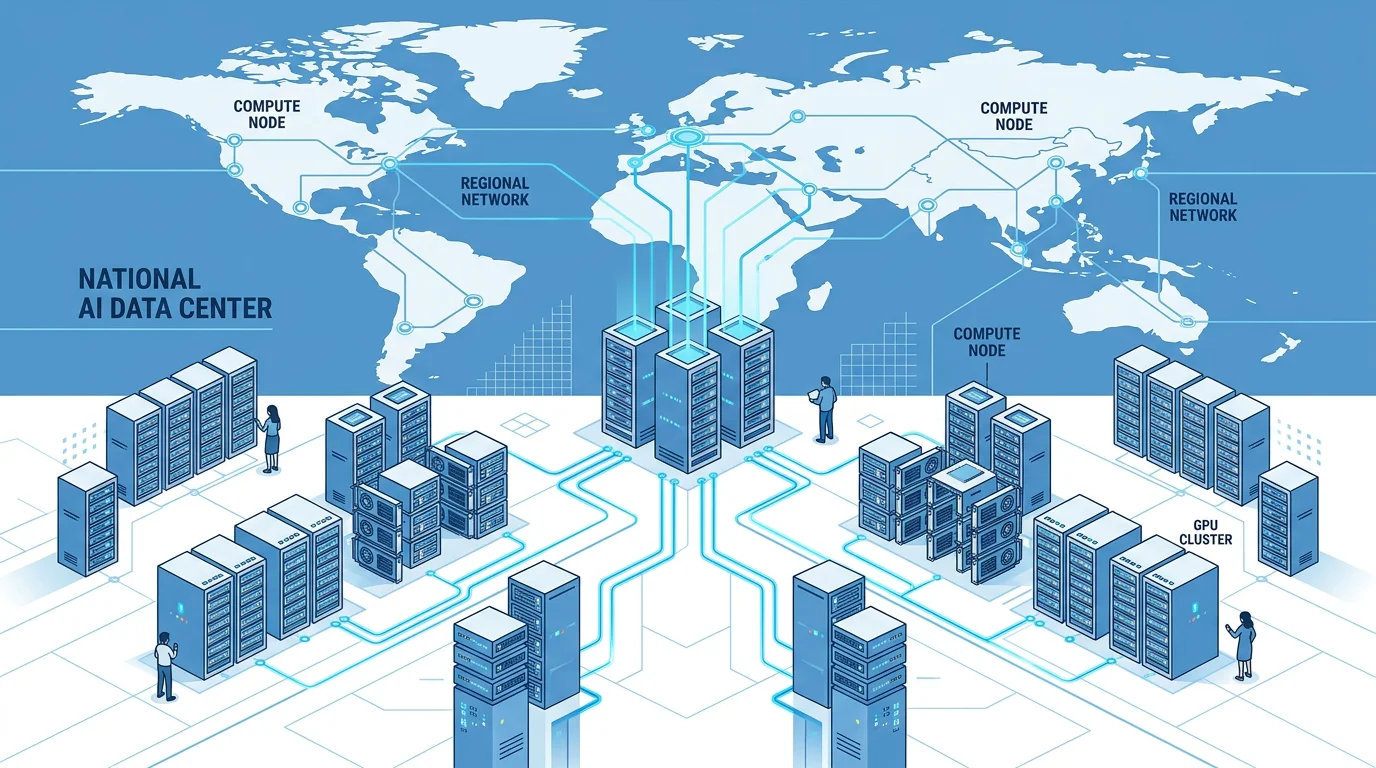
The drivers overlap. For some organizations, the imperative is security and the protection of sensitive information. For others, it is economic value, cultural relevance, or autonomy from dependence on a single foreign provider. Sovereign wealth funds are amplifying the trend: a July 2026 IE University study reported total direct investment spending rising 91 percent to USD 404 billion, with roughly one third flowing to artificial intelligence.
The components of a sovereign AI system
Think of a sovereign AI system as a layered stack, where each layer reinforces self-reliance. The foundational questions are ownership questions: Who owns the chips and data centers? Who provides the data used to train and refine the models? Who controls the algorithms and the user-facing applications? Energy is often treated as a bonus layer, because a system you cannot power is not truly independent.
Achieving meaningful control generally requires four disciplines working together:
- Data sovereignty: sensitive data resides on storage physically located within the sovereign perimeter, so training, inference, and model weights remain yours.
- Technical sovereignty: a transparent chain of custody, sometimes captured as an AI bill of materials, accounts for every component in the stack.
- Operational sovereignty: full administrative control, domestic talent, and no dependence on a foreign kill switch.
- Assurance sovereignty: independent, continuous verification that the system behaves as intended, producing audit-ready evidence.
Open source models and weights lower the barrier to entry, allowing organizations to fine-tune a foundation model with their own data rather than training from scratch. As you design these layers, our guidance on building an AI-ready network can help you structure the underlying connectivity that a sovereign system depends upon.
The data dependency problem sovereignty overlooks
Here is a nuance that most sovereignty discussions miss. Keeping data local reduces where it can travel, but it does not reduce how much of it exists. A system that hoards personal data inside a national perimeter is still a system that can be breached, misused, or repurposed. The perimeter changes; the underlying liability does not.
This is where a structural approach matters. Rather than protecting data after collection, the more resilient discipline prevents unnecessary collection, storage, and exploitation from occurring at all. This is the premise behind our approach to zero-data AI architecture: absence of data is designed as a feature, not treated as a limitation. When a system holds nothing sensitive, there is nothing sensitive to leak.
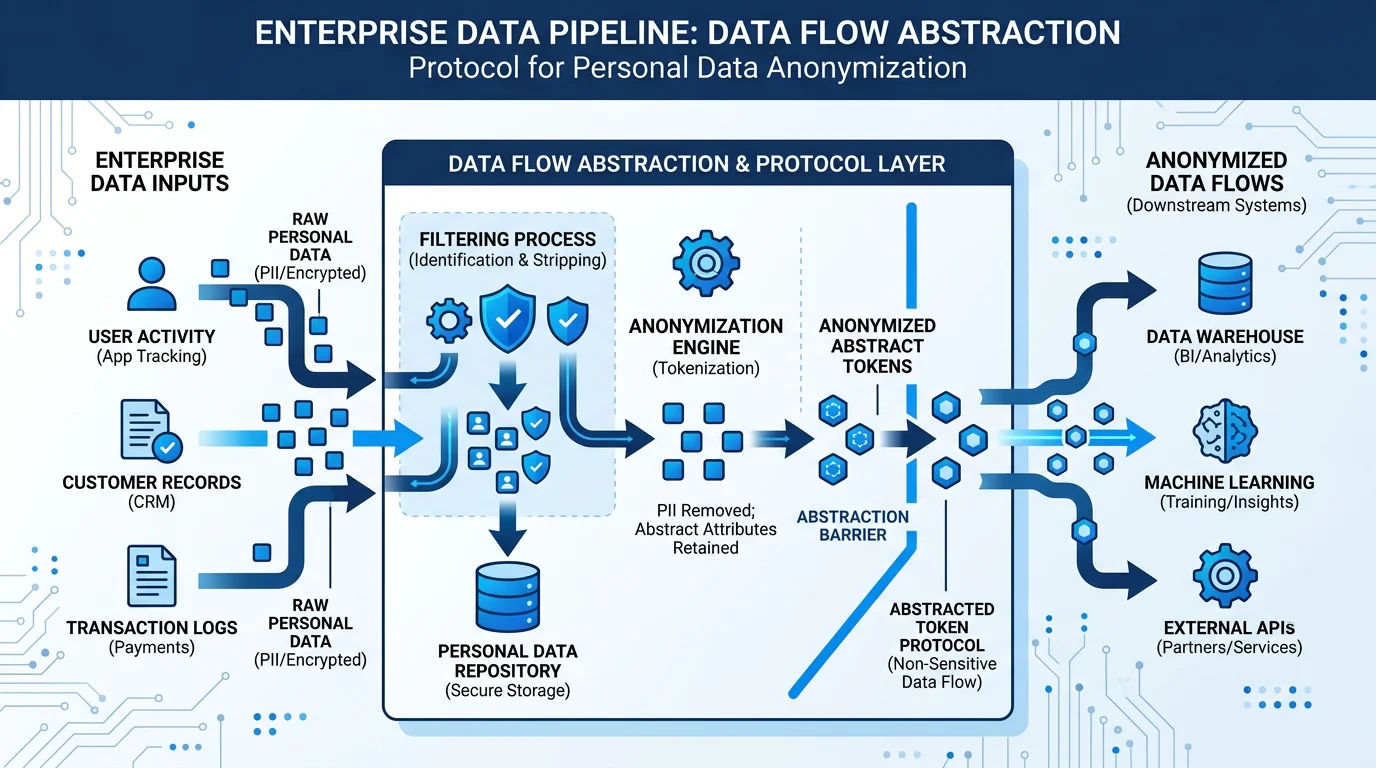
The two philosophies are complementary. Sovereignty controls the boundary; a zero-data discipline reduces what sits inside it. For AI security and risk teams, combining both shrinks the attack surface dramatically, because you are reducing what any vulnerability could ever expose. This structural framing is the core of what the Zero Data Protocol defines.
Sovereign AI compared with related data concepts
Sovereign AI is frequently confused with adjacent ideas. The distinctions matter because they lead to different architectural decisions. The table below compares the main approaches to controlling data and where each places its emphasis.
| Approach | Primary focus | Personal data collected? | Where risk is reduced |
|---|---|---|---|
| Traditional sovereign AI | Jurisdictional control of infrastructure | Yes, kept local | At the geographic boundary |
| Data minimization | Collecting less, retaining less | Reduced, still present | After collection |
| Confidential inference | Encrypting data during processing | Yes, encrypted | During compute |
| Our Zero Data Protocol | Eliminating data dependency by design | No, by default | Before collection ever occurs |
Each model has a place. However, only a structural elimination of data dependency removes the risk at its origin rather than managing it downstream. For governance teams focused on long-term integrity, this difference is decisive.
How to move toward sovereign AI in practice
Where should you begin? Sovereignty is not a static checklist but a dynamic program. Start by mapping which layers of the stack you realistically control, then prioritize the ones that carry the greatest regulatory or security exposure. Compute is purchasable; procurement maturity, governance, and regulatory coherence are not.
A notable strategic shift is underway. According to Tracxn research, 91 percent of the USD 385.5 billion raised for AI infrastructure has flowed into the United States, meaning most sovereign programs are developing within the very ecosystem they intend to balance against. In response, many programs are pivoting from prestige models of 100 billion-plus parameters toward smaller language models of 7 to 10 billion parameters that run on accessible hardware and reduce export-control exposure.
For enterprise architects, the practical lesson is to pair boundary control with structural data discipline. Segmenting your environment limits how far any single breach can spread, a principle explored in our overview of micro-segmentation for breach containment. Combined with a zero-data foundation, these measures make sovereignty durable rather than merely declarative.
Conclusion
The direction of travel is unmistakable. With the market for nationally controlled artificial intelligence valued near USD 40 billion in 2025 and expanding rapidly, the question is no longer whether to pursue data and AI sovereignty, but how to do so without simply relocating your liabilities. Jurisdictional control matters, yet it protects a perimeter around data that could be reduced or removed entirely. The most resilient systems combine local control with a deliberate refusal to depend on personal data at all. That structural discipline, where the absence of data becomes a designed strength rather than a constraint, is precisely what our protocol-level architecture delivers. To explore how this foundation fits your roadmap, review our Zero Data Protocol overview and rethink what your systems truly need to hold.
Frequently Asked Questions
Is sovereign AI the same as AI sovereignty?
No. Sovereign AI refers to the systems and infrastructure that are independently owned and operated within a jurisdiction. AI sovereignty is the broader principle of a nation or organization exercising control over its AI capabilities.
Does keeping data local make it secure?
Local storage reduces cross-border exposure but does not remove the underlying risk. Data that exists can still be breached or misused. Our Zero Data Protocol addresses this by preventing unnecessary collection and retention in the first place.
Do enterprises need to build their own AI factories?
Not necessarily. Sovereignty exists on a spectrum, and many organizations achieve meaningful control by owning specific layers, such as data and governance, while using open source models and fine-tuning them on their own infrastructure.
Continue reading
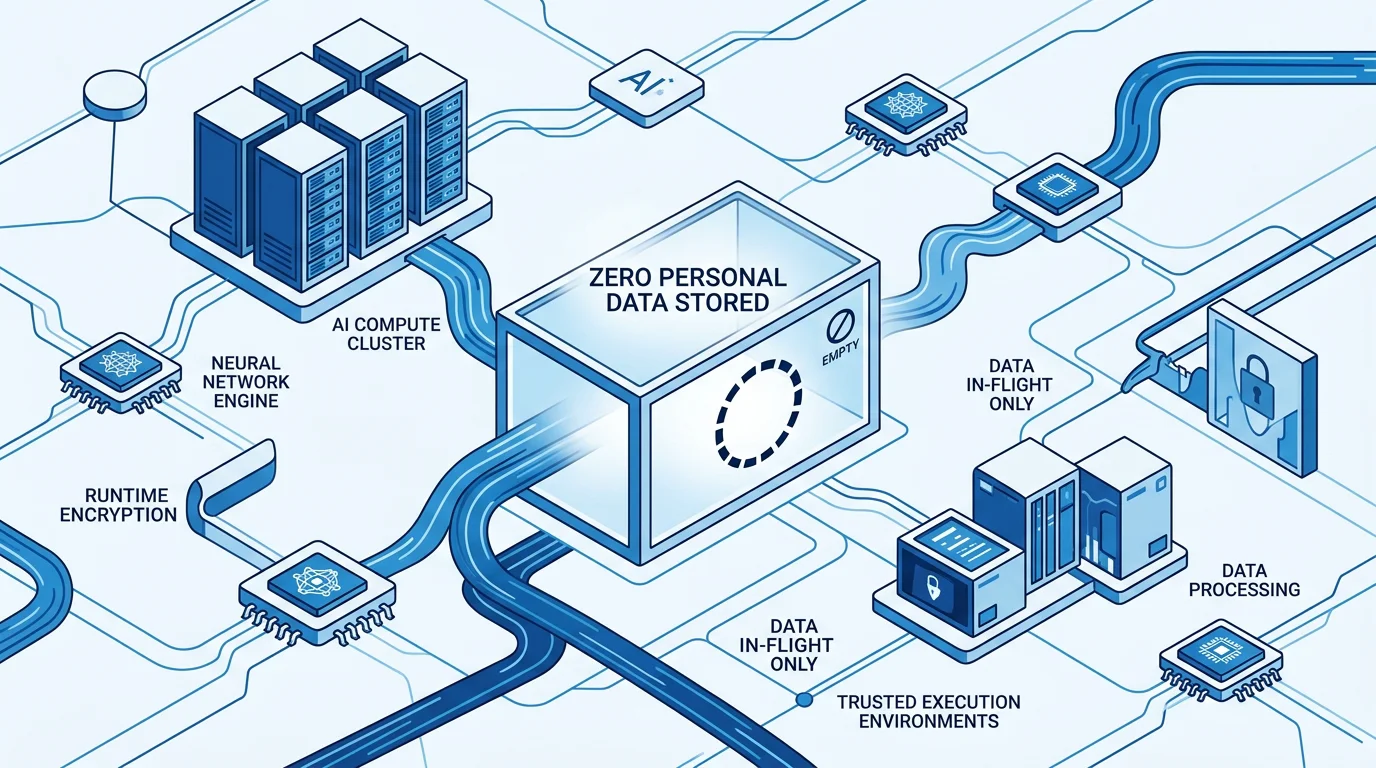
Zero Data Architecture: Building AI Without Personal Data
Zero data is a design approach that removes personal-data dependency from systems. Learn how zero data architecture reduces AI security risk.
Building an AI-Ready Network: Architecture for the AI Era
Learn how an AI-ready network supports demanding AI workloads with low latency, embedded security, and modern architecture built for scale.