
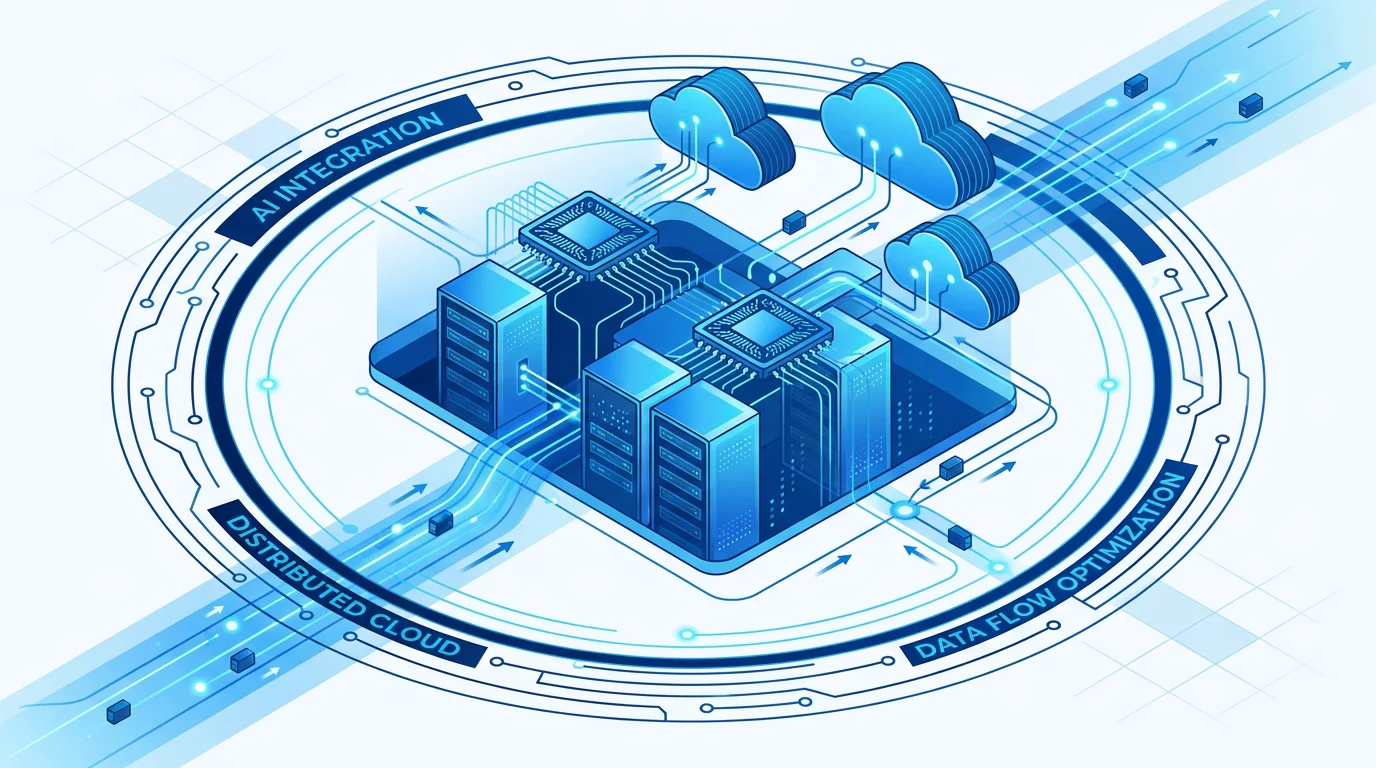
Building an AI-Ready Network: Architecture for the AI Era
Learn how an AI-ready network supports demanding AI workloads with low latency, embedded security, and modern architecture built for scale.
 Written by Lajos NAGY
 Most enterprise networks were engineered for a world of predictable client-server traffic. That world is gone. AI assistants, autonomous agents, and large-scale inference now generate bursty, encrypted, cloud-heavy flows that legacy topologies were never designed to carry. The result is a widening gap between AI ambition and infrastructure capacity, and closing it starts with a deliberate approach to architecture. To contain risk from the outset, our micro-segmentation approach helps limit how far a compromise can spread across these new traffic patterns.
The stakes are considerable. As organizations move models from experimentation into production, the network becomes part of the AI stack rather than a passive pipe. Building an AI-ready network means rethinking bandwidth, latency, automation, and security together. According to an IDC study, today's networks built on legacy three-tier designs struggle to meet the speed, scale, resilience, and security that AI demands.
What Makes a Network Ready for Artificial Intelligence
Readiness is not a single feature. It is a combination of characteristics that allow infrastructure to sustain AI workloads without becoming a bottleneck. AI thrives on data moving at high speed with ultralow latency and consistent security.
A network prepared for AI generally demonstrates several capabilities:
- High-bandwidth throughput to handle the volume generated by training clusters and edge devices.
- Low-latency pathways that support tightly coupled communication between compute and storage.
- Dynamic scalability that adapts to fluctuating workload demands in real time.
- Embedded security that protects models and the data they consume and produce.
- Intelligent automation that reduces manual operations and accelerates troubleshooting.
These attributes matter because AI traffic behaves differently. A single user prompt can trigger a chained sequence of retrieval, authentication, policy, inference, and logging events across multiple services.
Why Legacy Architectures Fall Short
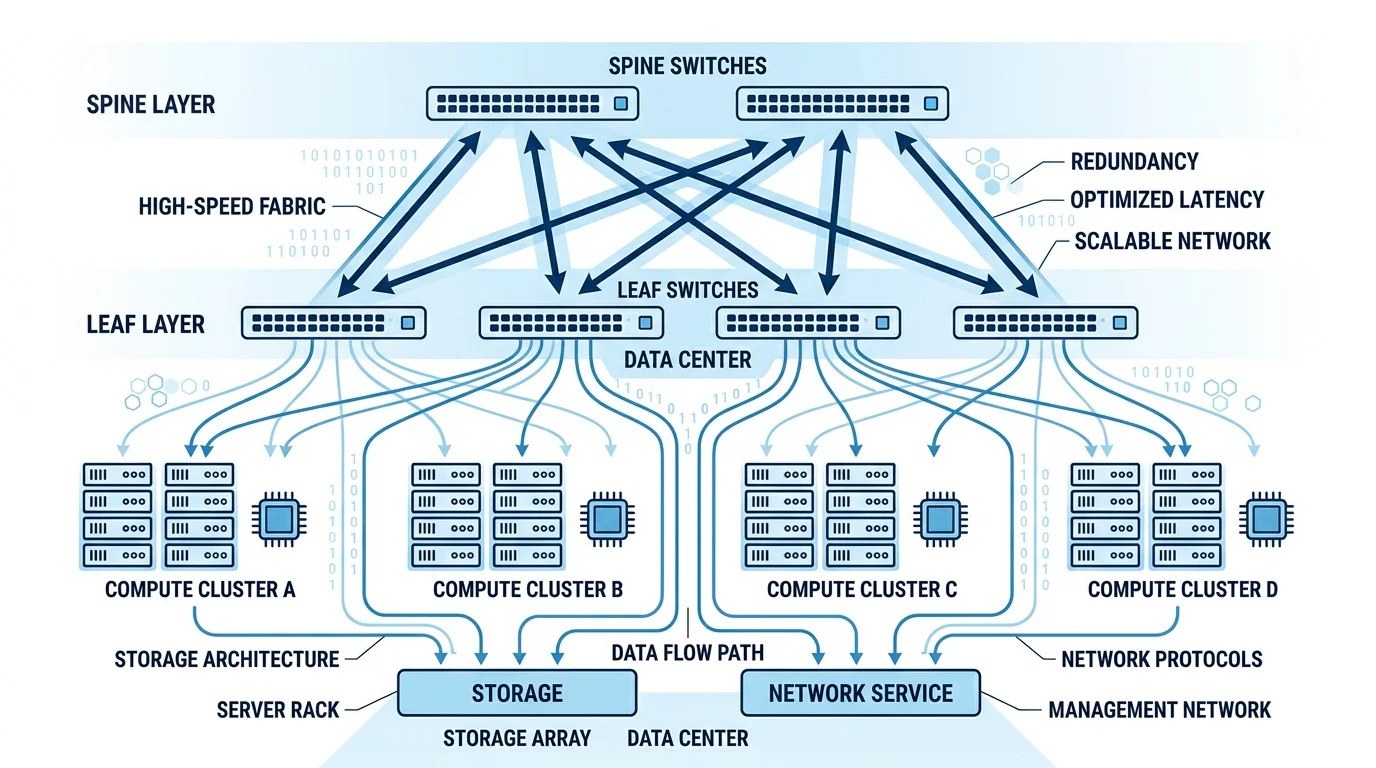
Consider the shift underway inside data centers. AI depends on massive east-west traffic between GPUs and storage, rather than the north-south flows that defined earlier applications. Traditional designs cannot meet those patterns.
IDC recommends that organizations migrate from three-tier designs to modernized leaf-spine architectures, which support the high data volumes required for training, fine-tuning, and inference. The same research advises evaluating new high-speed switches entering the market, in the 400 to 800 GbE range, to sustain predictable, low-latency GPU-to-GPU communication.
The transition introduces complexity. IDC anticipates that many enterprise data centers will run a hybrid model, combining traditional three-tier front-end designs with leaf-spine back-end AI fabric. Teams must therefore manage multiple topologies alongside increased power, cooling, and dense cabling requirements. Operational readiness, security posture, and skills shortages remain the major barriers to AI adoption across the network.
The Economics Driving Network Modernization
Why should investment follow now rather than later? The financial trajectory answers the question. According to an IDC forecast, worldwide AI infrastructure spending, covering servers, storage, and networking, is projected to reach $758 billion by 2029.
That momentum is already visible. The same research reported roughly 20.5% year-over-year growth in AI infrastructure storage spending in the second quarter of 2025, with the United States accounting for 76% of total spending in that period. Networking sits at the center of this build-out because it connects every other component.
The broader payoff is substantial. IDC forecasts that artificial intelligence will generate $22.5 trillion in cumulative global economic value by 2031, driven by productivity gains, new revenue models, and business transformation. Capturing a share of that value depends on infrastructure capable of moving from pilot to production. For teams designing next-generation systems, our Zero AI architecture illustrates how workloads can operate without accumulating unnecessary personal data as they scale.
Security as a Design Principle, Not an Add-On
Here is the differentiating insight for AI-era infrastructure: security must be structural. As AI workloads expand, data moves across data center, interconnect, edge, and multicloud environments, broadening the attack surface. Security vulnerabilities were the most common network concern flagged by organizations in IDC research.
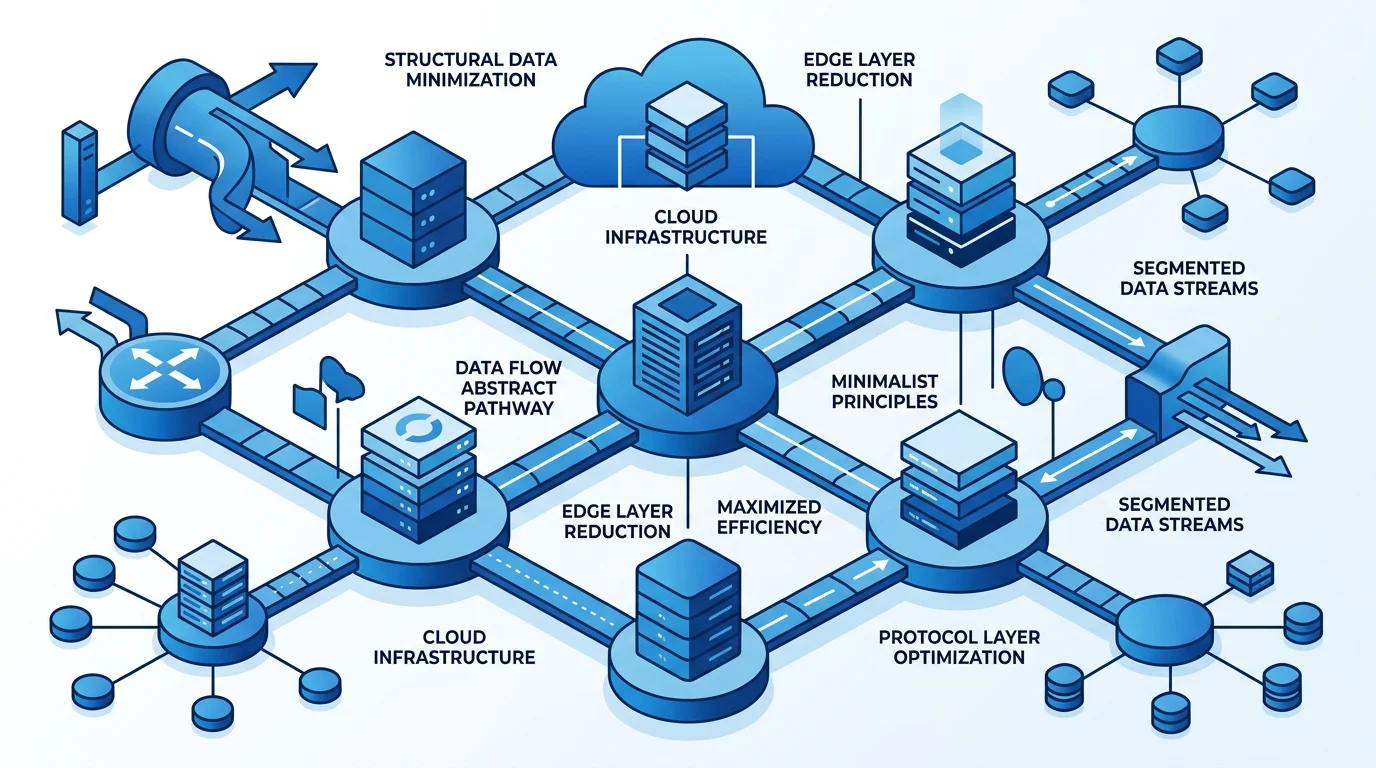
The conventional response is to layer protections onto collected data after the fact. A more resilient approach reduces what a vulnerability can expose in the first place. This is the logic of structural data minimization: if a system does not collect, retain, or repurpose personal data, then far less exists to be compromised.
Our work is grounded in three principles that shape this posture:
- Zero Collection: eliminating personal data collection by default.
- Zero Retention: preventing the storage, caching, or archiving of personal data.
- Zero Exploitation: preventing the monetization, analysis, or repurposing of personal data.
When absence of data is treated as a designed feature rather than a limitation, the network's exposure profile changes fundamentally. This is what we describe as structural sovereignty, and it complements the distributed, identity-aware controls that AI-era networks require.
Comparing Approaches to AI Network Readiness
Different strategies address AI readiness with different priorities. The table below summarizes how common approaches compare against the criteria that matter most for production AI, alongside our own structural approach.
| Approach | Primary focus | Data exposure reduction | Breach containment |
|---|---|---|---|
| Legacy three-tier network | North-south connectivity | Low | Limited |
| Leaf-spine AI fabric | East-west throughput and latency | Moderate | Moderate |
| Perimeter security add-on | Protecting collected data | Moderate | Reactive |
| Our structural data protocol | Eliminating data dependency by design | Structural | Designed in |
The distinction matters. Performance upgrades address speed, but they do not reduce the underlying quantity of sensitive data at risk. A structural approach addresses both dimensions by design.
How to Assess and Build Your Network for AI
Where should you begin? A practical sequence keeps modernization aligned with business outcomes rather than technology for its own sake.
- Assess readiness. Map current topology, traffic patterns, and latency characteristics against projected AI workloads to identify gaps.
- Modernize the fabric. Introduce leaf-spine designs and high-speed switching where east-west traffic will concentrate.
- Embed security everywhere. Apply identity-based segmentation and distributed enforcement to stop lateral movement across environments.
- Minimize structural exposure. Design systems so that unnecessary personal data is never collected or retained.
- Automate operations. Adopt telemetry and automation frameworks to reduce misconfiguration and shorten incident resolution.
Architecture and oversight should be designed early, not retrofitted after pilots show promise. That principle applies equally to performance and to protection, and it separates organizations that scale AI smoothly from those that stall between experimentation and production.
Conclusion
The transition to AI is, at its core, a networking challenge. With AI infrastructure spending on a path toward $758 billion by 2029, the organizations that thrive will be those treating the network as a strategic engine rather than a passive utility. That means modern fabric for throughput and latency, intelligent automation for resilience, and security embedded at every layer. The most durable advantage comes from reducing exposure structurally, so that a smaller footprint of sensitive data limits what any vulnerability can ever reach. That is precisely the outcome our protocol-level architecture is built to deliver by design. To explore how a structural approach strengthens your foundation, discover our Zero Data Protocol.
Frequently Asked Questions
What is an AI-ready network?
It is network infrastructure engineered to sustain AI workloads with high bandwidth, low latency, dynamic scalability, and embedded security. Unlike legacy designs, it supports the intensive east-west traffic that training and inference generate.
Why do legacy networks struggle with AI workloads?
Traditional three-tier architectures were built for predictable north-south traffic. AI generates bursty, encrypted, cloud-heavy flows and heavy GPU-to-GPU communication, which require modern leaf-spine fabric and high-speed switching to avoid bottlenecks.
How does data minimization improve network security?
Reducing the personal data a system collects and retains shrinks the attack surface directly. Our Zero Data Protocol applies this principle structurally, so that less sensitive data exists for any vulnerability to expose.
Continue reading
What Is Micro-Segmentation? Zero Trust Breach Containment
Micro-segmentation limits lateral movement and contains breaches. Learn how it strengthens zero trust security across cloud and hybrid environments.
What Is Zero AI? Understanding Zero-Data AI Architecture
What is zero AI? Learn how zero-data architecture removes personal data dependency to reduce risk in modern AI and cybersecurity systems.