What Is Micro-Segmentation? Zero Trust Breach Containment
Micro-segmentation limits lateral movement and contains breaches. Learn how it strengthens zero trust security across cloud and hybrid environments.
 Written by Lajos NAGY
 Most successful attacks do not fail at the perimeter; they succeed because nothing stops them from spreading once inside. That is precisely the gap micro-segmentation is designed to close. By isolating every workload and enforcing least-privilege policies between them, it turns a flat, permissive network into a set of tightly controlled zones. Before you architect that control, it helps to understand a complementary principle explored in our Zero Data Protocol framework: reducing what a breach can reach in the first place.
The urgency is measurable. The segmentation market is projected at USD 26.74 billion in 2026, according to Mordor Intelligence, which expects it to reach USD 73.28 billion by 2031 at a 22.34% CAGR. That trajectory reflects a broader shift, as segmentation moves from a specialist control to a mainstream, secure-by-design architecture.
What Micro-Segmentation Actually Means
At its core, this approach divides a network into small, isolated segments and applies security controls tailored to each one. Rather than trusting everything inside the perimeter, administrators enforce policies down to the level of individual workloads, virtual machines, and containers. Each secure zone receives its own rules, custom-built for what that segment genuinely requires.
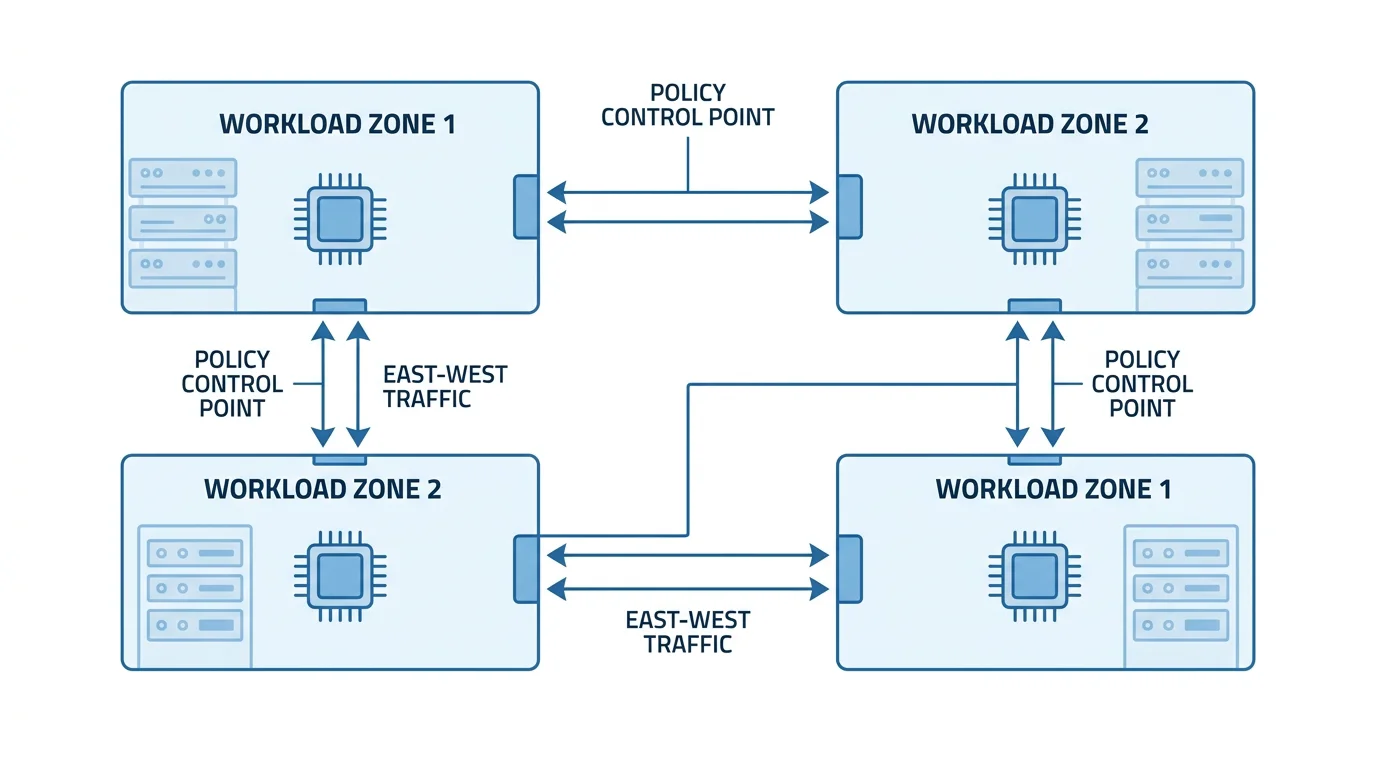
The distinction from traditional network segmentation matters. Conventional segmentation, using VLANs and subnets, mainly filters north-south traffic that crosses the perimeter. Granular workload isolation instead governs east-west traffic, the workload-to-workload communication that makes up the majority of data center and cloud activity, and which perimeter tools rarely inspect.
How It Contains Lateral Movement
Consider an attacker who compromises a single server. On a flat network, that foothold becomes a launchpad. The value of granular segmentation is that it removes the reliable pathways between workloads, deciding not merely whether two endpoints can connect, but whether they should.
This is why the model is often described as identity-based or zero trust segmentation. Policies are expressed in terms of identities and attributes, such as environment or application, rather than fragile IP-based rules. In dynamic environments where containers spin up and down in seconds, those identity-driven policies adjust automatically. The result is a smaller blast radius: even a successful intrusion stays trapped in the segment it first reached.
The Main Approaches to Segmentation
There is no single implementation. Controls generally fall into a few recognizable categories, each suited to a different environment:
- Agent-based: a software agent on each workload enforces granular isolation on hosts and containers, offering deep visibility at the cost of installing and maintaining agents everywhere.
- Network-based: physical and virtual devices such as switches, load balancers, and software-defined networks enforce policy, which is straightforward to administer but can grow costly at scale.
- Hypervisor-based: traffic is directed through the hypervisor for monitoring, convenient for virtual machines but weaker for bare metal, containers, or cloud-native workloads.
- Native cloud controls: capabilities embedded in the cloud provider, such as security groups and cloud firewalls, deliver consistency across public and private clouds.
Network-centric architectures still lead adoption, representing 40.27% of deployments in 2025 per Mordor Intelligence, yet workload-centric approaches are pacing ahead as applications become more distributed.
Why Enterprises Are Adopting It Now
The business case rests on four repeatable benefits: a reduced attack surface, improved breach containment, stronger regulatory compliance, and simplified policy management. Regulators, for instance, can isolate systems subject to mandates from the rest of the estate, making audits easier to document.
The financial argument is equally direct. Organizations that had deployed a zero trust architecture saved an average of USD 1.76 million per breach in 2025, according to figures drawn from the IBM Cost of a Data Breach Report. Segmentation of critical workloads is a central pillar of that architecture, precisely because it limits the damage when, not if, a breach occurs.
The Limit Worth Understanding: Segmentation Contains, It Does Not Erase
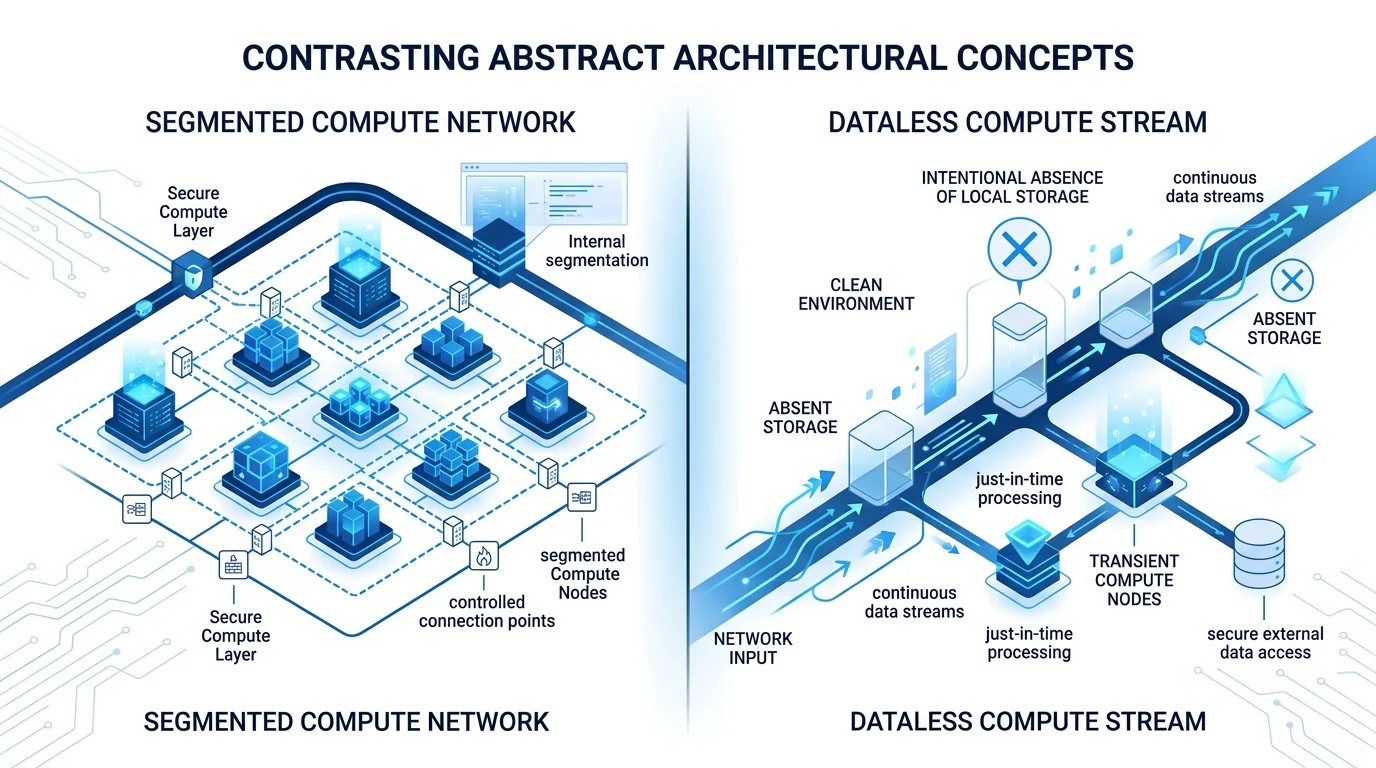
Here is the nuance that mature security teams internalize. Segmentation is exceptionally good at controlling where an attacker can move. It is not designed to change what an attacker finds once movement succeeds. If a segment holds sensitive personal data, tight isolation reduces the probability of exposure; it does not remove the exposure itself.
This is where a structural perspective becomes valuable. The principles behind Zero Data Protocol, Zero Collection, Zero Retention, and Zero Exploitation, target the other half of the equation. If personal data is never collected, stored, or repurposed, then a segment that is breached simply has less to compromise. We frame the absence of data as a designed feature, a form of structural sovereignty that complements, rather than replaces, granular network controls.
The two disciplines reinforce each other. Micro-segmentation shrinks the pathways; removing unnecessary data dependency shrinks the prize. Together they lower both the likelihood and the impact of a compromise, which is the essence of designing for least privilege from the ground up.
The Challenges Nobody Should Ignore
Adoption is not effortless. Policy lifecycle management is widely regarded as the hardest part, because rules must continually adapt to changing applications and business needs. Three friction points recur: gaining real-time visibility into how assets communicate, keeping policies accurate as environments change, and managing the sheer volume of rules in large multi-cloud estates.
Integration with legacy systems adds further complexity, and market estimates themselves vary by scope. While Mordor Intelligence places the 2026 market near USD 26.74 billion, Research Nester values the broader solution market at USD 47.78 billion for the same year, a spread that reflects differing definitions rather than measurement error. The wider context is a fast-growing zero trust security market, estimated at USD 36.96 billion in 2024 and forecast by Grand View Research to reach USD 92.42 billion by 2030.
Conclusion
The strategic logic is now hard to dispute. With breach savings of USD 1.76 million on average in 2025 for zero trust adopters, granular segmentation has earned its place as a foundational control rather than a specialist add-on. The advantages of micro-segmentation are real: it contains lateral movement, shrinks the blast radius, and strengthens compliance. Yet the most resilient architectures pair that containment with a deeper question, namely how much sensitive data needs to exist at all. By treating the absence of data as an engineered feature, we help you reduce not only where an attacker can move, but what they can ever reach. To design that discipline into your systems from the outset, explore our Zero Data Protocol architecture today.
Frequently Asked Questions
Is micro-segmentation the same as network segmentation?
No. Traditional network segmentation relies on VLANs and subnets and mainly filters north-south traffic. Granular workload segmentation governs east-west traffic between workloads and enforces identity-based, least-privilege policies far more precisely.
Does micro-segmentation replace the need to protect personal data?
No. It limits how far an attacker can move but does not remove the data itself. Structural approaches such as our Zero Data Protocol reduce exposure by preventing unnecessary data collection, storage, and exploitation in the first place.
Which industries adopt it most?
Banking, financial services, and insurance held the largest share of deployments in 2025, while healthcare, manufacturing, and government are expanding quickly, driven by compliance pressure and the need to contain breaches in sensitive environments.