
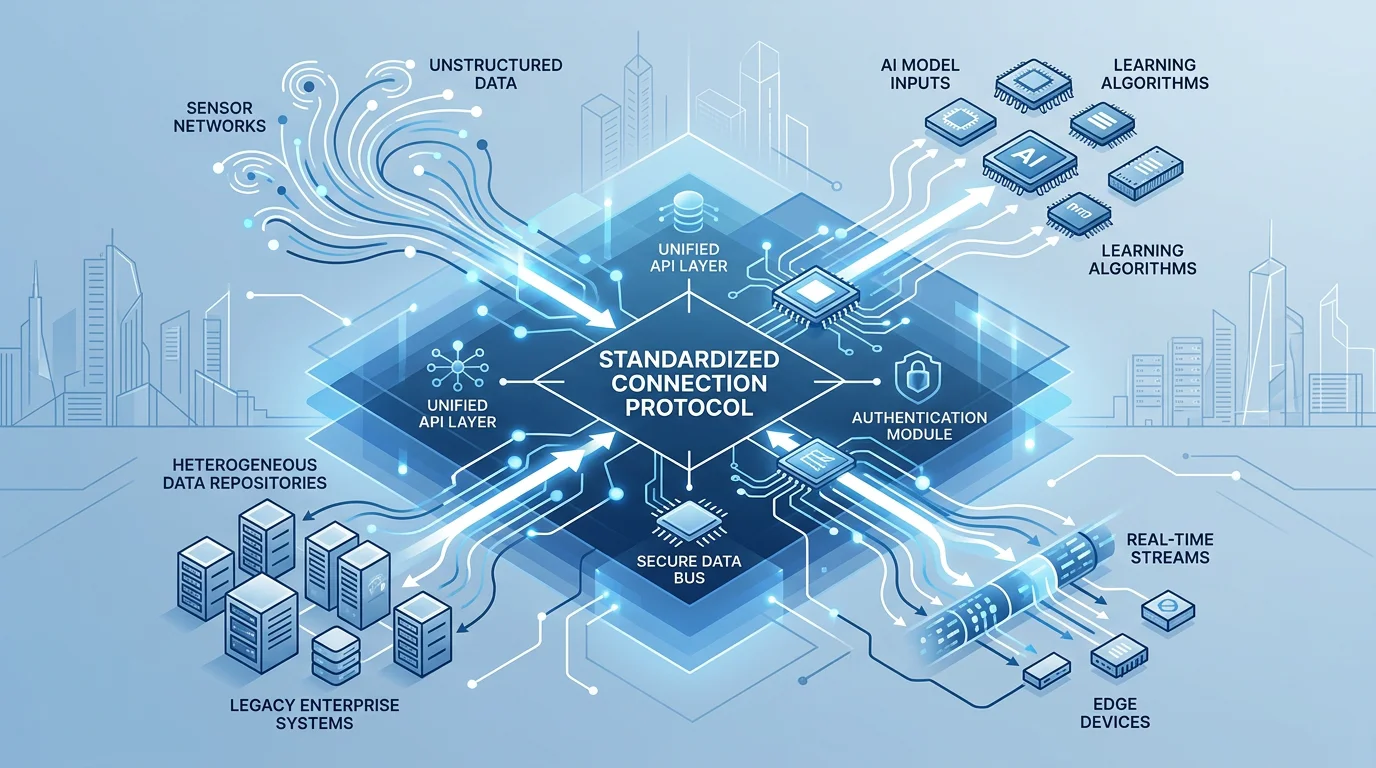
Agent Data Protocol Explained: Standardizing AI Agents
The agent data protocol standardizes fragmented AI agent datasets. Learn how it works, why it matters, and how to reduce agent data risk in 2026.
 Written by Lajos NAGY
 How do you train an autonomous AI agent when the data it needs is scattered across dozens of incompatible formats, tools, and interfaces? This is the fragmentation problem that a standardized protocol for agent data was designed to solve. As enterprises race to deploy autonomous systems, the way agents consume, produce, and expose information has become a defining concern. At our Zero Data Protocol, we track these architectural shifts because the structure behind agent data shapes both capability and risk.
The stakes are considerable. Autonomous agents now sit at the center of enterprise workflows, moving money, querying databases, and acting on sensitive records with minimal supervision. Understanding how agent data is standardized, and where that standardization ends, is essential for any team building the next generation of AI infrastructure. The distinction between training data formats and data governance is where most confusion begins.
What Is the Agent Data Protocol?
The agent data protocol, commonly abbreviated as ADP, is a lightweight representation language that acts as an interlingua between agent datasets in diverse formats and unified training pipelines. Rather than a product, it is a shared schema. It standardizes how agent trajectories, actions, and observations are represented, so that data collected for one framework can be reused across many others.
According to an arXiv preprint first published in 2025, researchers unified 13 existing agent training datasets into this format and reported an average performance gain of roughly 20% over corresponding base models. The design is expressive enough to capture API and tool use, browsing, coding, software engineering, and general agentic workflows, while remaining simple to parse and train on without per-dataset engineering.
The core promise is reproducibility. When agent training data follows a single, well-documented standard, results become easier to verify, compare, and extend across the research community and enterprise teams alike.
How the Protocol Unifies Fragmented Agent Data
Consider the practical challenge. One dataset records browser clicks, another logs terminal commands, a third captures function calls to external APIs. Each uses its own conventions. Without a common structure, every research group rebuilds the same conversion logic, wasting effort on plumbing rather than progress.
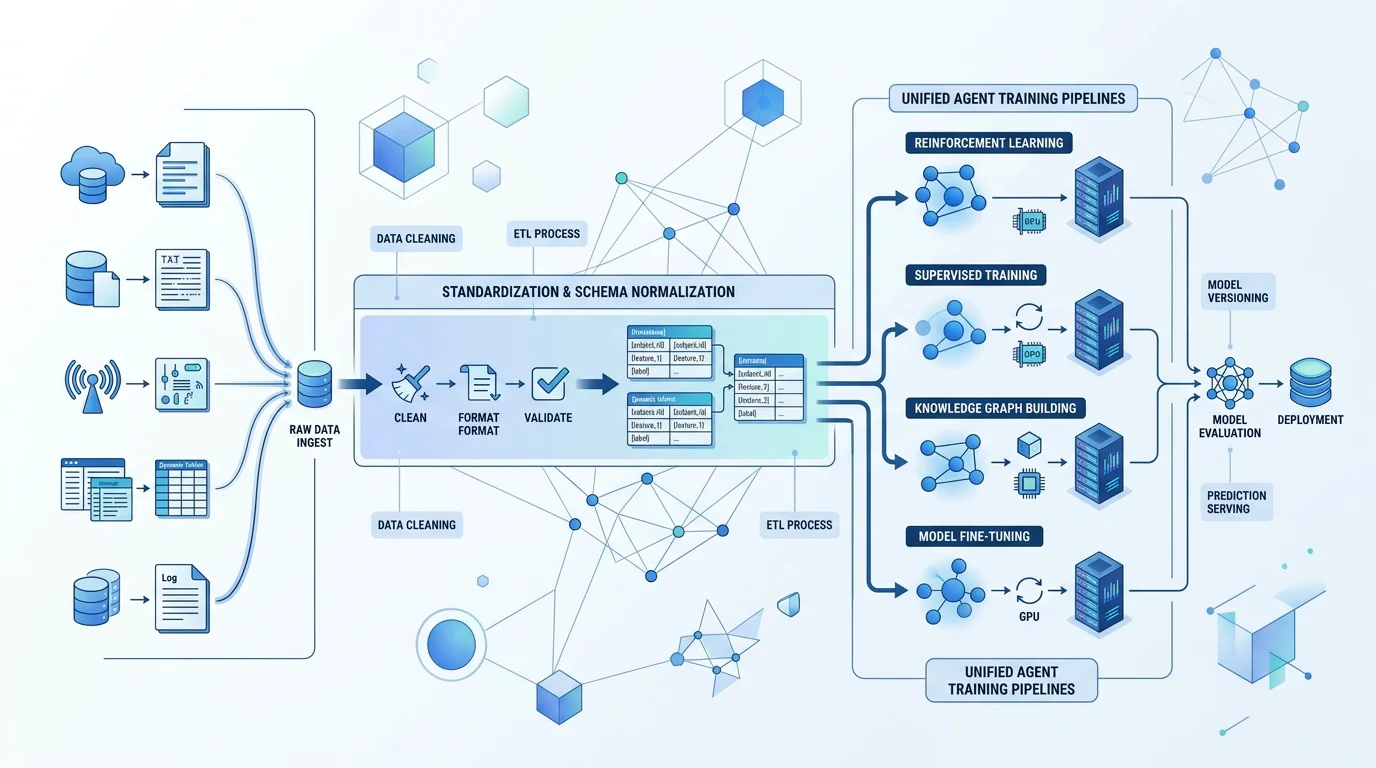
A well-designed agent data standard replaces this many-to-many mess with one-time adapters. The published implementation follows a staged pipeline: raw source data is converted into an intermediate interchange layer, normalized into a standardized schema, then transformed into agent-specific formats ready for supervised fine-tuning. Type validation ensures data integrity throughout the process.
The benefit for engineering teams is direct. Instead of writing bespoke converters for every dataset and every agent architecture, you build one adapter per format. This reduced community effort is arguably the protocol's most immediate contribution to scalable agent development.
Why Agent Data Standards Matter for the Enterprise
Standardization is not an academic luxury. The commercial context makes it urgent. As of 2026, the agentic AI market is frequently valued in the billions and projected to grow at a compound annual rate exceeding 40% over the coming decade, according to a 2026 statistics compilation. That growth places enormous pressure on the data foundations beneath every agent.
Adoption has become near universal at the executive level. In a 2026 enterprise survey by Writer and Workplace Intelligence, 97% of executives said their company deployed AI agents in the past year. Yet the same research found that only a minority of pilots reach reliable production, exposing a wide gap between experimentation and operational maturity.
For architects designing next-generation systems, the lesson is clear. The value of an agent depends on the quality and structure of the data it learns from and acts upon. Well-governed data protocols are the difference between an agent that scales and one that stalls.
The Hidden Risk: What Data Your Agents Can Touch
Here is where a critical distinction emerges. The agent data protocol governs training data, how agents learn. It does not govern the personal and proprietary data those agents access once deployed. That second question is now the sharper enterprise concern.
The regulatory and threat landscape reflects this. By the end of 2026, an estimated 40% of enterprise applications will be integrated with task-specific AI agents, up from less than 5% in 2025, as reported by TheStreet citing Gartner. In response, the National Institute of Standards and Technology launched a formal AI Agent Standards Initiative in February 2026, the first government-level effort targeting agent security specifically.
The recurring failure pattern across 2026 security research is over-permissioning: agents granted broader data access than their function requires, then acting on records they should never have touched. When an agent can reach personal data, the potential for misuse exists by design. This is a structural problem, not a configuration bug.
From Data Standardization to Data Minimization
Standardizing agent data solves the training bottleneck. It does nothing to reduce the volume of sensitive data an agent can expose. Addressing that requires a different architectural principle: designing systems so that unnecessary personal data is never collected, stored, or exploited in the first place.
This is the paradigm behind our zero-data AI approach. Instead of protecting collected data after the fact, the goal is to prevent unnecessary collection, retention, and exploitation from occurring at all. Three principles define it: zero collection, so no personal data is gathered by default; zero retention, so nothing is cached or archived; and zero exploitation, so nothing is monetized, analyzed, or repurposed.
The reasoning is grounded in evidence. In the same 2026 Writer survey, 67% of executives believed their company had already suffered a data leak or breach because of an unapproved AI tool, while 36% lacked any formal plan for supervising agents. An agent that holds no personal data cannot leak what it does not have.
Building Agent Systems That Need Less Data
What does data minimization look like in practice for agentic infrastructure? It begins by treating the absence of data as a designed feature rather than a limitation. Our sovereign AI framework is built on this idea of structural sovereignty, where systems are architected to operate effectively without depending on personal data wherever possible.
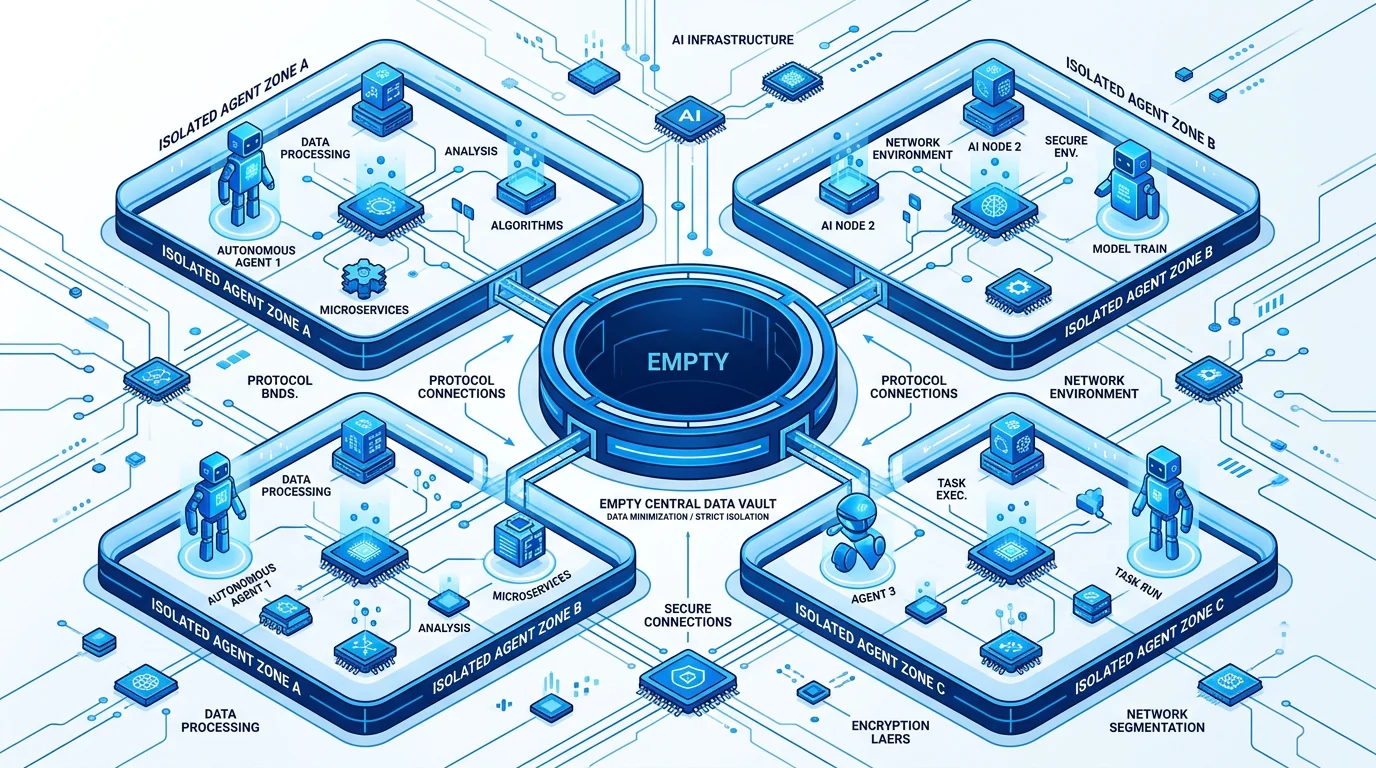
Containment matters as well. Even in systems that must process some sensitive information, limiting how far any single compromised component can reach is essential. Our approach to micro-segmentation for breach containment restricts lateral movement, so an over-permissioned agent cannot cascade access across an entire environment. Combined with data minimization, this narrows both the likelihood and the blast radius of an incident.
The practical checklist for responsible teams is unglamorous but effective. Inventory every agent to surface shadow deployments. Apply least privilege so no agent holds standing broad access. Require human approval for irreversible actions. Above all, question whether each piece of personal data truly needs to exist within the system at all.
Comparing Approaches to Agent Data
Several distinct concepts are often confused under the umbrella of agent data. The table below clarifies how each addresses a different layer of the problem, from training standardization to structural data elimination.
| Approach | Primary focus | Personal data dependency |
|---|---|---|
| Agent data protocol (ADP) | Standardizing training data formats for fine-tuning | Not addressed (training scope only) |
| Zero-party data | Data intentionally shared by users | Still collected and stored |
| Zero data retention | Deleting data after processing | Collected first, then removed |
| Zero-knowledge proofs | Verifying facts without revealing data | Data still exists to be proven |
| Our Zero Data Protocol (ZDP) | Eliminating personal-data dependency by design | None by architecture |
The comparison highlights a simple point. Most approaches manage data after it exists. A protocol-level architecture that prevents unnecessary data from existing addresses the risk at its structural root.
Conclusion
The agent data protocol is a meaningful advance for training reproducibility, unifying fragmented datasets and delivering roughly 20% performance gains without domain-specific tuning. Yet standardizing how agents learn is only half the equation. As autonomous systems spread through the enterprise, with 97% of executives reporting agent deployment in the past year, the more pressing question is what personal data those agents can reach and potentially expose. The most resilient answer is architectural: build a data protocol for agents that removes unnecessary data dependency entirely, so absence becomes a feature rather than a vulnerability. That principle of structural data minimization is what makes agent infrastructure both capable and defensible. To go further, explore our zero data architecture and see how systems can operate without relying on personal data.
Frequently Asked Questions
Is the agent data protocol a security tool?
No. The agent data protocol standardizes training data formats for fine-tuning AI agents. It does not govern or protect the personal data an agent accesses once deployed. Those concerns require a dedicated data-minimization architecture such as our Zero Data Protocol.
How does an agent data protocol improve model performance?
By converting many fragmented datasets into one consistent schema, it lets you train agents on far more diverse, high-quality data without custom engineering. Research reported an average gain of roughly 20% over base models across coding, browsing, and tool-use benchmarks.
What is the difference between zero data retention and zero collection?
Zero data retention deletes personal data after it has been processed, meaning it was still collected first. Zero collection prevents that data from being gathered at all, removing the exposure risk before it ever begins.
Continue reading
What Is ZDP? The Zero Data Protocol for Secure AI Systems
ZDP, the Zero Data Protocol, eliminates personal-data dependency by design. Learn how this architecture reduces breach risk for modern AI systems.
What Is Zero AI? Understanding Zero-Data AI Architecture
What is zero AI? Learn how zero-data architecture removes personal data dependency to reduce risk in modern AI and cybersecurity systems.