
Roughly 81% of organizations plan to implement a zero trust strategy within twelve months, yet very few examine what their controls quietly accumulate along the way. Every continuous verification decision consumes identity signals, device posture, geolocation, and behavioral telemetry. These records do not disappear once access is granted. To contain lateral movement effectively, our guide on micro-segmentation for zero trust breach containment pairs naturally with a harder question about the data your architecture retains.
The uncomfortable truth is that a zero trust architecture can be rigorous about access and careless about accumulation. According to CIO reporting on the Zscaler ThreatLabz 2025 VPN Risk Report, 96% of organizations now favor this approach. The framework verifies relentlessly, but verification generates data, and data creates exposure. This article examines that gap and how structural data minimization complements, rather than replaces, your controls.
What the zero trust model actually secures
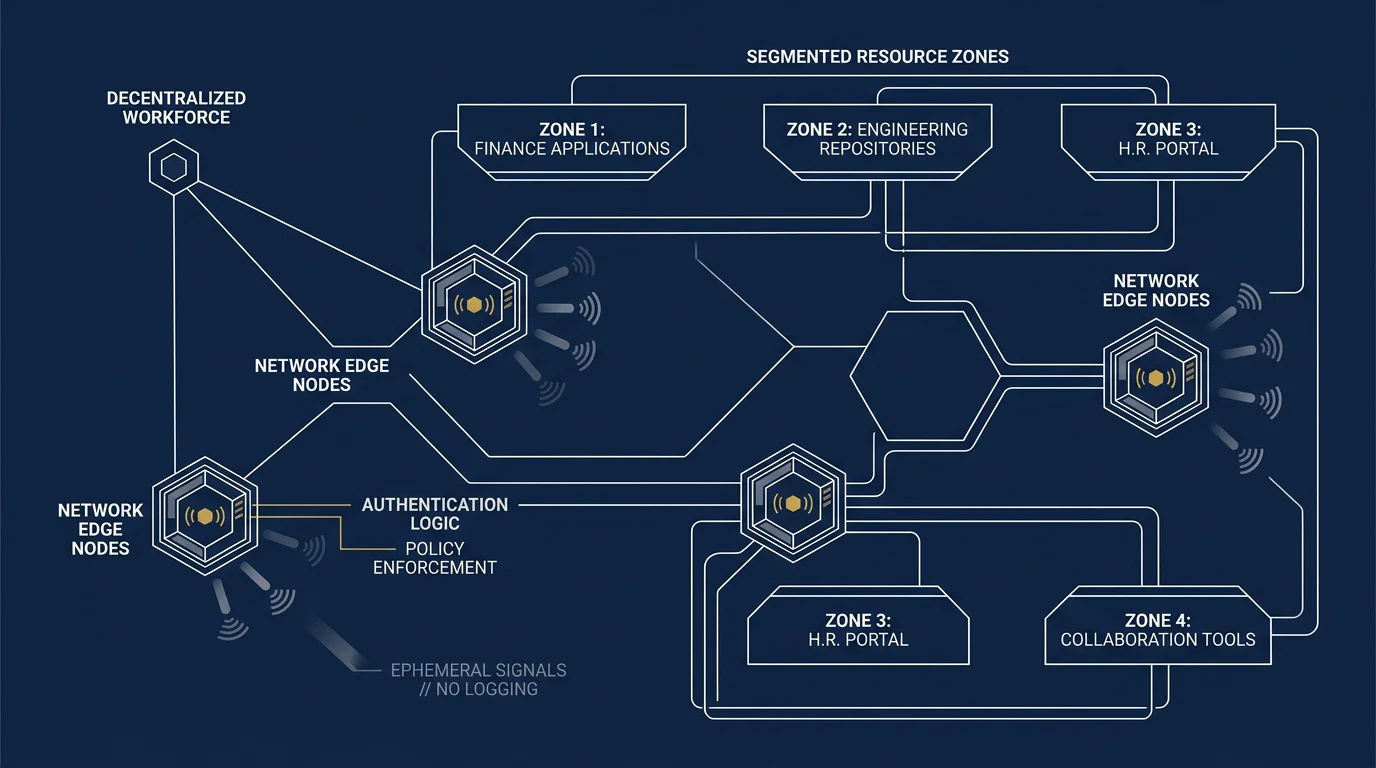
The founding principle is simple to state: never trust, always verify. No user, device, or workload receives implicit trust based on network location. Instead, every request is authenticated and authorized against real-time signals before access is granted, and that trust is re-evaluated continuously throughout a session.
In practice, a mature program rests on three tenets: verify explicitly, enforce least privilege, and assume breach. Access becomes conditional, temporary, and tightly scoped. Segmentation limits how far an intruder can move, and continuous monitoring shortens detection time. These are genuine gains. The zero trust security model replaces a brittle perimeter with per-connection decisions, which is why adoption keeps climbing across regulated sectors.
The evidence for effectiveness is substantial. According to Expert Insights research, a survey by Gartner found that 63% of organizations worldwide have implemented these principles partially or fully. The same analysis notes that adopting the approach can address up to half of an organization's environment while mitigating a meaningful share of enterprise risk. The framework works as advertised for access.
Where access control stops: the data zero trust still collects
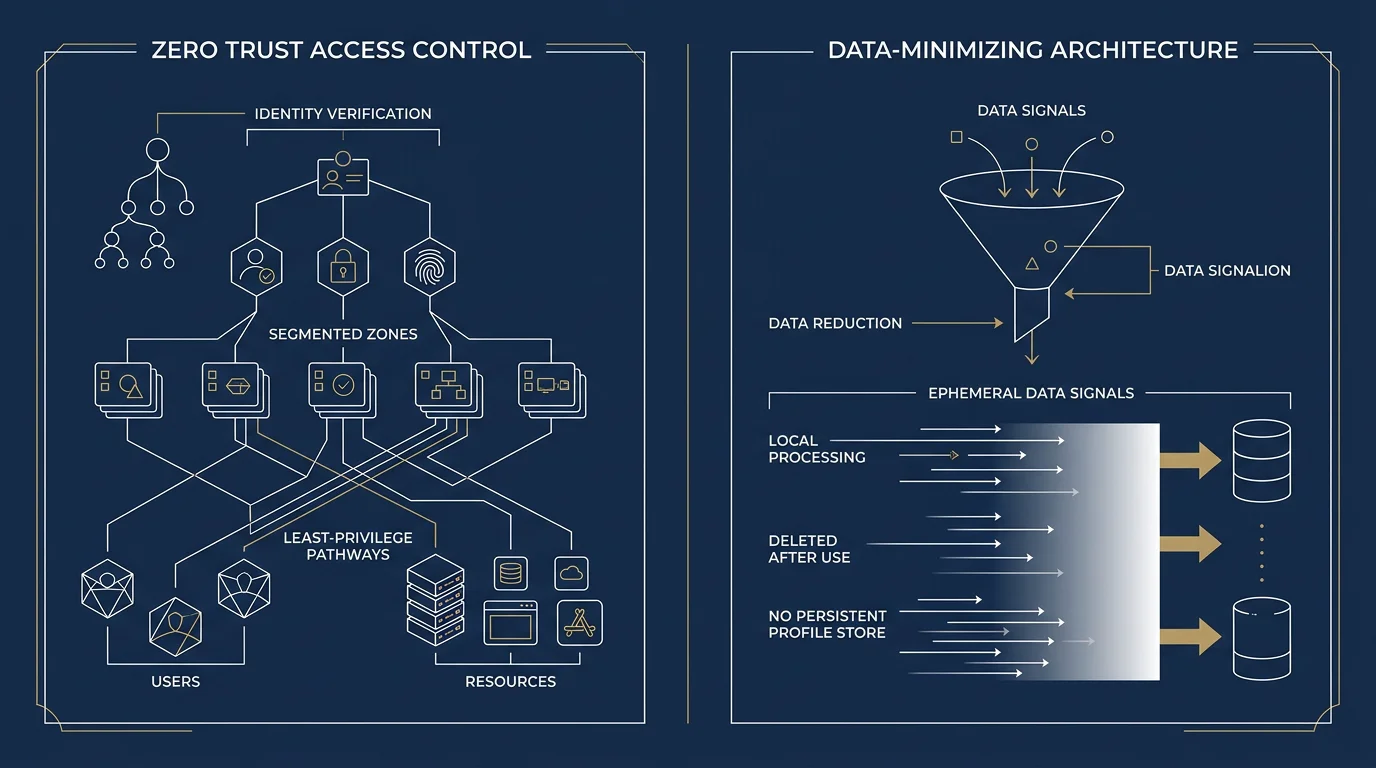
Consider what a single access decision requires. The engine ingests user credentials, device health, operating system version, installed applications, geolocation, and behavioral patterns. It compares this context against policy, then logs the outcome. Multiply that by every request, every session, every day, and a vast reservoir of personal and operational data accumulates.
This is the blind spot. The model is designed to reduce the uncertainty of access, not to reduce the quantity of data collected. Identity stores, session records, device inventories, and behavioral analytics all persist somewhere. Each repository is an asset an attacker can target. The framework assumes breach, yet it also builds precisely the data-rich targets that make a breach lucrative.
The threat landscape confirms the concern. According to Swif analysis of the Verizon 2025 Data Breach Investigations Report, 22% of breaches in 2025 began with credential abuse. When identity and behavioral telemetry are retained at scale, a compromised control plane exposes far more than a single door. The question shifts from "who can access this?" to "what can this system reveal if it is breached?"
Zero Trust and Zero Data Protocol: two complementary layers
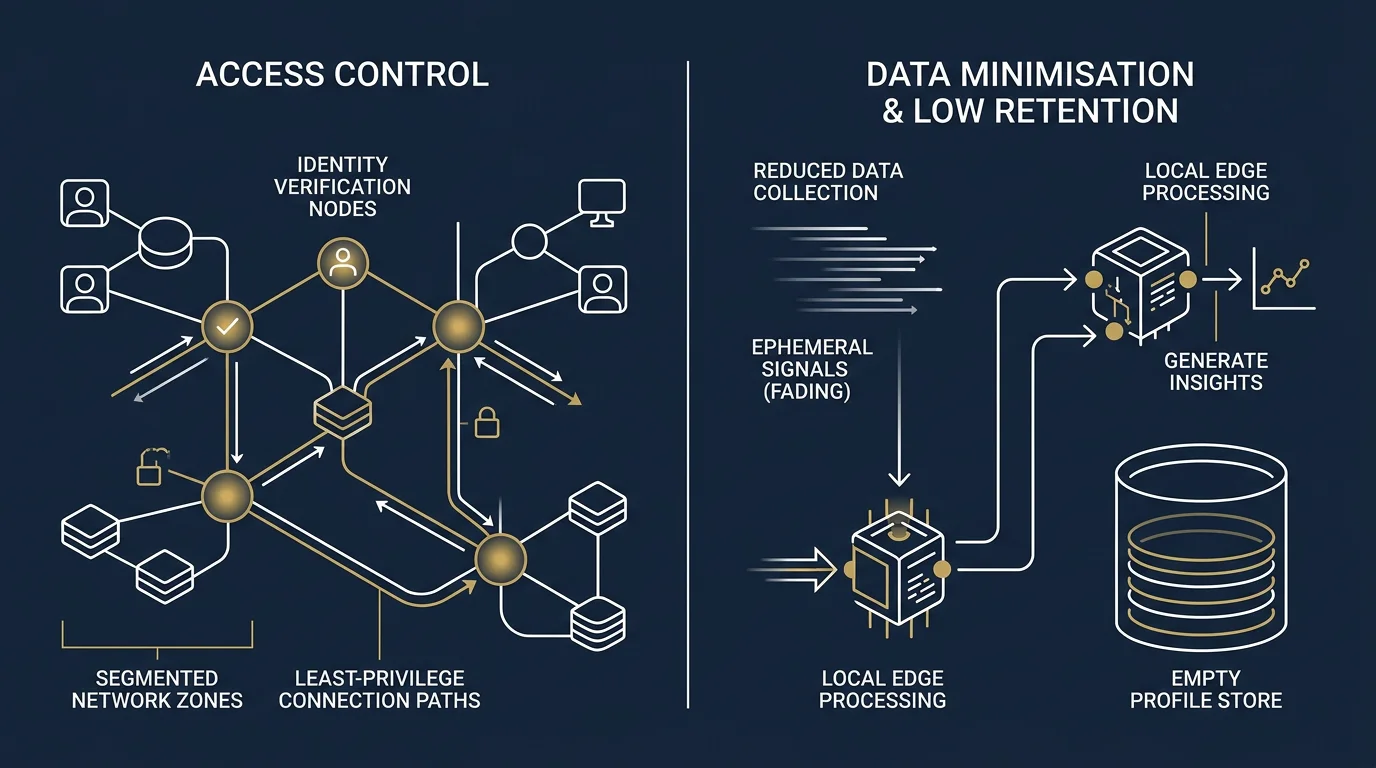
The distinction is structural. A zero trust program controls access to data that is assumed to exist. Zero Data Protocol (ZDP) reduces the dependency on personal data in the first place. One governs the gate; the other questions whether the treasure needs to sit behind the gate at all. These are not competing choices. They operate at different layers and reinforce each other.
We designed ZDP as a protocol-level architecture built on three commitments: zero collection, so personal data is not gathered by default; zero retention, so nothing is stored, cached, or archived unnecessarily; and zero exploitation, so data is never monetized, analyzed, or repurposed. The result is what we call structural sovereignty, where the absence of data is a designed feature rather than a limitation. For access enforcement that avoids building persistent surveillance profiles, our approach to Network Access Control without surveillance (zero trust approach) illustrates how the two layers coexist.
| Dimension | Zero trust architecture | Zero Data Protocol (our approach) |
|---|---|---|
| Core objective | Verify every access request continuously | Remove structural dependency on personal data |
| Operating assumption | Data exists and must be protected | Data should not be collected unless essential |
| Primary mechanism | Identity, device, and behavioral signals | Zero collection, zero retention, zero exploitation |
| Exposure if breached | Retained telemetry and identity stores at risk | Minimal, because little personal data persists |
| Relationship | Controls the gate | Reduces what sits behind the gate |
To be explicit: this is not a replacement narrative. You still need continuous verification, least privilege, and segmentation. ZDP addresses a different failure mode, namely the assumption that personal data must accumulate somewhere for a system to function.
Practical architecture examples
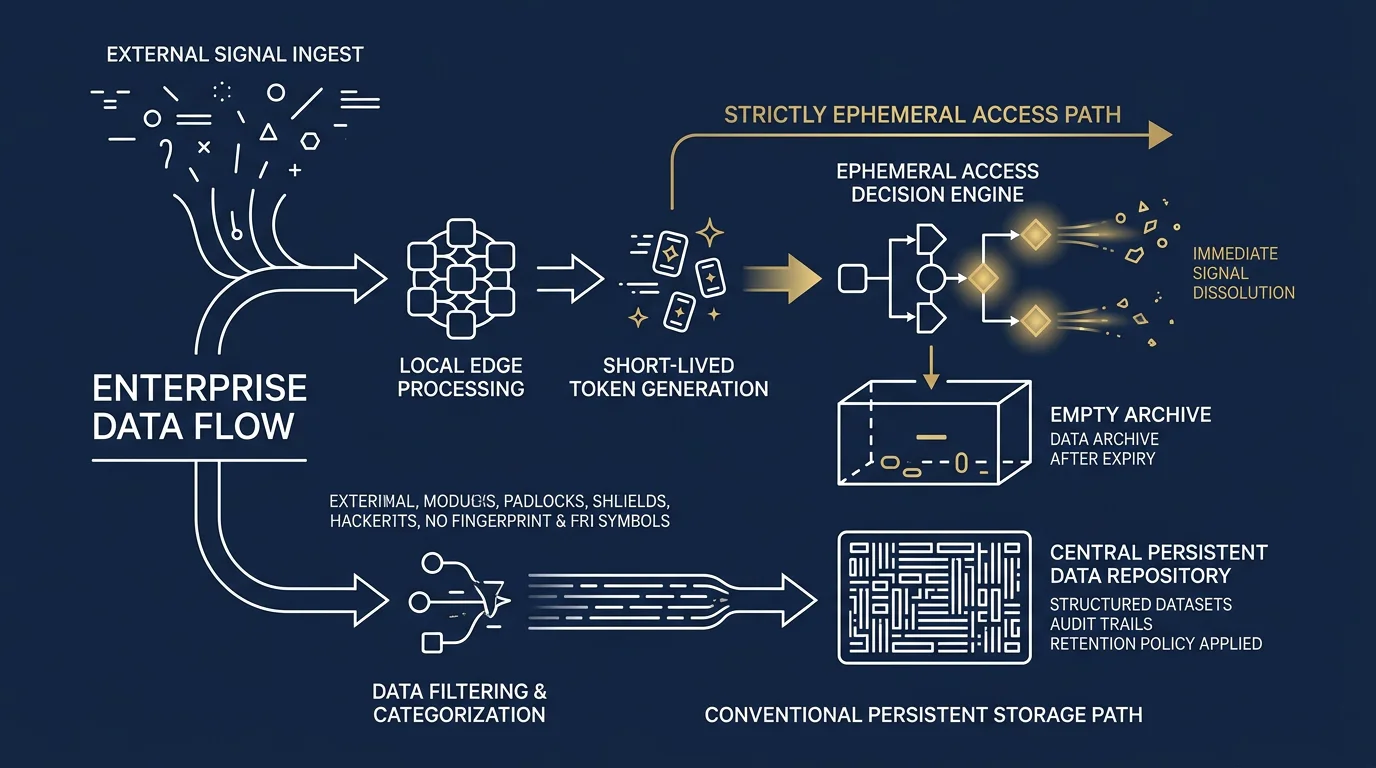
Imagine an access decision that consumes device posture at the moment of the request, evaluates it locally, and discards the raw signal immediately afterward. The policy outcome is recorded, but the underlying personal telemetry does not enter a long-lived store. The gate still functions; the reservoir never fills.
Consider a second scenario involving autonomous software. AI agents increasingly request resources on behalf of users, and each interaction risks accumulating context that outlives its purpose. Standardizing how these agents request and release data, rather than letting them hoard it, keeps verification intact while removing needless retention. Our work on the Agent Data Protocol for standardized, controlled zero-trust AI shows how agent interactions can remain governed without building persistent behavioral dossiers.
A third example concerns behavioral analytics. Many programs profile users continuously to detect anomalies. A data-minimizing design favors ephemeral, on-device evaluation over centralized behavioral archives. You retain the security signal you need for the decision, and you avoid creating a surveillance dataset that a future breach could expose.
How to implement a data-minimizing zero trust program
Structural change starts with honest measurement. Before adding controls, map what each control collects and where it persists.
- Inventory your data flows. For every verification point, document which personal signals are captured, how long they are retained, and who can query them.
- Classify what is truly essential. Separate signals required for the immediate access decision from data retained "just in case." The latter is usually your largest liability.
- Prefer ephemeral evaluation. Where possible, evaluate device and behavioral context at the moment of the request and discard the raw data afterward.
- Segment to contain, not to surveil. Use segmentation to limit blast radius rather than as a pretext to centralize more telemetry.
- Govern machine and agent identities. Non-human identities now vastly outnumber human ones in automated environments, so extend minimization to service accounts, tokens, and AI agents.
- Review retention continuously. Treat every retained dataset as a standing risk that must justify its own existence at each audit.
These steps do not weaken verification. They constrain accumulation, so that the assume-breach posture is matched by a genuinely smaller target.
Limitations and honest caveats
No architecture is a silver bullet, and rigor demands acknowledging the trade-offs. Some detection capabilities genuinely benefit from historical behavioral baselines, so aggressive minimization can reduce the depth of certain analytics. You must weigh that reduction against the exposure a large behavioral archive creates.
There is also a maturity gap to respect. Even where adoption is high, deep, end-to-end programs remain rare. According to Swif analysis of the Okta State of Zero Trust Security report, 61% of organizations have launched a zero trust initiative, up from 24% in 2021, yet launching is not the same as operating a mature, instrumented estate. Layering data minimization onto an immature program without first stabilizing verification can create confusion rather than resilience.
Finally, the financial case for strong controls is well established. The IBM 2025 Cost of a Data Breach Report found that organizations with a zero trust architecture in place saved an average of 1.76 million dollars per breach. Data minimization does not contradict that finding; it compounds it, because a breach of a system holding little personal data is inherently less costly.
A checklist for CISOs and security architects
Use the following questions to test whether your program controls access without silently accumulating exposure.
- Have you documented every personal signal each verification point collects and retains?
- Can you distinguish data needed for the immediate decision from data kept speculatively?
- Are device and behavioral signals evaluated ephemerally where feasible?
- Do your identity and session stores hold the minimum required, with defined expiry?
- Have you extended minimization to machine identities and AI agents?
- Would a breach of your control plane expose a large behavioral dataset, or very little?
- Do you review each retained dataset against a clear justification at every audit?
If several answers reveal accumulation without purpose, the priority is not more access control. It is structural reduction of what the system depends on. Our overview of What Is ZDP? The Zero Data Protocol for secure zero-trust AI systems details how that reduction operates at the protocol level.
Bringing access control and data minimization together
The zero trust approach remains a sound foundation for modern security, and you should continue to invest in continuous verification, least privilege, and segmentation. Yet verification is not free of consequence, because every decision generates data that someone must protect. The mature posture recognizes both truths at once: control access rigorously, and reduce the personal data your architecture depends on so that a breach reveals as little as possible. Access control answers who may enter; structural data minimization answers what is worth stealing. Treat them as two layers of one discipline, and you close a gap that neither addresses alone.
Take action with Zero Data Protocol
If your verification stack keeps accumulating identity, device, and behavioral telemetry, you are protecting a target that need not exist. You have invested in controlling access; the next step is questioning how much personal data your systems truly require to operate.
We built Zero Data Protocol as a protocol-level architecture that eliminates personal-data dependency by design, through zero collection, zero retention, and zero exploitation. Rather than protecting data after the fact, we prevent unnecessary collection from occurring at all, so the absence of data becomes a structural feature. Explore the Zero Data Protocol structural architecture to see how it complements your existing controls.
Frequently Asked Questions
Does Zero Data Protocol replace a zero trust architecture?
No. It operates as a complementary structural privacy layer. You still need continuous verification and least privilege for access, while our approach reduces the personal data those controls depend on.
Why does zero trust still create data exposure?
Every access decision consumes and often retains identity, device, and behavioral signals. Those repositories persist over time and become valuable targets, which means rigorous access control can coexist with growing data risk.
What is the difference between controlling access and minimizing data?
Controlling access governs who may reach a resource that is assumed to exist. Minimizing data questions whether that personal data needs to be collected or retained at all, reducing what a breach can expose.
Is data minimization compatible with breach detection?
Largely, yes, though some analytics benefit from historical baselines. The practical approach favors ephemeral, local evaluation for most decisions while retaining only the minimal signals genuinely required for detection.
Where does Zero Data Protocol fit for AI systems?
AI agents can accumulate context that outlives its purpose. Our Agent Data Protocol standardizes how agents request and release data, keeping verification intact while preventing the buildup of persistent behavioral profiles.