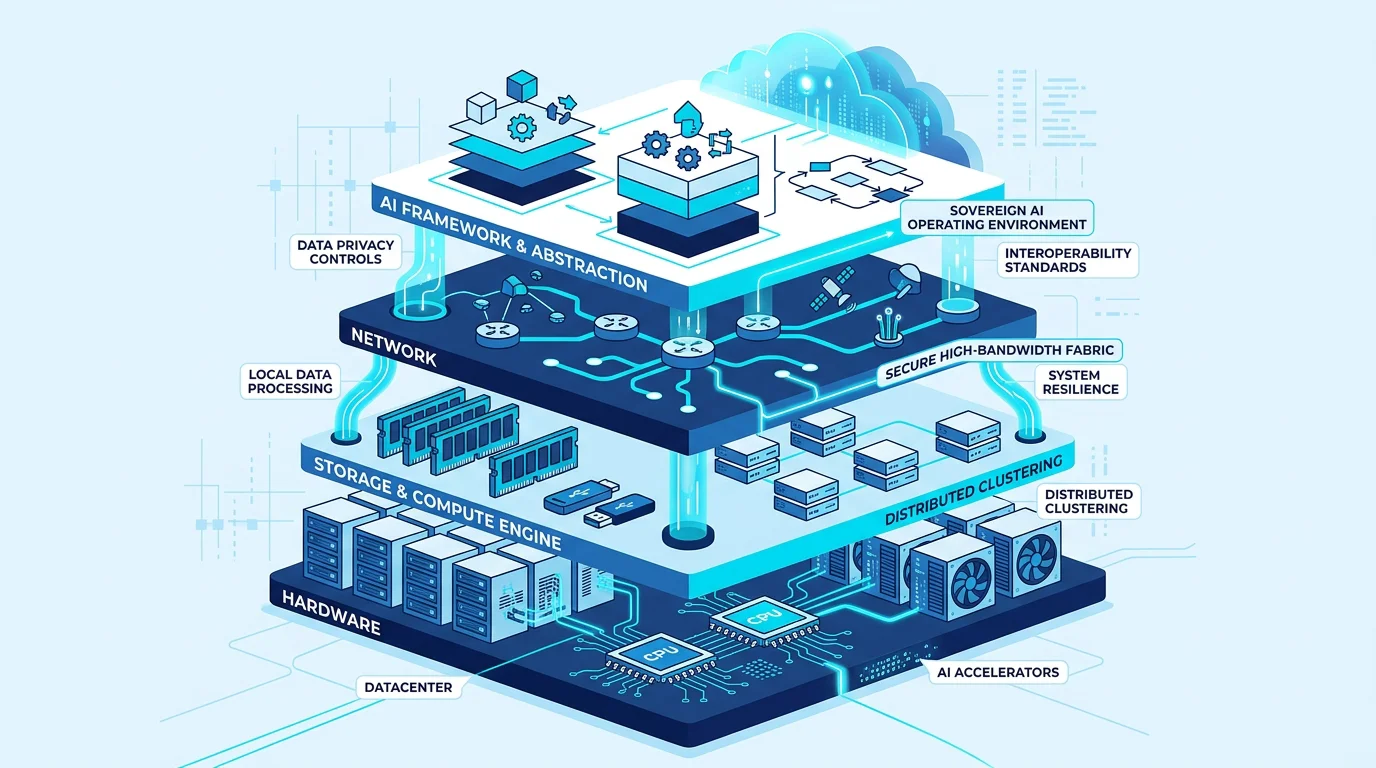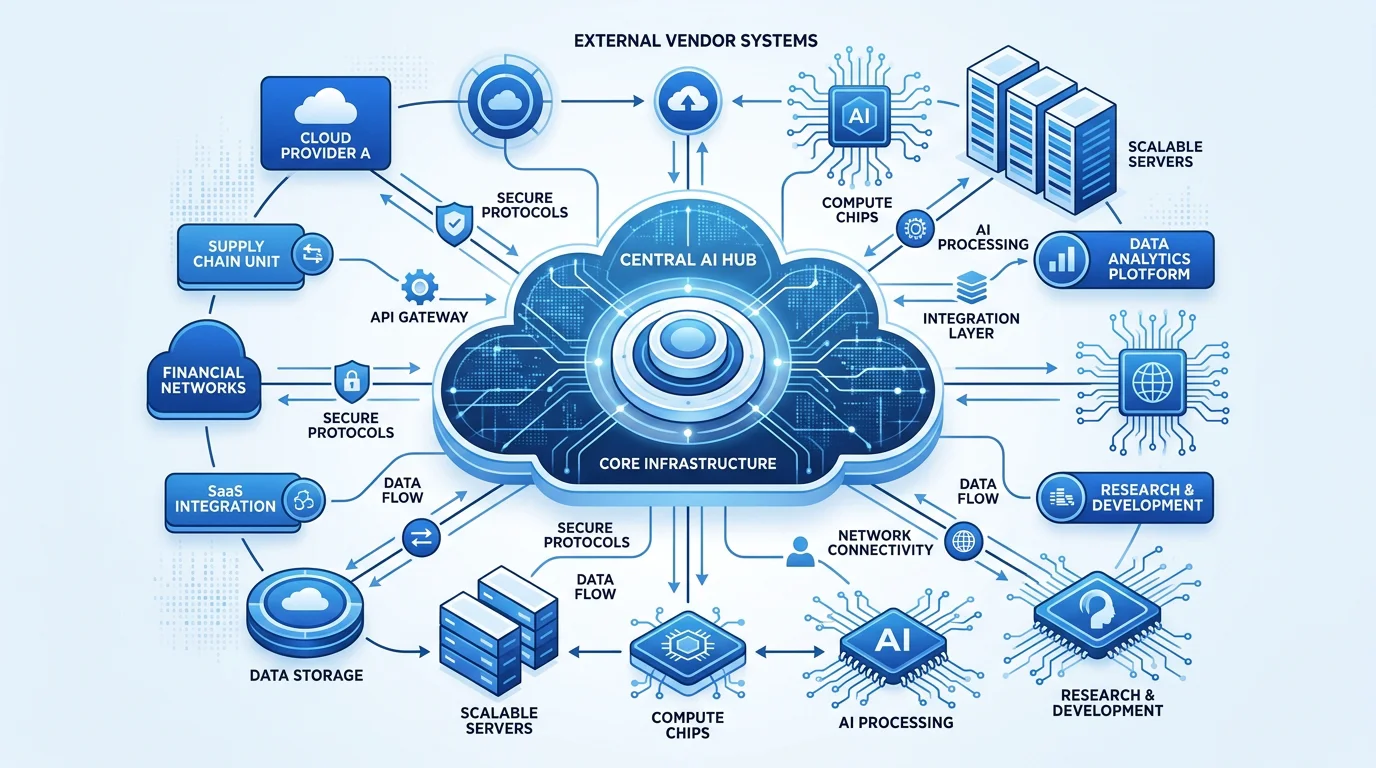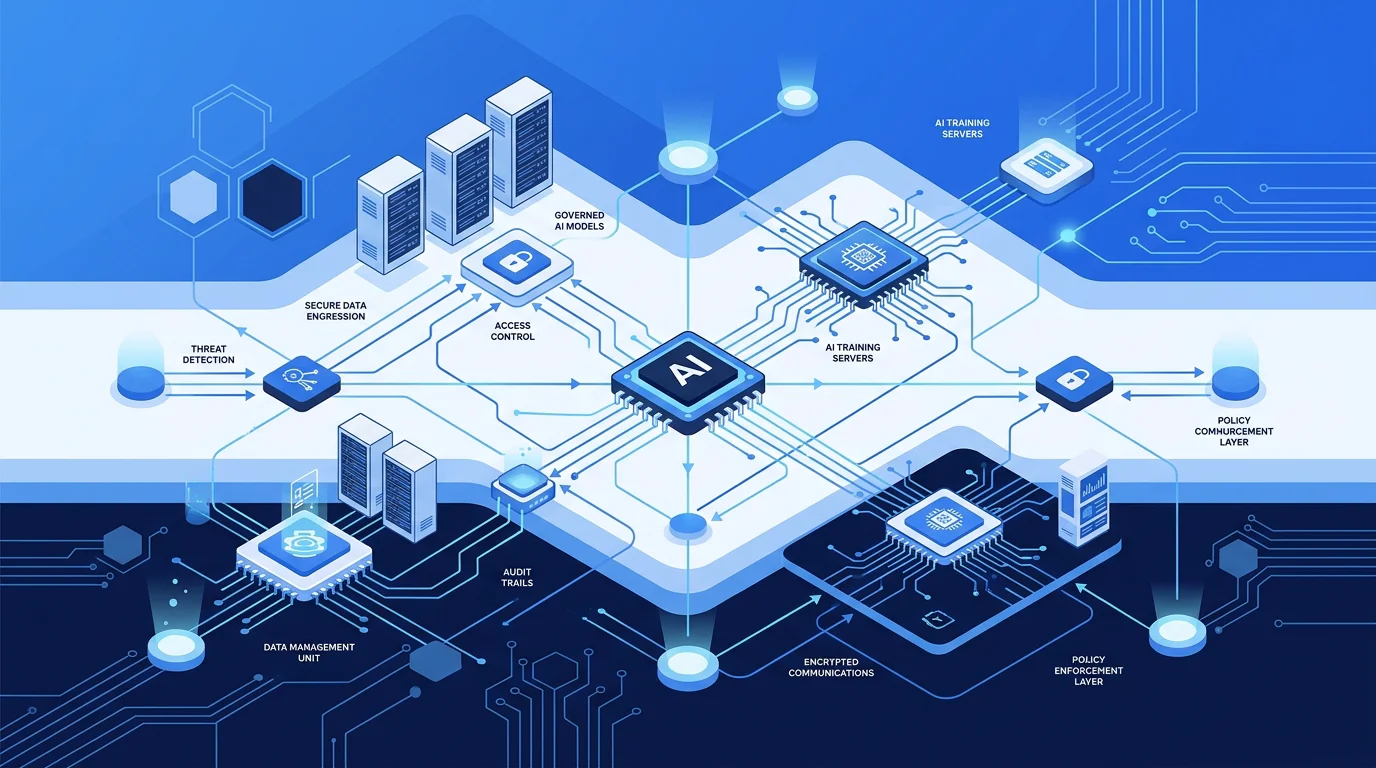

Artificial intelligence now sits inside nearly every business function, yet oversight has not kept pace. According to Microsoft's February 2026 enterprise analysis, roughly 80% of Fortune 500 companies operate active AI agents embedded in sales, finance, security, and customer service workflows. That velocity is precisely why the ability to secure and govern enterprise AI has become a board-level concern. Before scaling further, many teams revisit their architecture, and our Sovereign AI for enterprise data control perspective offers a useful starting point.
The challenge is structural rather than cosmetic. Adoption has consistently outrun controls, creating a widening gap between what organisations deploy and what they can actually oversee. One 2026 analysis describes the distance between AI adoption and mature governance as the widest in enterprise software history. Closing that gap is now the defining task for security and risk leaders.
Why governing AI has become a security priority
The conversation has shifted from whether AI helps to whether anyone can see and control it. Today the core question for leaders is how to secure and govern AI across the enterprise when capabilities are embedded in SaaS platforms, developer tools, analytics suites, and third-party services that most teams never formally approved.
The evidence of the gap is measurable. Aggregated 2026 research citing Aon indicates that 88% of organisations used AI in at least one business function in 2025, while Economist Impact found only 8% maintained a comprehensive governance framework. In other words, deployment is near universal, but disciplined oversight remains rare. This imbalance turns AI into a force multiplier for both productivity and risk.
Because AI risk touches data protection, cyber resilience, third-party exposure, and compliance at once, no single team owns it outright. This is why AI governance has become as foundational to security leaders as cloud governance was a decade ago.
What securing enterprise AI actually means
Securing AI is often treated as an extension of existing disciplines, and that assumption causes confusion. Traditional functions rest on stable boundaries: application security covers code, cloud security covers infrastructure, and data security protects information at rest and in motion. An AI system does not fit any single category.
Instead, an AI system is simultaneously an application that executes logic, a data processor that ingests and generates sensitive information, and a decision layer that influences or automates actions. A single interaction can involve identity misuse, data exposure, and supply chain risk within one workflow. A malicious prompt from an authorised user, for example, is not a classic breach, yet it can trigger data leakage or unauthorised actions. Securing AI therefore requires a shared lens across development, operations, data handling, and user interaction.
Start with an AI inventory and continuous visibility
You cannot govern what you cannot see. Most enterprises underestimate how many models, embedded features, and autonomous agents already operate across their environment, which creates the most immediate governance gap. A centralised inventory is the practical foundation.
An effective AI inventory functions as a system of record. It should capture each use case, deployed model, data source, vendor, business owner, risk classification, and applicable controls. From there, governance extends across the full lifecycle through continuous monitoring rather than one-time reviews. Shadow AI and unmanaged deployments carry both security and cost risk, so visibility must be ongoing, not a single audit.
Map the risk: five layers of the AI lifecycle
A workable approach organises risk around how AI is used and where it operates. Security teams can structure their programme around five recurring layers, each aligned to a distinct part of the enterprise AI ecosystem.
- Misuse and emergent behaviour: prompt injection, guardrail bypasses, and harmful outputs that appear without the system being explicitly compromised.
- Operational control: agents acting at machine speed, making runtime monitoring and centralised control points essential.
- Development and infrastructure: misconfigured permissions and vulnerabilities in AI-generated code introduced long before deployment.
- Supply chain: opaque models, datasets, and dependencies from third parties with uneven transparency.
- Readiness and oversight: governance, red-team testing, and trained teams that turn controls into practice.
The supply chain layer deserves particular attention. Vendor selection now carries a geopolitical dimension, and structured Third-party AI risk management helps you assess how suppliers process and protect enterprise information before you grant them access.
Align with recognised governance frameworks
Mapping your programme to established frameworks demonstrates maturity and reassures boards. The NIST AI Risk Management Framework has become the most widely referenced voluntary standard in the United States, while ISO/IEC 42001:2023 provides the first international AI management system standard and increasingly serves as a unifying compliance layer for multinationals.
Regulatory pressure reinforces these choices. Enforcement of the EU AI Act on high-risk systems is set to begin on 2 August 2026, according to one 2026 operating-model analysis. Non-compliance can carry penalties described by this 2026 governance playbook as reaching up to 35 million euros or 7% of global turnover. These stakes make framework alignment a commercial as well as a compliance decision.
Govern autonomous agents with identity and control planes
Autonomous agents change the governance equation because they act with delegated authority across multiple systems. Every agent should be observable, owned, and bound to a single distinct identity so that actions remain attributable and enforceable. A centralised control plane replaces fragmented oversight with one organisation-wide standard that is auditable and scalable.
Practical controls include an agent registry, least-privilege access that inherits the user's permissions, defined data retention periods, and continuous behavioural monitoring to detect drift. Standardising how agents connect to data and tools reduces duplication and shrinks the attack surface. To harmonise these patterns, you can review how to Standardize agent governance with the Agent Data Protocol across teams.
Reduce data dependency by design: an emerging structural angle
Most guidance concentrates on monitoring AI after deployment. A complementary, and increasingly discussed, angle is architectural: the less personal data a system collects, retains, and exploits, the smaller its exposure and future target surface. This is the direction behind the emerging Zero Data Protocol framework, built on three principles, Zero Collection, Zero Retention, and Zero Exploitation. It is an independent framework, not a regulation, certification, or guaranteed solution, and residual risk always remains.
The market context supports the interest. One market study valued the global AI governance market at 197.9 million US dollars in 2024, with projections toward 6.63 billion by 2034. As spend on oversight grows, structural approaches that minimise what must be governed in the first place become attractive. When systems derive value from function rather than data extraction, teams may simplify governance and limit unnecessary retention. Our view on enterprise security risks in generative AI expands on where these exposures concentrate.
The table below contrasts common governance postures. Our data-minimisation approach is shown as the option that reduces exposure at the source rather than only after collection.
| Approach | Primary focus | Exposure reduction |
|---|---|---|
| Consent and policy banners | Disclosure and legal notices | Limited; data still collected |
| Post-deployment monitoring | Runtime detection of misuse | Reactive; data already retained |
| Zero Data Protocol (our approach) | Structural minimisation: collect, retain, exploit less | Reduces exposure at the source |
Bringing governance and security together
The path to secure and governed enterprise AI begins with clarity: knowing where AI exists, what it accesses, how it behaves, and who is accountable. Build a living inventory, map risk across the lifecycle, align with NIST and ISO/IEC 42001, and give autonomous agents distinct identities under a central control plane. Layer these operational controls with a structural mindset that limits unnecessary data collection and retention, so there is less to protect and less to lose. Governance done well does not slow innovation; it makes responsible scale possible while acknowledging that residual risk never disappears entirely.
Take action with Zero Data Protocol
If your teams are weighing how to reduce risk while continuing to scale AI, the most durable gains often come from architecture rather than from consent promises alone. Reducing dependency on personal data lowers exposure, liability, and the future target surface that attackers and regulators scrutinise.
We connect privacy, cybersecurity, AI governance, and system design into one direction through the principles of Zero Collection, Zero Retention, and Zero Exploitation. To explore how a structural approach to minimal data dependency can support your programme, discover our Zero Data Protocol framework and its guidance for building digital trust through design.
Frequently Asked Questions
What does it mean to secure and govern AI across the enterprise?
It means achieving full visibility into every model, agent, and vendor, then applying consistent policies, lifecycle controls, and monitoring. Security addresses threats such as prompt injection and data leakage, while governance defines ownership, accountability, and acceptable use. The two disciplines must operate together.
Which frameworks should we align with first?
Most enterprises begin with the NIST AI Risk Management Framework for structure and ISO/IEC 42001 for a certifiable management system. Organisations operating in the European Union must also account for the EU AI Act, whose high-risk enforcement is scheduled for August 2026. These frameworks are complementary rather than mutually exclusive.
Why is an AI inventory considered the foundation?
You cannot assess, control, or monitor systems you do not know exist. A centralised inventory captures use cases, models, data sources, vendors, owners, and risk classifications. It is the reference point that makes every subsequent governance decision possible.
How does data minimisation reduce AI risk?
Collecting and retaining less personal data shrinks the exposure, liability, and target surface a system carries. Our Zero Data Protocol framework applies this structurally through Zero Collection, Zero Retention, and Zero Exploitation. It reduces exposure rather than eliminating all risk, so complementary controls remain necessary.
What makes autonomous agents harder to govern?
Agents act with delegated authority at machine speed and can affect several systems at once. Effective control requires a distinct identity per agent, a central registry, least-privilege access, and continuous behavioural monitoring. Without these, unmanaged or shadow deployments quickly escape oversight.