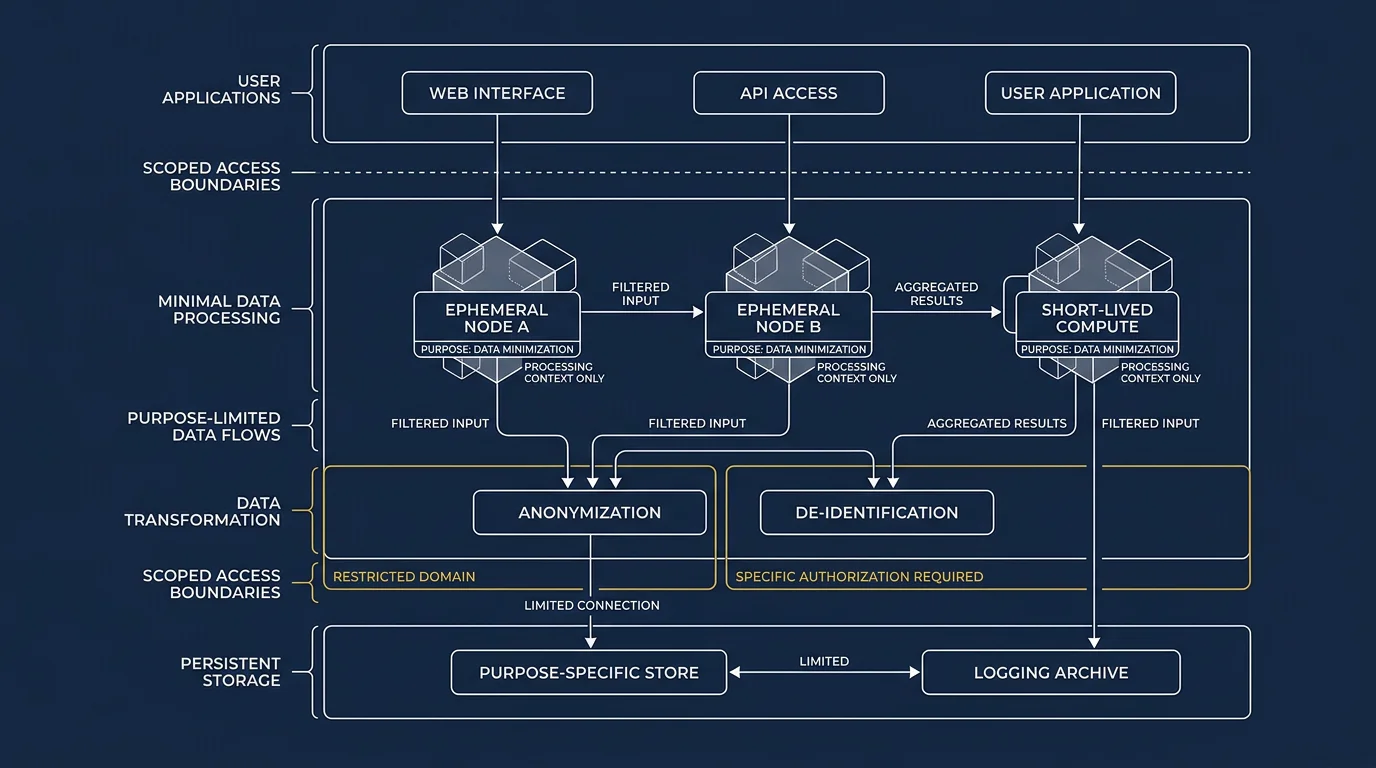

How much of the personal data your systems currently hold is genuinely necessary to deliver the service? For many organizations, the honest answer is uncomfortable. The discipline that answers this question is not a policy document but an engineering practice: the deliberate engineering of data minimization into pipelines, storage and access paths. Our guidance on AI Data Protection and data minimization reflects this shift, where restraint is designed in rather than promised after the fact.
The stakes have grown alongside artificial intelligence. Models trained on sprawling datasets amplify the risks of inference, profiling and re-identification. When privacy is only written into procedures, it is often not enforced at machine speed. Treating privacy as an architectural property, not a compliance afterthought, is what separates resilient systems from fragile ones in 2026.
From Policy to Architecture: What Privacy Engineering Means
Privacy engineering is the technical practice of building privacy protections into systems rather than describing them in documents. The topic that most searches frame as privacy engineering data minimization is really about one shift: moving guarantees out of the policy binder and into the running system. ISACA notes that privacy engineering means building minimization into pipelines instead of procedures, and enforcing least-privilege at the system level rather than only the policy level.
This distinction matters because manual controls fail silently. A retention rule that depends on someone remembering to run a deletion script is not a control; it is a hope. Privacy engineering replaces intention with default behavior. As one practitioner framing puts it, the goal is to make privacy "something that happens by default, not by intention."
The Core Building Blocks You Can Actually Ship
Principles become useful only when they map to implementable controls. A mature program treats each of the following as a design requirement, not an aspiration.
- Purpose limitation: Every data element is tied to a declared, legitimate purpose. If a purpose cannot be named, the field is not collected. This prevents function creep, where information gathered for one reason is quietly repurposed for another.
- Data minimization: Collect only what is adequate, relevant and limited to the stated need. A newsletter needs an email address, not a payment card.
- Scoped access: Role-based and attribute-based access controls ensure that people and services see only the records their function requires.
- Retention limits: Data carries an expiry from the moment it is written, with automated deletion when its purpose ends.
A disciplined test helps at design time: for every field, ask why it is needed, what will be done with it, how long it will be kept and who can access it. When teams need a structured way to codify these decisions, our Privacy by Design guidelines translate them into repeatable engineering steps.
Privacy-Preserving Processing and Lifecycle Controls
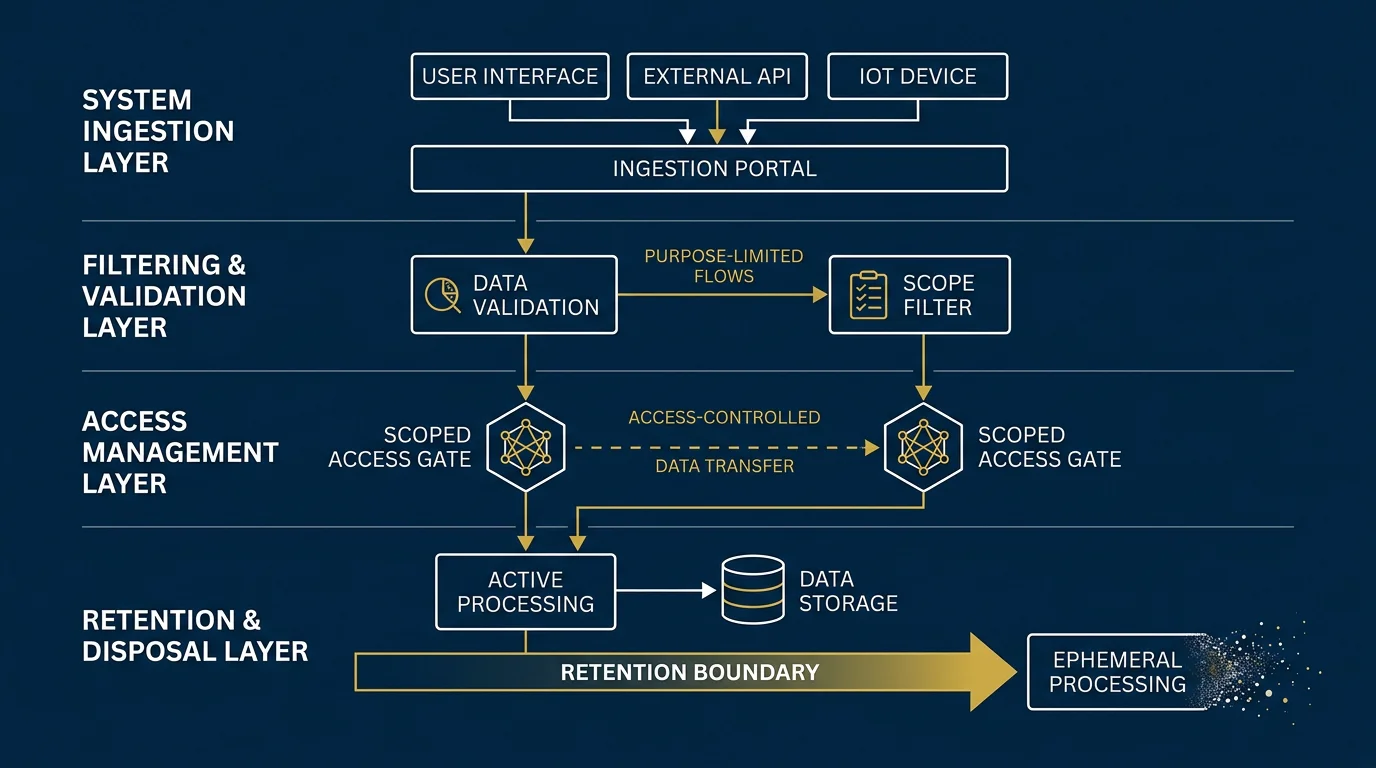
Some processing genuinely requires sensitive inputs. Here, privacy-preserving techniques let systems extract value while limiting individual exposure. Pseudonymization separates data from identity. Aggregation and differential privacy add mathematical guarantees that no single record dominates a result. The IAPP reports that differential privacy is now applied during model training to limit the influence any single data point has on the final model, which helps satisfy data minimization requirements at the data level.
Lifecycle controls close the loop. Session caches with expiry times, self-deleting stores and automated erasure workflows dispose of data promptly once it loses business value. This is where minimization and security converge: the record that no longer exists cannot be breached, subpoenaed or leaked. Codifying these rules is the purpose of a formal Data retention and deletion policy, which turns lifecycle intent into enforced schedules.
From Least Privilege to Least Data to Zero Data
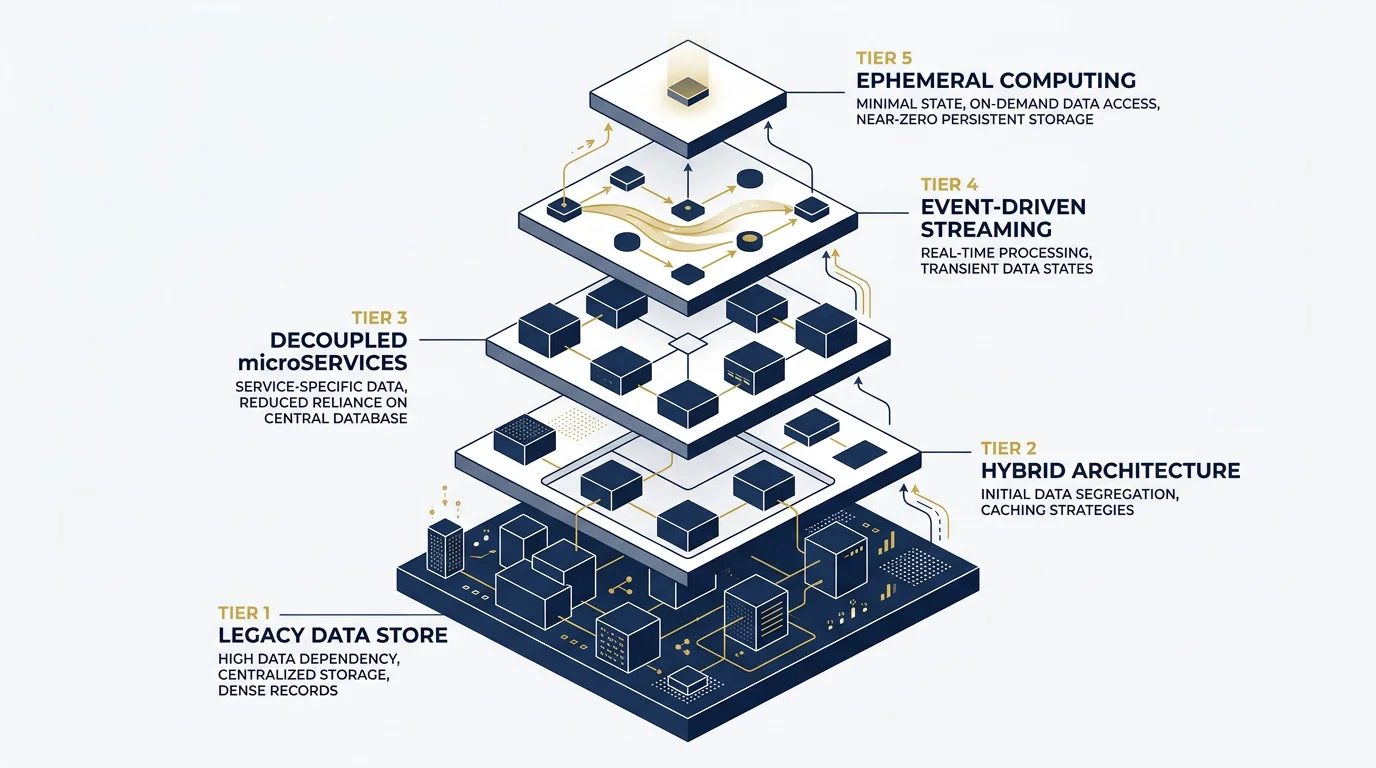
Privacy engineering sits inside a broader progression that many security teams already recognize. Least privilege limits who can act on a resource. Extending the same logic to data yields least data: hold the smallest footprint the function allows. Push further and retention shrinks to the minimum, until, wherever a service does not functionally depend on personal data, the target becomes zero data.
This progression, from privacy engineering to least privilege, then least data, then minimum retention, then zero data where possible, is the independent framework we describe as the Zero Data Protocol. It rests on three structural commitments: Zero Collection, Zero Retention and Zero Exploitation. The reasoning is direct: the safest data is the data you never collect, and less retention means less exposure, less liability and fewer future targets. When identity is not functionally necessary, users should remain free not to provide it.
Zero Data Protocol is presented as one architectural direction among several, not an absolute guarantee. The value comes from a structural stance: trust as an outcome of needing less personal data, rather than as a promise made in a consent banner. Teams working to shrink their attack surface can start with our practical resource on how to Reduce enterprise sensitive data footprint.
The Business Case for Designing With Less Data
The financial argument for minimization has strengthened. According to the Cisco 2026 Data Privacy Benchmark Study, 99% of organizations report at least one tangible benefit from their privacy initiatives, with agility and innovation now cited as leading outcomes. Privacy investment increasingly reads as capability building, not pure cost.
Spending reflects that view. Drawing on the same Cisco benchmark, a 2026 industry report notes that 38% of companies globally spent five million dollars or more on privacy in the past year, up sharply from prior figures, while the broader data protection market is projected to reach USD 575.5 billion by 2032. The direction is clear: enterprises are industrializing privacy inside their data pipelines rather than bolting it on afterward.
Comparing Three Approaches to Personal Data
The table below contrasts common postures. It is qualitative, because the difference lies less in individual metrics than in structural defaults.
| Approach | Default collection | Retention | Residual exposure |
|---|---|---|---|
| Consent-based compliance | Broad, gated by banners | Often open-ended | High |
| Standard data minimization | Limited to stated purpose | Purpose-bound schedules | Moderate |
| Zero Data Protocol (our approach) | None where not functionally necessary | Minimal to none | Structurally reduced |
Consent-based models place the burden on users and leave large datasets in place. Standard minimization reduces that footprint meaningfully. Our structural approach aims to remove the dependency itself wherever function allows, so there is less data to govern, secure or explain in the first place.
Turning Principles Into Durable Architecture
The move from principle to practice is what defines credible privacy work today. When you treat data minimization as an engineering requirement, purpose limitation, scoped access, retention limits and privacy-preserving processing stop being aspirations and become enforced behavior. Begin with a field-by-field audit, automate deletion, and question every dependency on personal data. The systems that need less are, by design, the ones with less to lose.
Take action with Zero Data Protocol
If your teams are ready to move privacy out of the policy binder and into the architecture, the direction matters more than any single control. Reducing what you collect, retain and exploit lowers exposure while strengthening the trust your users place in your systems.
Zero Data Protocol offers a structural protocol for building digital systems with zero dependency on personal data, connecting privacy, cybersecurity, AI governance and system design into one direction. Explore the Zero Data Protocol framework to see how Zero Collection, Zero Retention and Zero Exploitation translate into resilient, minimal-data architecture.
Frequently Asked Questions
What is the difference between privacy by design and privacy engineering?
Privacy by design is the principle that privacy should be built into systems from the start. Privacy engineering is the technical practice of actually doing it, implementing minimization, access controls and automated deletion in the running system rather than in a document.
Is data minimization a legal requirement?
In many jurisdictions, yes. Frameworks such as the GDPR require that personal data be adequate, relevant and limited to what is necessary for the stated purpose. Similar minimization concepts appear in laws across the United States, Brazil and beyond.
How does data minimization reduce security risk?
The less data you hold, the smaller your attack surface and the lower the impact of any breach. Data that was never collected, or that has already been deleted on schedule, cannot be exfiltrated, misused or exposed.
Can systems really operate with zero personal data?
Not every system can, but many collect far more than their function requires. Where identity or personal data is not functionally necessary, our Zero Data Protocol approach shows how to design services that depend on none of it, which is the safest possible posture.
Where should a team start with privacy engineering?
Begin with a data inventory and a field-by-field audit: for each element, justify why it is collected, how long it is kept and who can access it. Then automate retention and deletion so the controls run without manual intervention.