
Reported personal data breaches across Europe now average 443 per day, a sharp climb that underscores how fragile data-heavy systems have become. Against this backdrop, the case for building protection into architecture instead of patching it later has never been clearer. The principles of privacy by design offer a durable answer, and you can strengthen them further with our analysis of generative AI data privacy risks.
Privacy by design is not a new idea, but its urgency is. First articulated in the 1990s and formalized as a framework in 2009, it has since been written into law and pushed to the center of AI governance. According to Kiteworks, cumulative GDPR fines since 2018 now exceed €7.1 billion, a figure that turns abstract principles into concrete financial exposure.
What privacy by design actually means
At its core, privacy by design is an approach to systems engineering that treats data protection as a starting condition, not a finishing touch. The concept was developed by Ann Cavoukian, then Information and Privacy Commissioner of Ontario, and gained international recognition when data protection authorities adopted it as a shared standard in 2010.
The idea behind formal privacy by design guidelines is straightforward: privacy is best protected when it is integrated into technology at the moment of creation. Rather than reacting to incidents after they occur, you anticipate them. Rather than asking users to hunt for privacy settings, you make protection the default state. This is what regulators mean when they describe data protection by design and by default.
The distinction matters because bolted-on privacy tends to fail under pressure. When protection is a feature added late, it competes with functionality and usually loses. When it is embedded in the architecture, it becomes part of how the system works.
The seven foundational principles
Most guidelines trace back to seven foundational principles. They are not a compliance checklist, but a set of design commitments that shape every decision:
Proactive not reactive: anticipate and prevent privacy-invasive events before they happen.
Privacy as the default setting: if a user does nothing, their data remains protected automatically.
Privacy embedded into design: protection is part of the core architecture, not an add-on.
Full functionality, positive-sum: reject false trade-offs such as privacy versus security; aim for both.
End-to-end security: protect data across its full lifecycle, from collection to secure destruction.
Visibility and transparency: keep practices open and subject to independent verification.
Respect for user privacy: keep the design user-centric, with strong defaults and clear notice.
These principles have been cited in hundreds of academic and policy documents. They are deliberately technology-neutral, which is both their strength and their weakness: they adapt across contexts, but they leave engineers with the hard work of translation.
Why the guidelines matter more in 2026
Two forces have made these guidelines more than a governance ideal. The first is enforcement. European data protection authorities now receive an average of 443 breach notifications per day, a 22% year-over-year increase and the highest daily rate since GDPR took effect. Each notification represents exposure that better design might have prevented.
The second force is artificial intelligence. As models ingest ever larger volumes of personal data, the risk of inference, profiling, and unintended exposure grows. The EU AI Act, according to the official EU AI Act / EUR-Lex source for penalties and risk classification, layers a risk-based regime on top of GDPR, with penalties reaching up to 7% of global turnover for prohibited practices. Systems that minimize their dependence on personal data face a smaller regulatory surface. If you are integrating machine learning, our guide to reducing exposure through data minimization shows how these obligations translate into engineering choices.
From principles to engineering: start with data minimization
A recurring criticism of the original framework is that its principles are abstract and difficult to enforce. Researchers have long argued that the most reliable starting point is not the full list, but a single practice: minimizing the data you collect in the first place. Data that is never collected removes an entire category of retention, breach and secondary-use exposure.
This is more than a security tactic; it is a structural discipline. Data minimization means collecting only what a documented purpose requires, restricting internal access to those who genuinely need it, and applying anonymization or pseudonymization wherever identity is not functionally necessary. The failure to practice it carries real cost. According to Secureframe, citing the ISACA State of Privacy 2026, not practicing privacy by design ranks among the most commonly cited privacy failures, second only to inadequate training.
Retention is the other half of the equation. Data kept beyond its purpose becomes a liability and a future breach target. Establishing clear retention limits and secure deletion routines is one of the most tangible expressions of these guidelines, a topic we examine in our enterprise data retention and deletion guide.
A structural approach: collect less, retain less, exploit less
Where classic guidelines focus on protecting data once it exists, an emerging line of thinking asks a sharper question: does the system need the data at all? This is the premise of the Zero Data Protocol (ZDP), an independent framework built on three commitments: Zero Collection, Zero Retention, and Zero Exploitation. It is not a regulation, certification, or product, but a design direction.
The human consequence of this approach is what we call Human Freedom Choice: when identity or personal data is not functionally necessary, users should remain free not to provide it. This reframes trust as an architectural outcome rather than a promise printed in a policy or a consent banner. The safest data, in this view, is the data you never collect. You can explore how this maps to access design in our overview of the least-privilege, least-data principle.
This structural framing complements the seven principles rather than replacing them. Positive-sum functionality, privacy by default, and end-to-end security all become easier to achieve when the underlying system depends on less personal data to begin with.
A practical implementation checklist
Turning guidelines into operational reality requires concrete steps. The following practices consistently appear across authoritative frameworks:
Conduct a Data Protection Impact Assessment before, not after, a project launches.
Define the minimum data each feature genuinely requires, and default users to non-identifiable states.
Set retention periods explicitly, then automate secure deletion when they expire.
Apply encryption, access controls, and activity logging across the full data lifecycle.
Assemble cross-functional teams so privacy, security, and engineering decisions are made together.
Document requirements from conception to retirement to support independent verification.
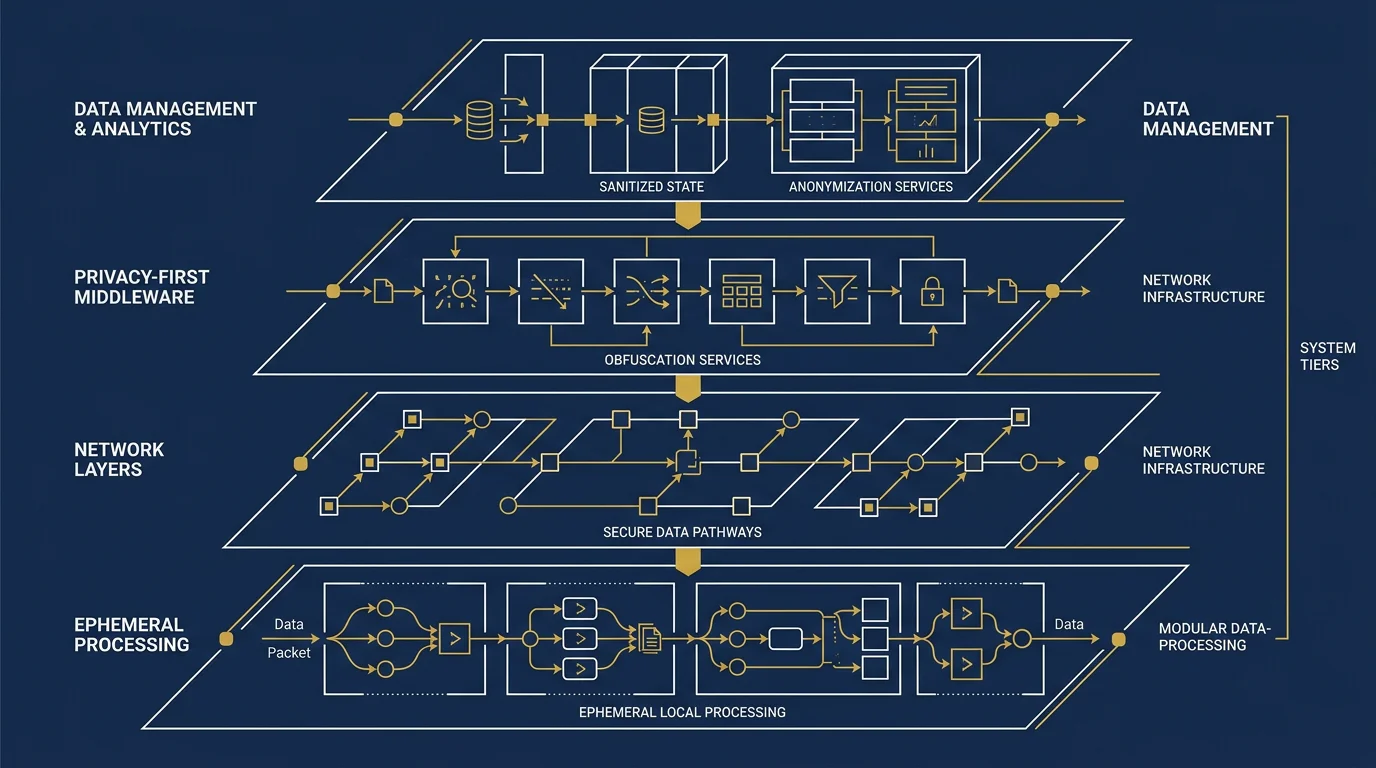
Privacy-enhancing technologies such as differential privacy, federated learning and on-device processing are increasingly being adoptedprivacy-enhancing computation to analyze sensitive data while limiting exposure. Techniques such as differential privacy, federated learning, and on-device processing make it possible to derive value from data without centralizing raw identifiers.
Acknowledging the limits and residual risks
No framework eliminates risk. Privacy by design has been criticized as vague and difficult to translate into unambiguous engineering requirements, precisely because legal principles are open-ended while code demands formal definitions. Overly aggressive minimization can also collide with legitimate obligations, such as fraud detection in banking or insurance, so balance matters.
These guidelines reduce exposure and liability; they do not guarantee security or automatic compliance. Treat them as a direction of travel rather than a finished destination. A system that collects less, retains less, and exploits less is more resilient, but it still requires ongoing testing, audits, and honest assessment of what residual risks remain.
Bringing the guidelines together
The enduring value of privacy by design lies in its refusal to treat protection as an afterthought. The seven principles give you a vocabulary; data minimization gives you a starting point; and a structural focus on collecting, retaining, and exploiting less personal data gives you resilience against enforcement pressure and AI-driven risk alike. Begin with a single question for every new feature: what data does this genuinely need, and for how long? Answer it honestly, design around the smallest possible answer, and revisit that answer regularly as your systems and obligations evolve.
Take action with Zero Data Protocol
If your teams are weighing how much personal data your systems truly need, the hardest part is moving from principles to architecture. That shift is exactly where a structural approach helps, connecting privacy, cybersecurity, AI governance, and system design into one clear direction rather than a patchwork of policies.
We built Zero Data Protocol on three commitments, Zero Collection, Zero Retention, and Zero Exploitation, to help you reduce dependency on personal data by default. Explore the Zero Data Protocol framework to understand how designing for less data can lower exposure, reduce liability, and build digital trust through architecture rather than promises.
Frequently Asked Questions
Is privacy by design a legal requirement?
Yes, in some jurisdictions. In the European Union, Article 25 GDPR explicitly requires data protection by design and by default. Other jurisdictions may impose related accountability, minimization or security obligations, but the exact legal requirements vary.
What is the difference between privacy by design and privacy by default?
Privacy by design is the broader approach of embedding protection throughout the engineering process. Privacy by default is one of its principles, ensuring the most protective settings apply automatically without user action. Default is a subset of the wider design philosophy.
Where should an organization start implementing these guidelines?
Begin with data minimization, since it is the most concrete and measurable practice. Identify the minimum data each function genuinely requires, then set explicit retention limits. Our data retention and deletion guidance can help you operationalize the second step.
How does privacy by design apply to artificial intelligence?
AI systems amplify risks of inference, profiling, and unintended exposure because they process large volumes of personal data. Applying these guidelines means minimizing training data, using techniques like differential privacy or federated learning, and reducing the model's dependence on identifiable information wherever possible.
Does following these guidelines guarantee compliance or security?
No. These guidelines reduce exposure and liability, but they do not eliminate risk or guarantee automatic compliance. They should be paired with ongoing impact assessments, audits, and honest evaluation of the residual risks that remain in any system.