
Most organizations still treat stored data as an asset and rarely as a liability. Yet every record you keep past its usefulness is a record an attacker can steal, a regulator can question, and a legal team can be forced to produce. A disciplined data retention and deletion policy reverses that default, A disciplined data retention and deletion policy reverses that default and extends data minimization across the full information lifecycle.
The pressure is no longer theoretical. Unmanaged AI usage now adds an average of $17.9 million to breach expenses, according to Sprinto, largely because systems ingest and retain personal data no one ever deletes. Retention has quietly become one of the most consequential security decisions an enterprise makes, and it deserves a deliberate policy rather than accumulated habit.
What a retention and deletion policy actually governs
A retention policy is not a filing schedule. It is a control framework that answers four questions for every category of information: what you keep, where it lives, how long it stays, and how it is destroyed. The deletion half is where most policies fail, because writing a retention period is easy and enforcing secure disposal is not.
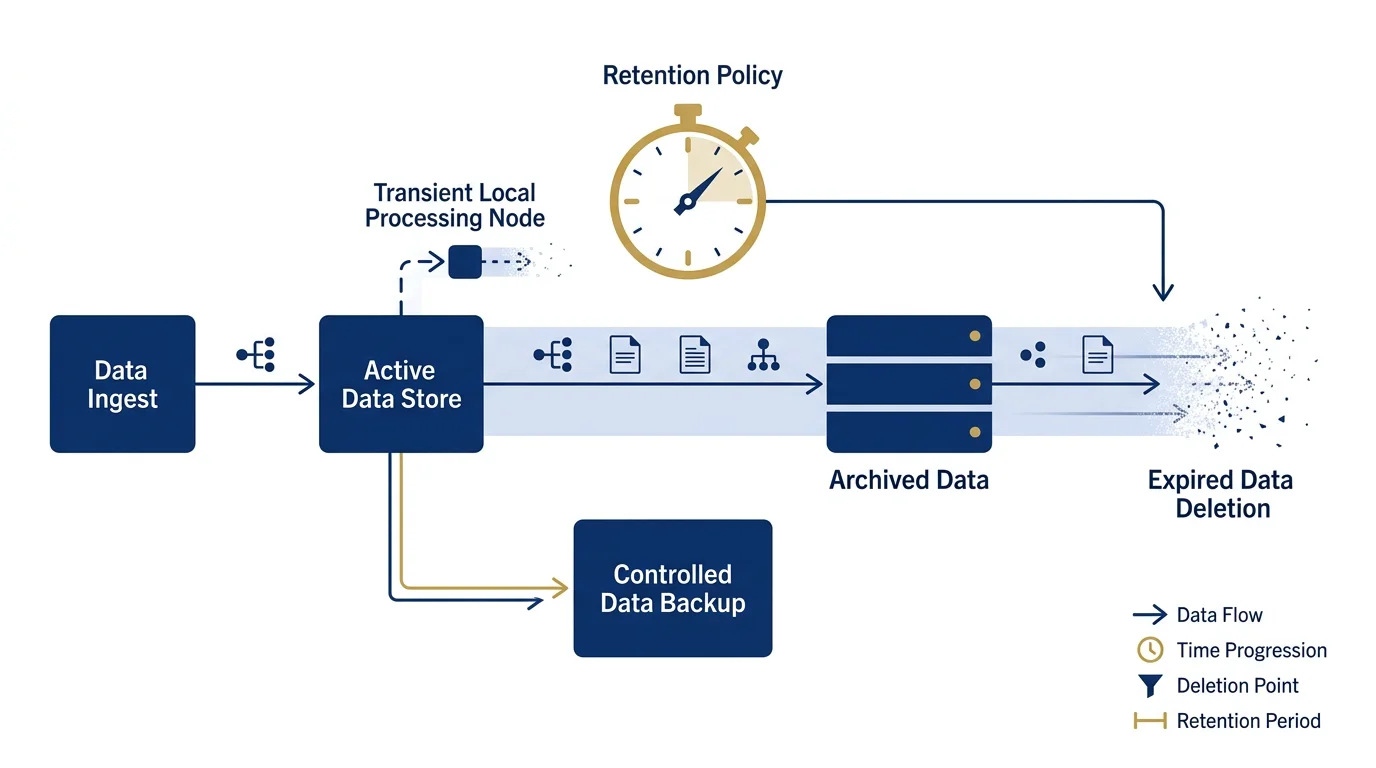
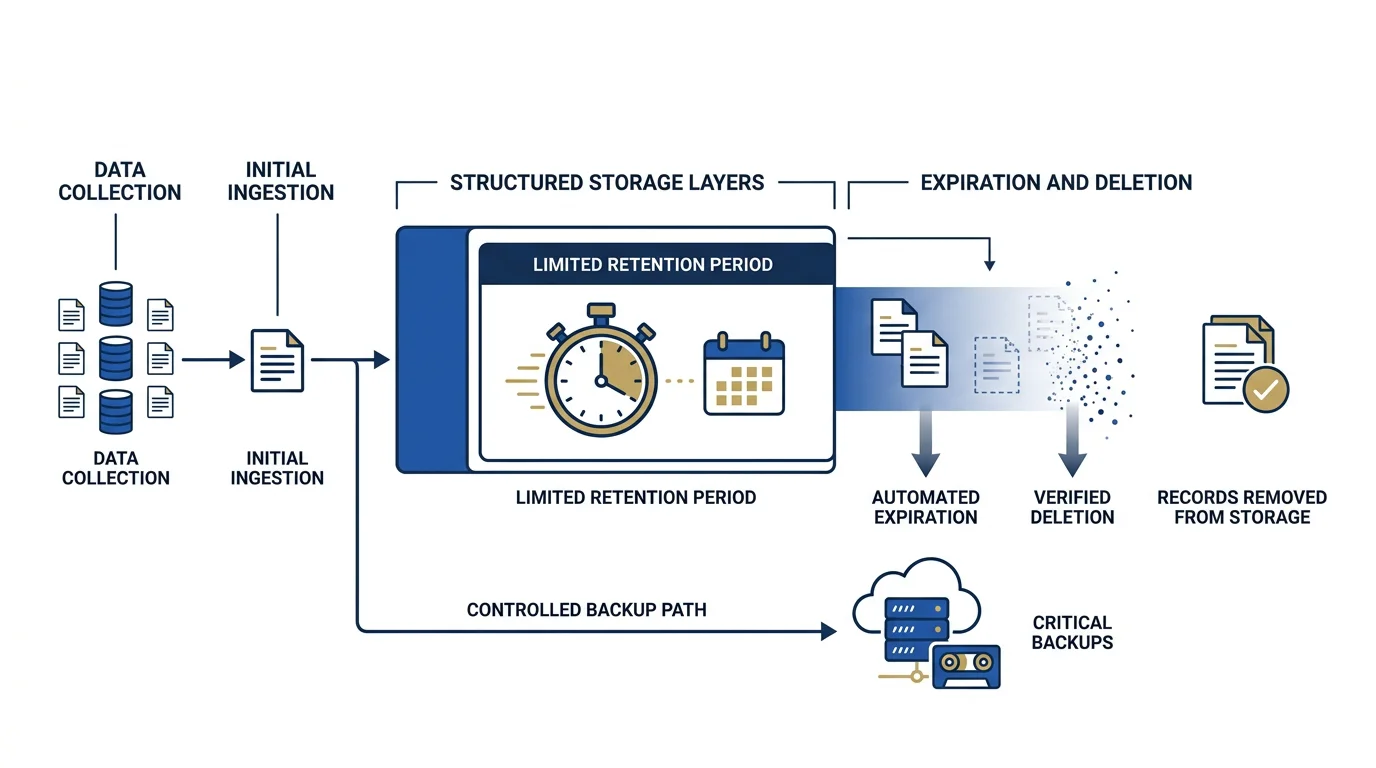
Think of the policy as covering the full data lifecycle. It should classify data by type and sensitivity, assign a retention schedule to each class, define who owns the deletion decision, and describe the auditable method used to remove records. It should also handle exceptions such as legal holds, and account for copies that live in backups, logs, and analytics systems.
Why over-retention is now the bigger risk
For years the instinct was to keep everything, because storage is cheap and data might prove useful later. That logic no longer holds. The volume of retained sensitive data is now a direct multiplier of breach impact, and the threat environment has intensified. Ransomware is now present in 44% of all breaches, up from 32% the prior year, according to StationX citing the Verizon DBIR.
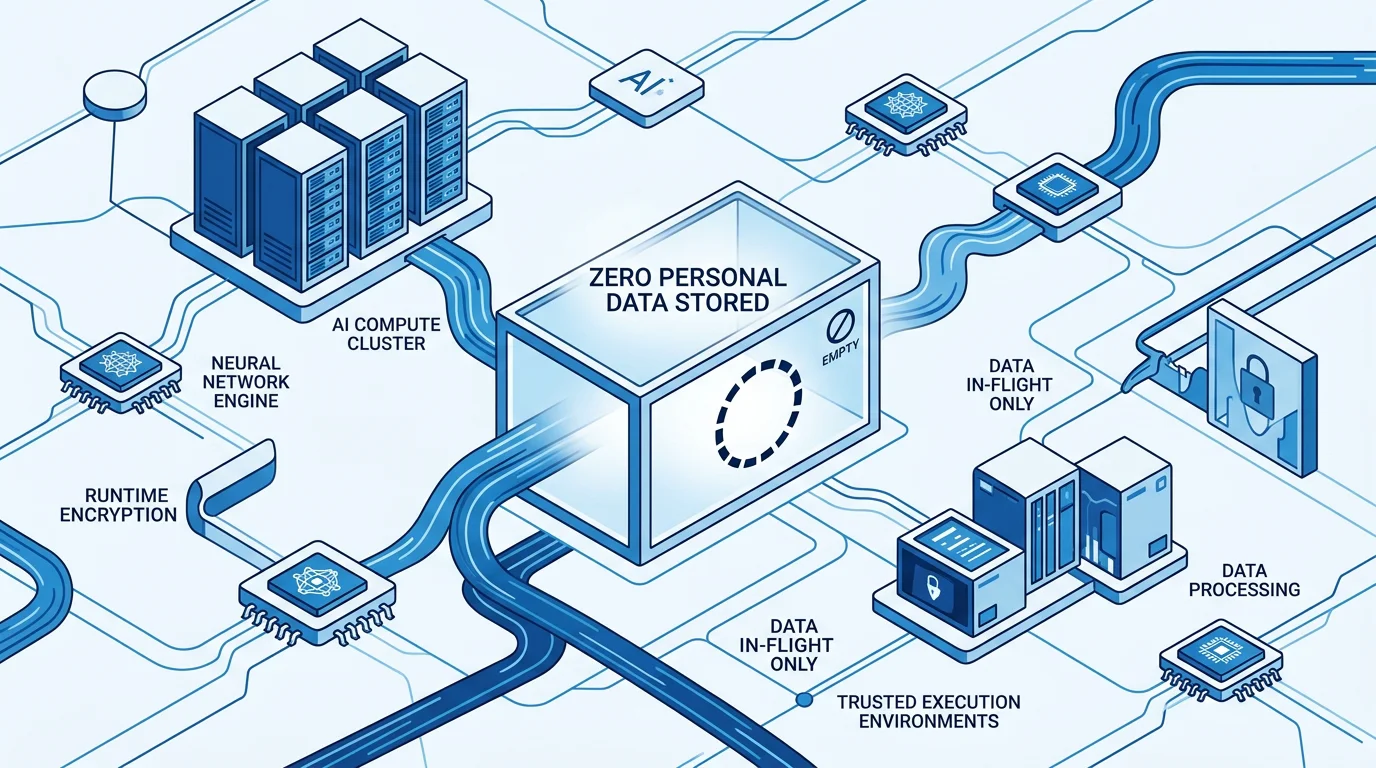
Every extra dataset you retain is another target, another compliance obligation, and another item to produce in litigation. The principle is straightforward: information that is not unnecessarily collected or persistently retained presents a smaller future exposure to breach, misuse, and disclosure obligations. This is why leading teams treat aggressive deletion as a security control, and why some designs favor a zero data architecture without personal-data retention wherever function allows it.
The counterpoint matters too. AI adoption is pushing retention times in the opposite direction, because many teams believe longer histories improve model quality. That tension is real, and your policy must resolve it explicitly rather than let default retention win by inertia.
Purpose limitation and retention schedules
Data minimization is usually framed as a collection principle: gather only what you need. Retention extends that principle across time. If you collected data for a defined purpose, that purpose also defines when the data must go. Purpose limitation and retention limitation are two halves of the same discipline.
A workable schedule assigns each data class a defensible period tied to a legal, contractual, or operational justification. Financial records may need seven years for tax purposes, while marketing engagement data may warrant only twelve to twenty-four months. The point is not the exact number but the justification behind it. A retention period without a stated reason is a liability waiting to be questioned.
Anchor each period to a source: statute, regulation, contract, or a documented business need.
Prefer the shortest defensible window: when several rules apply, do not blindly adopt the longest across all data.
Separate active from archival data: move inactive records to restricted storage before deletion.
Automate expiry: manual deletion does not scale and quietly fails.
When you plan analytics and AI programs, ask whether the model truly requires persistent personal data or whether transient inputs suffice. Our guidance on data readiness without data dependency shows how to prepare systems for AI while limiting what must be retained.
Legal holds, backups, and derived data
Three areas quietly break most deletion promises. The first is the legal hold: when litigation or investigation is reasonably anticipated, you must suspend deletion for the relevant records, and your policy needs a documented mechanism to place, track, and release holds without disabling deletion everywhere else.
The second is backups. Deleting a record from production does not remove it from disaster-recovery copies, snapshots, or archives. These layers often carry their own lifecycles. Microsoft 365 recycle bin retention, for example, runs for 93 days, per CrashPlan, after which native recovery ends unless separate backups exist. Your policy should state honestly that deletion from backups may lag, and define the maximum window before all copies expire.
The third is derived data. Aggregations, embeddings, model features, logs, and profiles created from personal data can persist long after the source is deleted. A credible policy tracks these derivatives and either deletes, re-derives, or genuinely anonymizes them. Ignoring derived data means claiming deletion you have not actually achieved.
Verifying deletion and assigning ownership
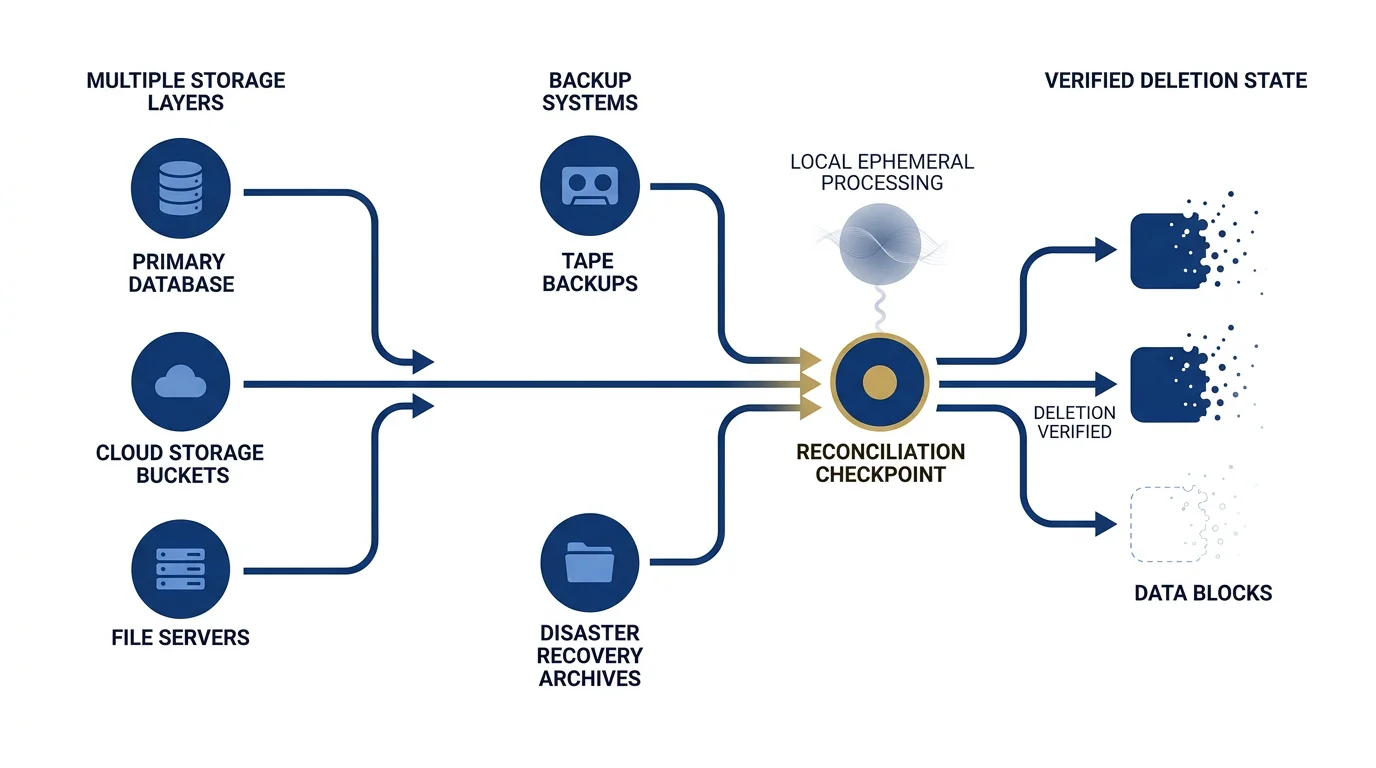
Deletion that cannot be verified is a claim, not a control. This is the differentiator most policies neglect. It is not enough to trigger a delete command; you need evidence that the data is gone across every system that held it, including third parties and processors. Accidental deletion already causes 34% of SaaS data loss incidents, which shows how loosely deletion is governed in practice, per CrashPlan research.
Verification requires a few concrete elements. Maintain a data map so you know every location a record can exist. Log deletion actions with timestamps and scope. Reconcile deletions against the map so nothing is silently missed. Where processors and vendors hold data, obtain deletion attestations, because your accountability does not end at your own perimeter. For the vendor dimension, review our guidance on third-party AI risk and deletion accountability.
Ownership is the other missing piece. Assign a named accountable owner for each data class, not a vague reference to IT. Retention decisions sit at the intersection of legal, security, privacy, and engineering, so cross-functional ownership prevents the policy from becoming an orphaned document nobody enforces.
Designing for less persistent personal data
The most reliable way to delete data on time is to avoid retaining it in the first place. This is where policy meets architecture. Instead of collecting personal data and then racing to expire it, you can design systems that collect less, retain less, and exploit less by default. Deletion you never have to perform is the deletion least likely to fail.
This structural approach favors non-collection where a function does not require identity, local or ephemeral processing where a result does not need to be stored, and genuine anonymization where analysis does not need individuals. The demand is real: 78% of customers expect companies to delete their personal data on request, according to Marketing LTB, while only a minority have automated the workflows to do so reliably.
Zero Data Protocol frames this as a direction rather than a single tool. To be clear, reducing retention does not remove your legal duty to keep certain records, and deletion is rarely instantaneous across backups. The goal is to minimize unnecessary persistent personal-data dependency, so that what remains is smaller, defensible, and far easier to govern.
An implementation checklist and approach comparison
Turning principle into practice is a sequence, not a single project. Use the following steps to stand up a policy that holds under audit and under attack:
Inventory and classify every data source by type and sensitivity.
Map legal and contractual obligations to each data class.
Set retention schedules with a documented justification per class.
Define secure disposal methods, including cryptographic erasure where appropriate and technically verifiable.
Implement legal-hold mechanics that suspend deletion narrowly.
Extend rules to backups and derived data, with maximum expiry windows.
Automate expiry and log every deletion for reconciliation.
Collect vendor deletion attestations from processors.
Assign named owners across legal, security, privacy, and engineering.
Review the policy at least annually and after regulatory change.
Different strategies carry different residual risk. The table below compares three common postures on the criteria that matter for exposure and governance.
Approach | Personal data retained | Breach exposure | Deletion effort |
|---|---|---|---|
Retain-and-secure (keep everything, protect it) | High | High | Very high |
Delete-on-schedule (retention periods enforced) | Moderate | Moderate | High |
Zero Data Protocol (collect less, retain less, exploit less) | Reduced where architecture allows | Potentially lower | Reduced for data not persistently retained |
Formal retention discipline remains uneven across organizations, and many deletion processes still depend on fragmented or manual workflows. That operational gap is precisely where structural reduction of unnecessary data dependency can provide value.
Turning retention discipline into durable trust
A credible data retention and deletion policy is not a compliance formality; it is one of the highest-leverage security controls you own. Anchor every retention period to a justification, extend deletion honestly to backups and derived data, and verify removal rather than assume it. Then push the harder question upstream: which personal data do you truly need to keep at all? The less unnecessary personal data you retain, the smaller your potential exposure, the more limited your future attack surface, and the easier your remaining obligations may become to govern. Start with what you can delete this quarter, assign clear ownership, and let architecture, not consent banners, carry the weight of your privacy commitments.
Take action with Zero Data Protocol
If your retention policy still fights an uphill battle against data you never needed to keep, the problem may be structural rather than procedural. Reducing what you collect and store makes every deletion obligation smaller and every audit simpler.
Zero Data Protocol offers a structural approach to building digital systems with minimal dependency on personal data, connecting privacy, cybersecurity, and AI governance into one direction: collect less, retain less, exploit less. Explore the Zero Data Protocol framework for minimal-data systems to see how architecture can reduce unnecessary exposure, simplify parts of data governance, and strengthen digital trust.
Frequently Asked Questions
What is the difference between data retention and data deletion?
Retention defines how long you keep data based on legal, regulatory, and business needs. Deletion is the secure, auditable removal of that data once its retention period ends. A complete policy governs both, because a retention rule without enforced deletion leaves data exposed indefinitely.
Does deleting data from production remove it everywhere?
No. Copies typically persist in backups, snapshots, logs, and derived datasets such as analytics or model features. A sound policy tracks these locations and defines a maximum window before all copies expire, while acknowledging that deletion from backups is rarely instantaneous.
How does a legal hold affect deletion?
When litigation or investigation is reasonably anticipated, you must suspend deletion of relevant records. Your policy needs a mechanism to place, track, and release holds narrowly, so that unrelated data still expires on schedule and you avoid spoliation claims.
Can retaining less data actually reduce security risk?
Yes. Reducing unnecessary collection and persistent retention lowers the amount of personal data exposed to future breach, misuse, or disclosure obligations. Approaches such as Zero Data Protocol support this through non-collection, local processing, and ephemeral use where appropriate. This can reduce the attack surface linked to retained personal data, but it does not eliminate security, legal, or operational risk.
How often should a retention and deletion policy be reviewed?
Review it at least annually, and additionally whenever regulations, business operations, or technology change. Involve legal, security, privacy, and engineering owners in each review, since retention decisions sit at the intersection of all four functions.