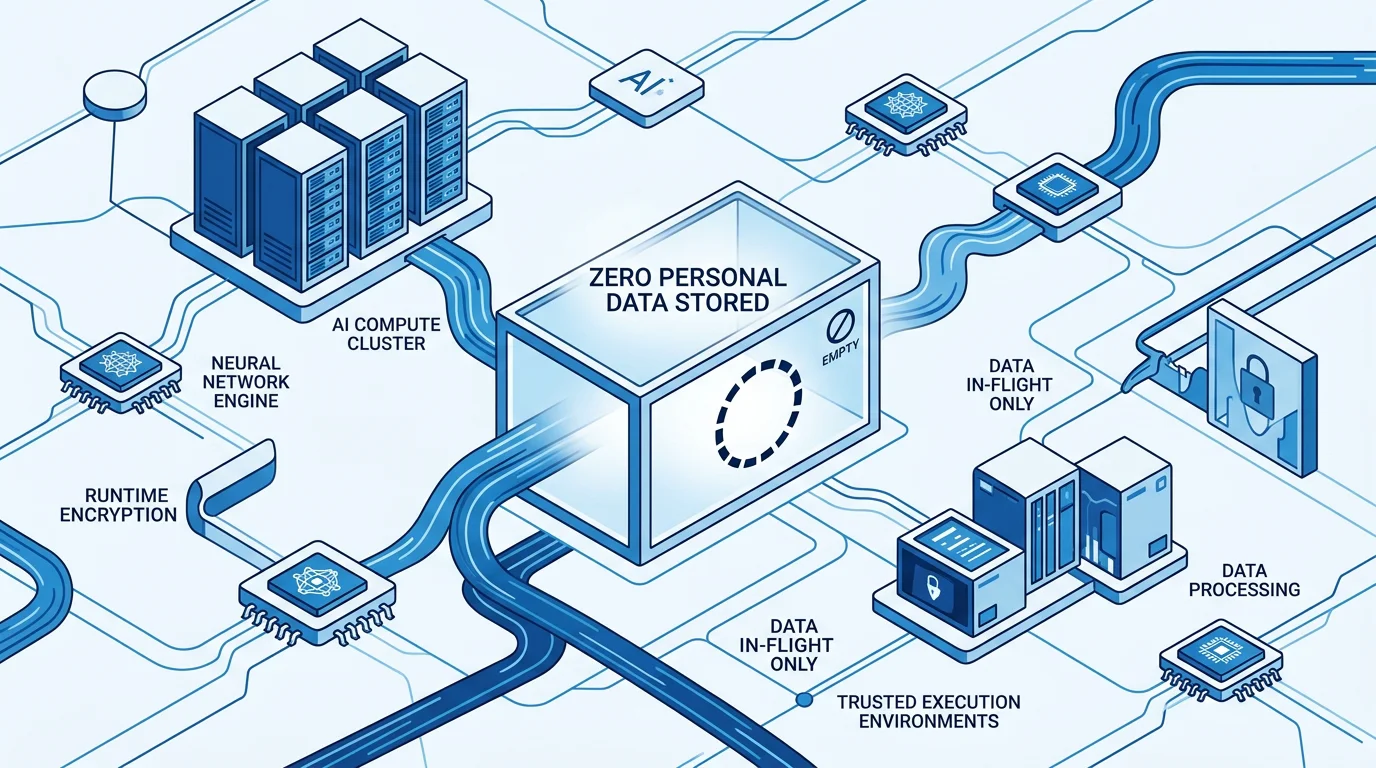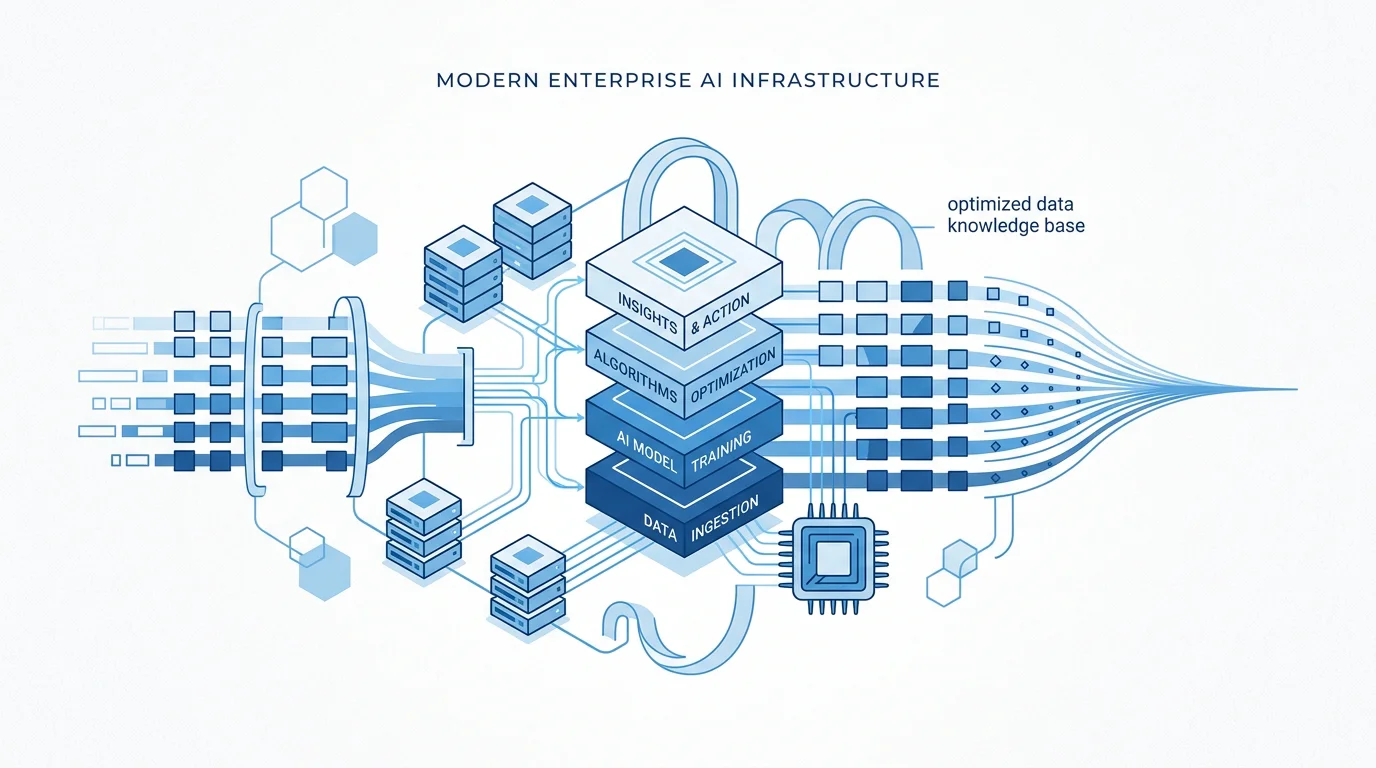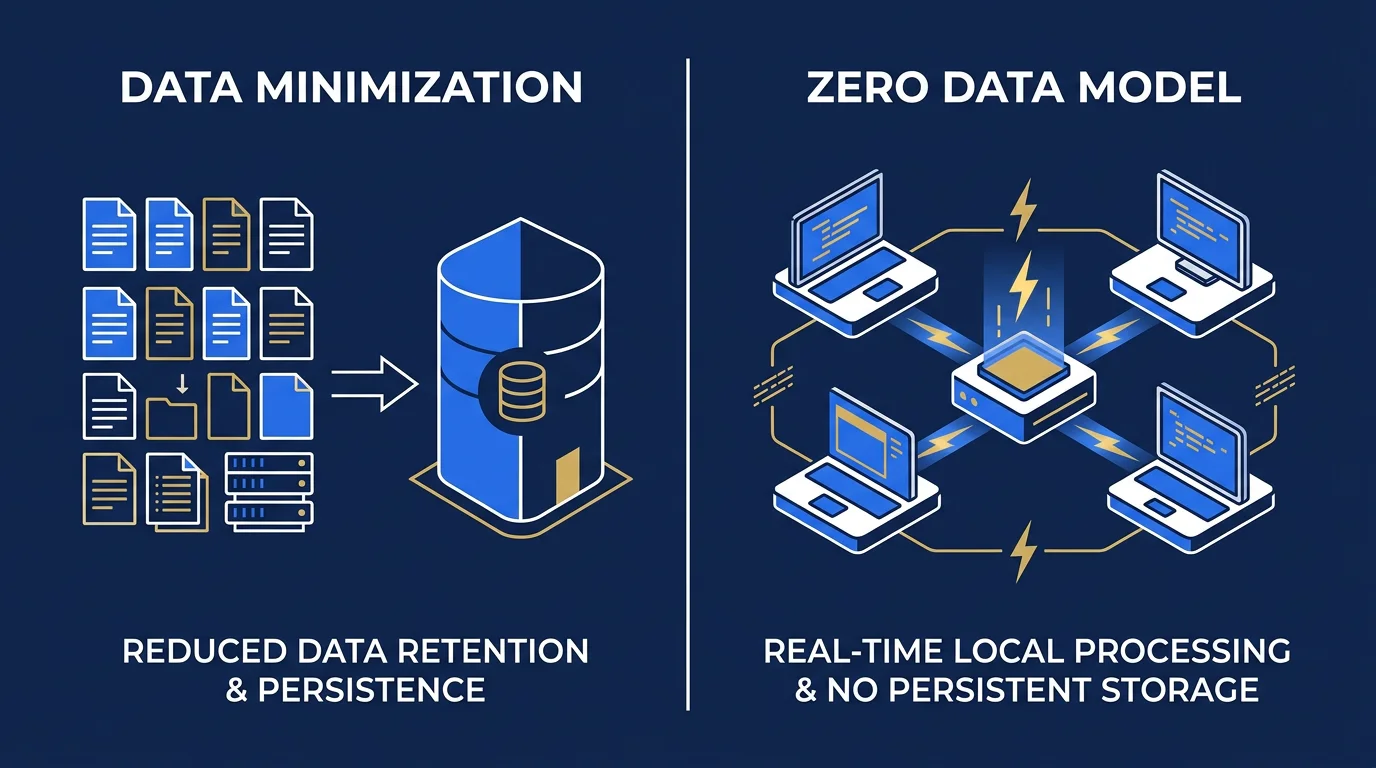

The average global cost of a data breach reached several million dollars last year, yet most organizations still treat personal data as an asset to accumulate. That instinct is expensive. The distinction between reducing collection and removing dependency defines the modern privacy conversation, and it is the heart of the debate around data minimization versus a zero data model. If you want to understand where architecture can carry more weight than policy, our Zero Data Architecture (building AI without personal data) guide frames the structural shift.
Minimization asks how little you can collect. Zero Data asks whether you need to depend on personal data at all. According to IBM figures reported by Swif, the global average breach cost fell to 4.44 million dollars in 2025, while the United States average hit a record 10.22 million dollars. Those numbers scale with the data you hold, which is exactly why the difference between the two philosophies matters for security architects and privacy leaders.
What data minimization actually requires
The topic of data minimization vs zero data begins with a well-established legal principle. Under the European General Data Protection Regulation, personal data must be adequate, relevant, and limited to what is necessary for a stated purpose. The principle is not new. It became a core privacy standard as government systems expanded in the 1970s, and it now anchors frameworks from GDPR to California's CCPA and Maryland's 2024 privacy act.
In practice, minimizing data collection means three disciplines working together. You limit what you gather at the point of collection. You retain records only for as long as a purpose justifies. You restrict who can access what remains. This is sound governance, and it measurably shrinks your attack surface. It does not, however, question whether the dependency on personal data should exist in the first place.
Where a Zero Data approach goes further
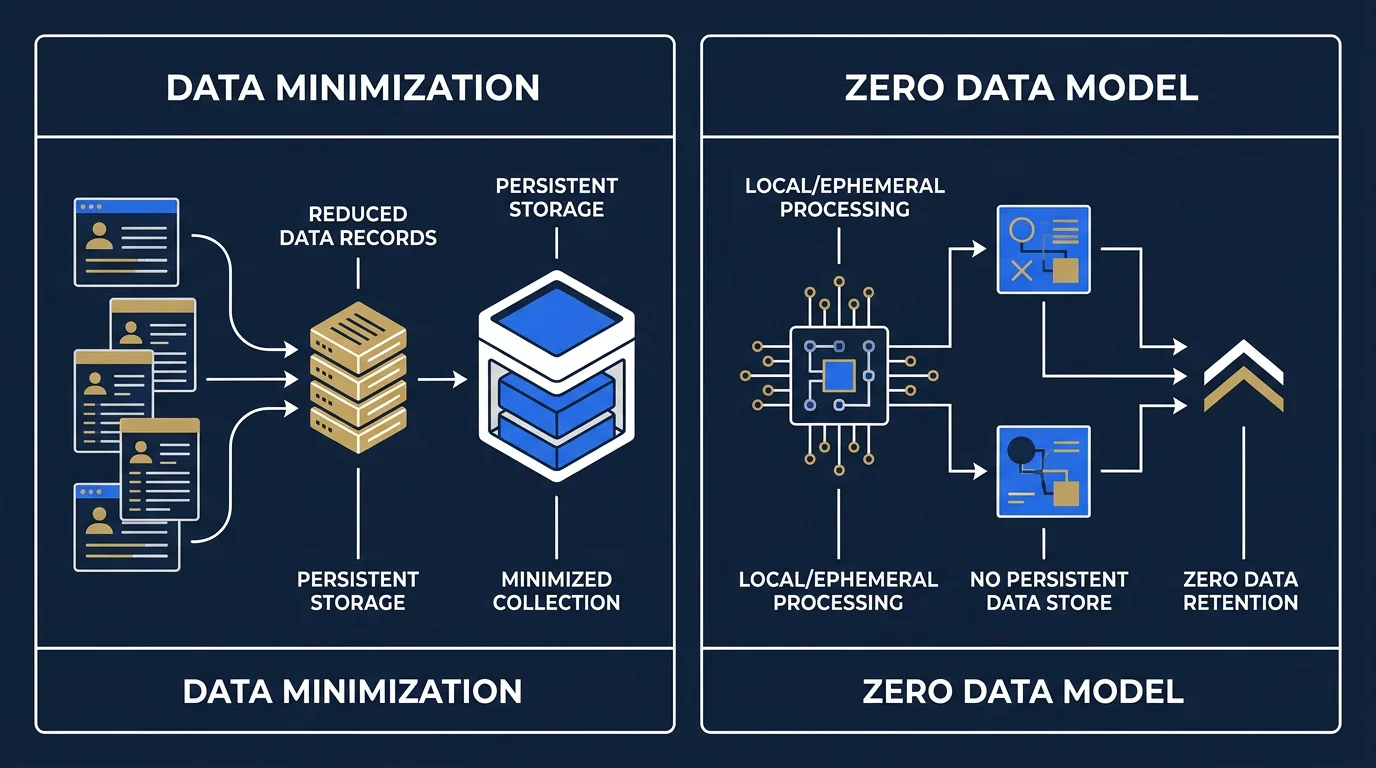
Consider a maps application. A user requesting directions reasonably expects the service to work without their precise location being retained, profiled, and shared with third parties. Minimization would trim what is stored. A Zero Data design asks a sharper question: can the system deliver its function without depending on that personal data at all?
This is the structural difference. Our position rests on three principles: Zero Collection, Zero Retention, and Zero Exploitation. The safest data is the data you never collect, because there is nothing to breach, sell, or subpoena. When value comes from system function rather than extraction, you remove entire categories of risk instead of merely lowering them. Our work on Data Readiness Without Data Dependency shows how this applies even to AI pipelines that traditionally assume large personal datasets.
To be clear, this is not a claim that any system eliminates all operational data. Logs, transactions, and configuration records exist. The aim is to remove unnecessary personal-data dependency, not to pretend that a functioning system holds nothing.
Data minimization vs Zero Data: a direct comparison
The two approaches share a direction but differ in ambition and in the residual risk they leave behind. The table below sets them against a Zero Data Protocol model on the criteria that matter to architects.
| Criterion | Data minimization | Zero Data (Zero Data Protocol) |
|---|---|---|
| Core question | How little can we collect? | Do we need personal data at all? |
| Collection | Reduced, still personal | Zero Collection by default |
| Retention | Time-limited storage | Zero Retention where function allows |
| Processing | Purpose-limited use | Zero Exploitation, no profiling |
| Residual personal data | Persistent, must be secured | Minimized to necessity only |
| Primary lever | Policy and governance | System architecture |
Minimization treats personal data as a resource to trim. Our approach treats dependency itself as the liability to design out. Both remain subject to applicable law; neither replaces your legal compliance obligations.
Collection, retention, processing, and the residual risk gap
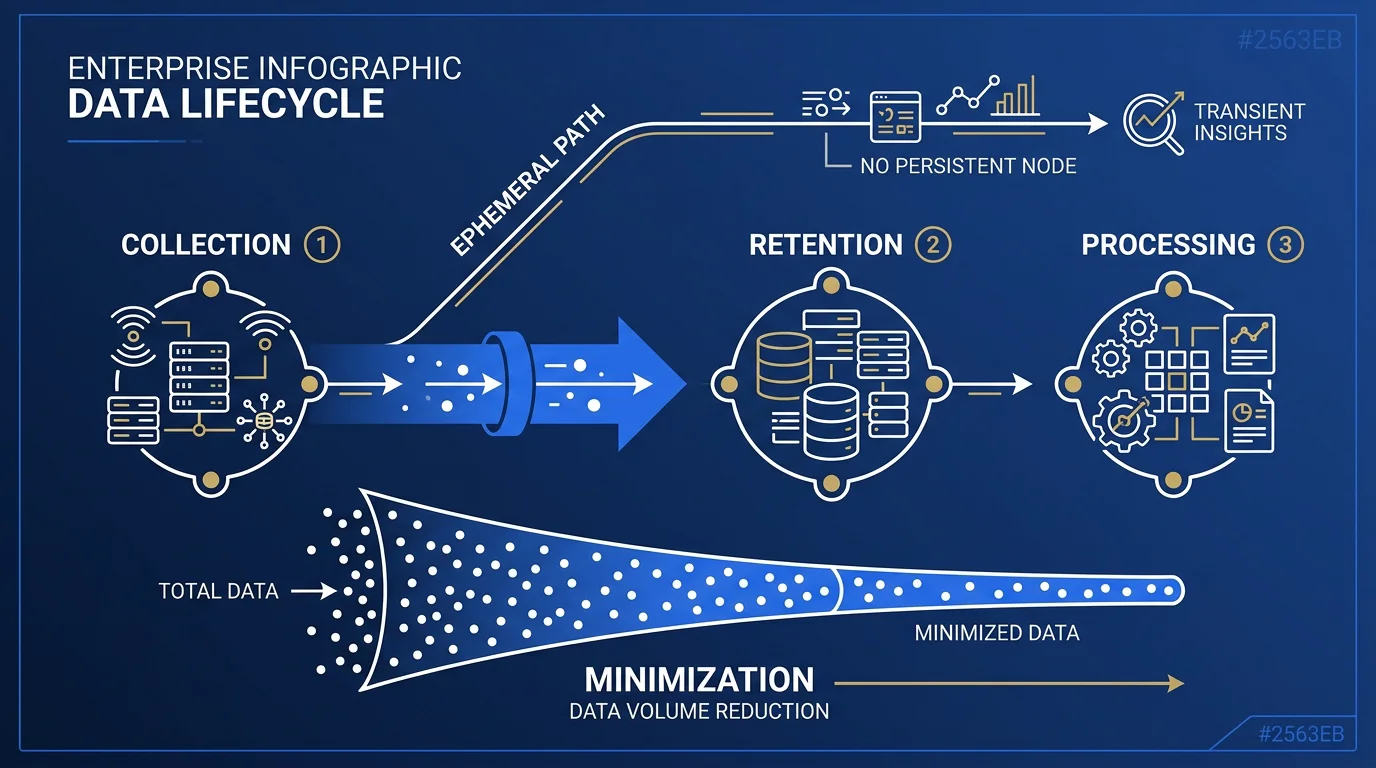
Every retained record is a future target. When you minimize, you shrink that target but you do not remove it. The residual dataset must still be encrypted, access-controlled, audited, and eventually deleted. Each of those controls can fail. The breach cost scales with the volume you hold, which is why reducing that volume helps and why removing it helps more.
The scale of exposure remains stark. The Identity Theft Resource Center, in figures reported by an April 2026 analysis, tracked 3,322 data compromises in the United States during 2025, an all-time record. Worse for affected individuals, the same analysis noted that 70 percent of breach notices offered no meaningful information about how the incident occurred. Data you never collected cannot appear in either statistic.
Retention is where governance often quietly fails. Minimization policies specify deletion schedules, yet backups, exports, and shadow copies persist. A Zero Retention posture removes that ambiguity by not creating the persistent copy in the first place. For teams weighing performance-driven data patterns against genuine privacy, our comparison of Zero-Copy Data vs Zero Data Protocol clarifies why speed and privacy are not the same guarantee.
Practical examples across common use cases
Abstract principles become clearer through concrete design decisions. The following patterns show how the two approaches diverge in real systems.
- Authentication: minimization stores a hashed identifier and limits retention. A Zero Data pattern favors ephemeral or attestation-based verification that avoids persistent identity dependency.
- Analytics: minimization samples fewer fields. A Zero Exploitation model relies on aggregate signals that never resolve to an individual, avoiding profiling and behavioral targeting.
- Network access: minimization logs less. Our approach to Network Access Control Without Surveillance enforces access decisions without building a surveillance record of users.
- Support systems: minimization purges tickets on a schedule. A Zero Retention design keeps only what an open case requires and discards it on resolution.
The type of record you hold also drives cost. Customer personal information averaged around 160 dollars per compromised record last year, according to IBM data compiled by Bright Defense. Every field you decline to store is a per-record liability you decline to carry.
How to implement: steps and a checklist
Moving from theory to architecture requires a sequence, not a single decision. Start by mapping where personal data enters, rests, and flows. Then challenge each dependency rather than merely trimming it.
- Inventory every collection point and the stated purpose behind it.
- For each point, ask whether the function can be delivered without personal data.
- Redesign collection to default to zero, requesting data only when strictly necessary.
- Replace persistent storage with ephemeral or aggregate processing where feasible.
- Remove profiling, behavioral targeting, and unnecessary identity dependency.
- Document what remains and confirm it against your legal obligations.
Use this checklist to pressure-test any design:
- Have you justified each retained field against a specific function?
- Can any persistent personal record become ephemeral or aggregate?
- Does any feature depend on identity that could work without it?
- Are backups and exports covered by your retention limits?
- Have you confirmed that reduced data still meets your compliance duties?
Operational limits: what neither approach removes
Honesty about limits builds more trust than absolute claims. A Zero Data model does not eliminate all operational data, and it does not replace regulatory frameworks such as GDPR, CCPA, or sector rules like HIPAA. Systems still process transactions, emit logs, and hold configuration. The goal is to remove dependency on personal data, not to claim a system holds nothing.
Minimization, meanwhile, has a ceiling. It reduces exposure but preserves the underlying model in which personal data is an asset to manage. Detection speed illustrates the stakes: breaches that ran past 200 days cost markedly more than those caught earlier, per the same IBM analysis. When there is less personal data to detect a breach within, the entire calculus improves. Neither approach is a silver bullet, but designing for less dependency changes what failure can cost you.
Choosing the right posture for your organization
The debate over data minimization versus a zero data model is not a contest with a single winner. Minimization is a mature, legally grounded discipline that every organization should practice. A Zero Data approach extends that logic to its structural conclusion by questioning dependency itself. Treat minimization as your floor and zero dependency as your direction. Map your data, challenge each collection point, and let architecture, not consent banners, carry the weight of trust wherever your function allows it.
Take action with Zero Data Protocol
If your teams are ready to move beyond trimming data toward removing unnecessary personal-data dependency, we can help you frame the shift. Zero Data Protocol connects privacy, cybersecurity, AI governance, and system design into one clear direction: collect less, retain less, exploit less.
Explore our structural protocol for zero data dependency to see how architecture can reduce exposure, liability, and future target surface. Value should come from what your system does, not from what it extracts. That is the foundation of digital trust built on design rather than promises.
Frequently Asked Questions
Is data minimization the same as a zero data approach?
No. Data minimization reduces how much personal data you collect and retain, while a zero data approach removes unnecessary personal-data dependency by design. Minimization lowers exposure; a zero data model aims to eliminate the dependency where function allows.
Does a Zero Data model eliminate all operational data?
No, and it does not claim to. Systems still process transactions, emit logs, and hold configuration records. The objective is to remove dependency on unnecessary personal data, not to pretend a functioning system holds nothing at all.
Does adopting Zero Data replace legal compliance?
No. Frameworks such as GDPR, CCPA, and HIPAA still apply to any personal data you process. Our Zero Data Protocol principles complement those obligations by reducing dependency; they do not substitute for your compliance program.
Why does reducing data lower breach cost?
Breach cost scales with the volume and sensitivity of data held, and customer personal information carries a measurable per-record cost. Every field you decline to store is one that cannot be exposed, stolen, or subject to notification requirements.
Where should an organization start?
Begin by inventorying every collection point and its stated purpose. Then challenge each dependency, redesign defaults toward zero collection, and confirm that whatever remains still satisfies your legal duties. Architecture-led change delivers more durable trust than policy alone.