
How long does an intruder need to travel from a single foothold to your most valuable systems? Recent research places that window at well under an hour. For CISOs and security architects, understanding the difference between microsegmentation and network segmentation is no longer a niche networking question; it is a board-level concern that shapes exposure to ransomware and lateral movement. It is also the foundation for our work on micro-segmentation for breach containment.
The economics reinforce the point. In 2025, the global average cost of a data breach fell to 4.44 million dollars, down from 4.88 million a year earlier, according to IBM research. Much of that decline stemmed from faster detection and containment, precisely the outcome that segmentation aims to deliver. The open question is how much personal data your controls must accumulate to achieve it.
Why lateral movement now defines the risk, not the perimeter
Perimeter defenses were built to inspect north-south traffic, the flow between clients and servers. They rarely see east-west traffic, the workload-to-workload conversations that dominate modern data centers and clouds. This is where the comparison of microsegmentation vs network segmentation becomes decisive.
The exposure is measurable. A 2026 industry study analyzing enterprise activity found that 80 percent of enterprise servers are reachable from anywhere inside the network, and that internal traffic represents more than 70 percent of communications. The federal zero trust standard describes the same structural flaw: once attackers breach the perimeter, further lateral movement is largely unhindered. Segmentation, in both its broad and granular forms, exists to remove that freedom of movement.
Network segmentation: broad zones and where they strain
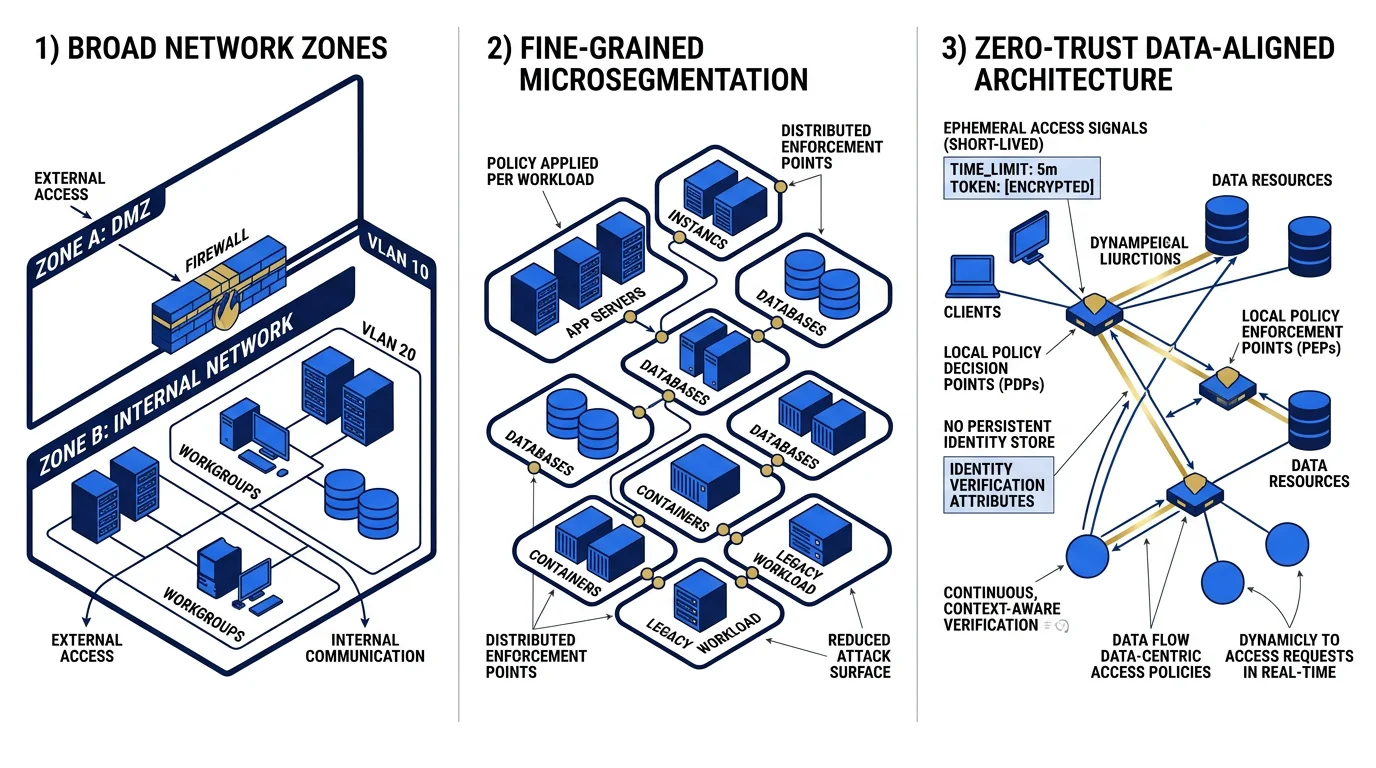
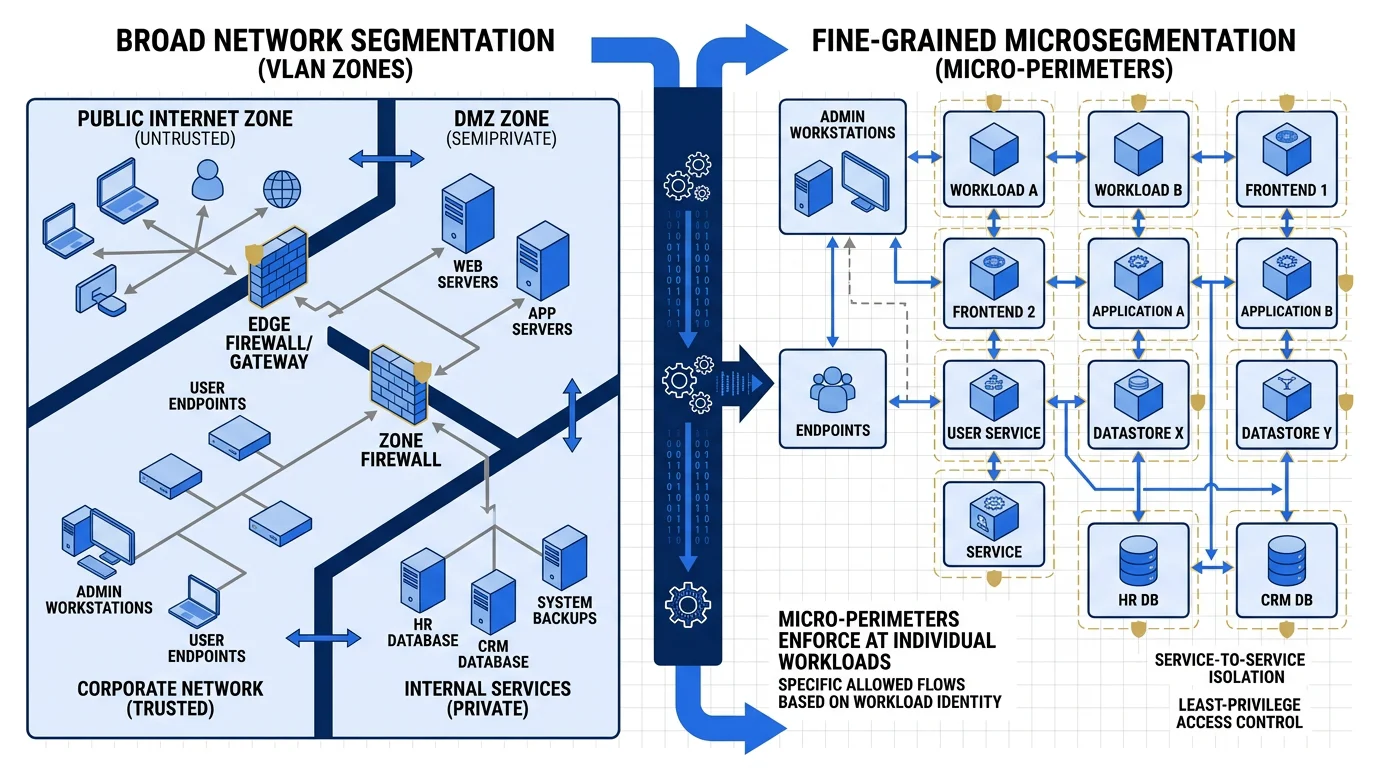
Network segmentation is the practice of dividing a flat network into smaller zones, typically using VLANs, subnets, firewalls, and access control lists. Traffic crossing a zone boundary must pass an enforcement point where policy is applied. It is the digital equivalent of adding walls and doors inside an open building.
Done well, this model limits broad exposure and satisfies many regulatory requirements. Its weakness lies inside each zone. Every device in a segment shares the same trust level, so a single compromised workstation or sensor can often reach everything nearby without touching an enforcement point. Re-segmenting to shrink those zones means re-addressing, re-cabling, and firewall rule sprawl, which is why most projects stop at a handful of coarse zones. For teams weighing this trade-off, our guidance on network segmentation without persistent identity profiling examines how to keep zoning effective without expanding surveillance.
Microsegmentation: granular control at the workload level
Microsegmentation extends the concept of segmentation down to the individual workload, device, or user. Instead of trusting everything inside a zone, it creates a micro-perimeter around each asset and enforces policy based on identity, context, and behavior. The result is full east-west coverage, including traffic that never leaves a single subnet.
The federal zero trust model names microsegmentation as one of its core deployment approaches. Cloud-native environments make it especially relevant, because containers and ephemeral workloads receive short-lived IP addresses that render address-based rules impractical. Policies are therefore expressed in terms of identities or attributes rather than network constructs. Academic work on microsegmented cloud architecture confirms this direction, treating identity-aware isolation as the foundation for containing lateral movement in distributed systems.
Microsegmentation and network segmentation compared
The two approaches answer different questions. Network segmentation governs zone-to-zone traffic; microsegmentation governs every connection inside those zones. Most mature architectures layer both for defense in depth. The table below adds a third column: a Zero Data Protocol-aligned enforcement discipline, which does not replace segmentation but changes what data the controls retain.
| Dimension | Network segmentation | Microsegmentation | ZDP-aligned enforcement |
| Scope | Broad zones and subnets | Individual workload, device, or user | Layered on either, per authorization event |
| Enforcement point | Zone boundaries and firewalls | Close to the asset (host, hypervisor, access layer) | Local or ephemeral decision point |
| Policy basis | IP address, port, subnet | Identity, attributes, and context | Least privilege with minimal metadata |
| Persistent profiling | Low, but blind inside zones | Often high (identity and telemetry stores) | Designed to avoid persistent profiles |
| Data retention | Firewall and flow logs | Continuous telemetry and behavior history | No unnecessary retention by design |
Neither traditional model is inherently better; each carries a distinct cost. Network segmentation is coarse but light on data. Microsegmentation is precise but frequently data-hungry, and that hunger is easy to overlook.
The overlooked cost: both models can accumulate identity and telemetry profiles
Here is the nuance that vendor comparisons rarely surface. To enforce identity-based policy, many microsegmentation platforms build and maintain rich, persistent profiles: device inventories, user identities, behavioral baselines, and continuous flow telemetry. That data store becomes a security asset and, simultaneously, a liability. If a system can access personal data, a compromise of that system can expose it.
This tension is real. The zero trust standard itself notes that identity-tier policies rely on cryptographic service identities used for authentication at each request, which is powerful but implies durable identity infrastructure. The design question becomes: how much of that profiling must persist, and for how long? Reducing what a vulnerability can expose is the framing behind our approach to network access control without surveillance.
A zero-data approach: least privilege without persistent profiling
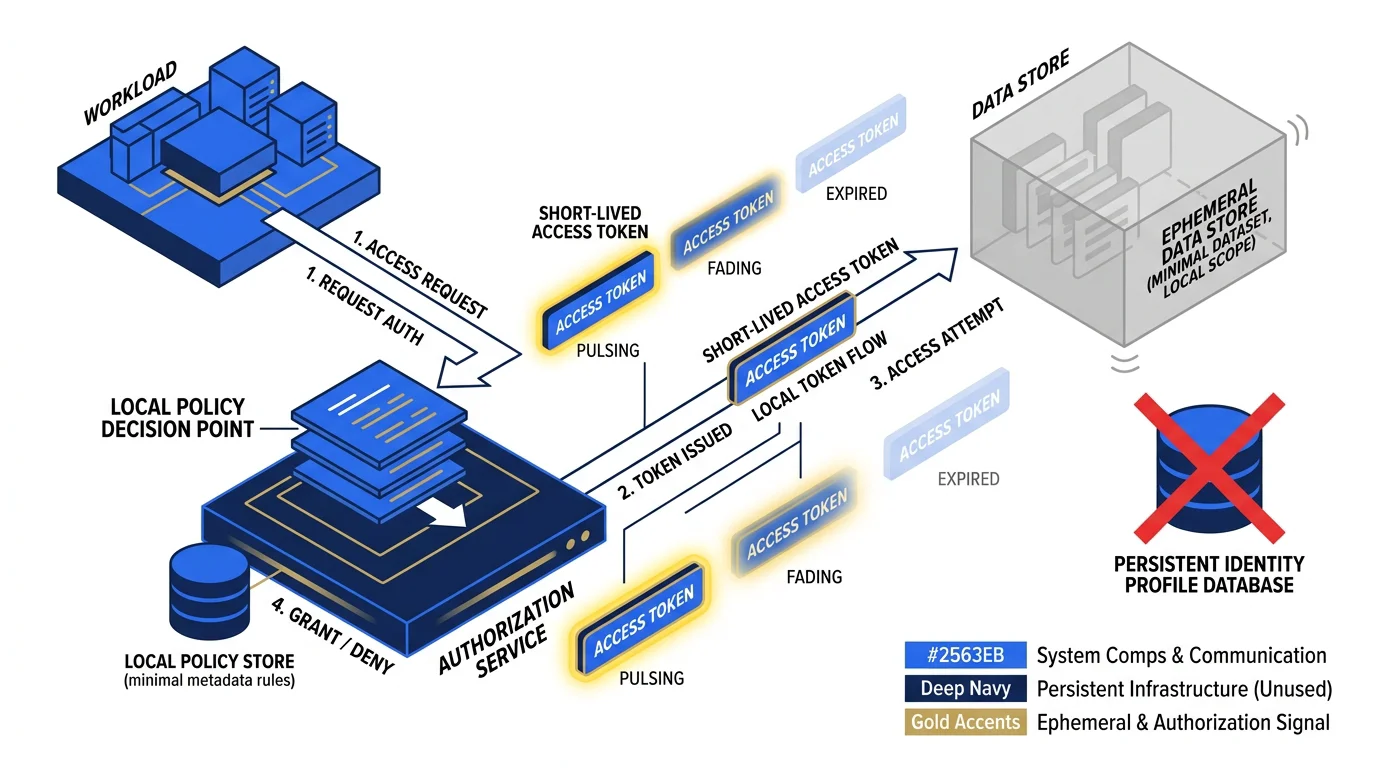
A Zero Data Protocol-aligned architecture does not compete with segmentation. It sits alongside it and constrains the data footprint of enforcement. The principle is structural: design controls so that the absence of stored personal data is a feature, not a limitation.
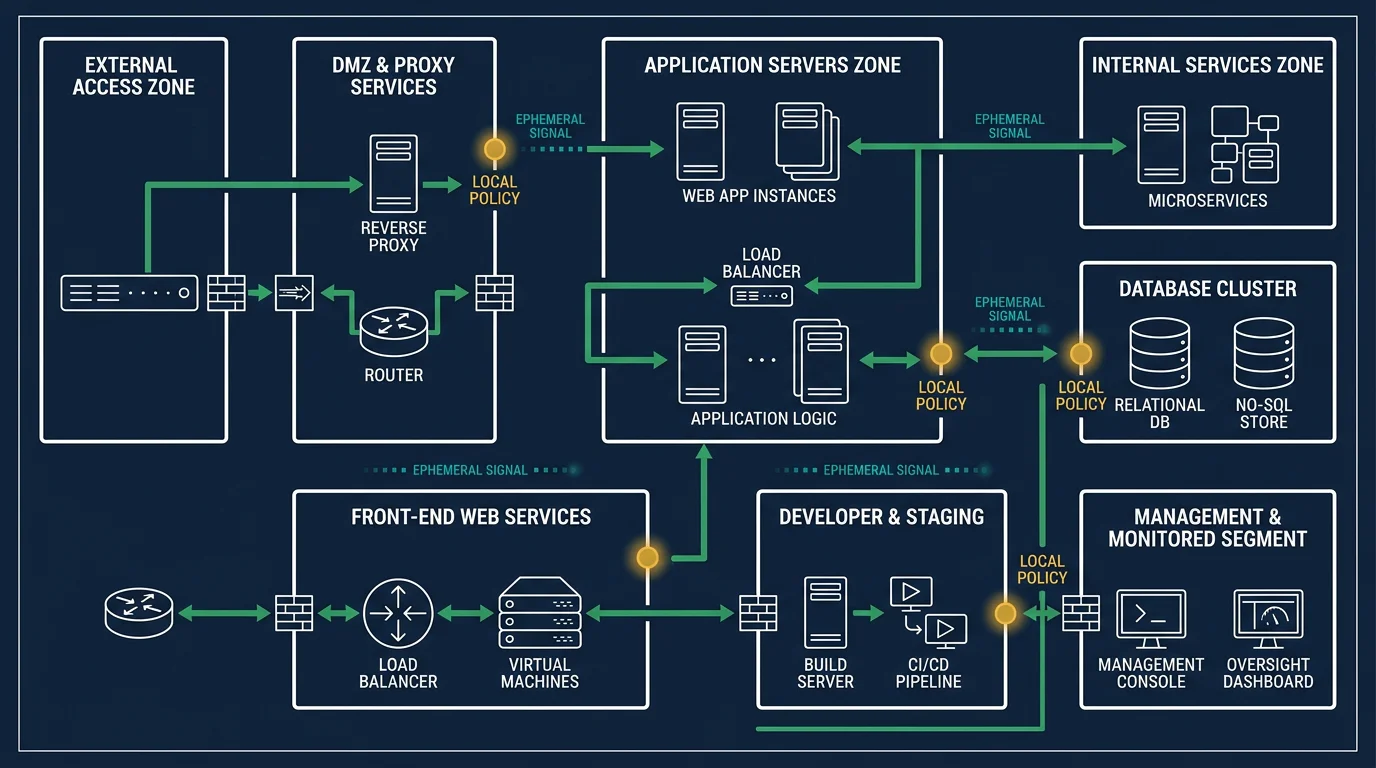
In practice, that means favoring local or ephemeral authorization over central identity stores, keeping metadata to the minimum required for a single decision, and retaining nothing beyond that decision's lifetime. Least-privilege policy still applies at the workload level. What changes is the aftermath: there is no durable profile to steal, monetize, or repurpose. We frame this as reducing what a breach can expose, rather than expanding what you must defend, which aligns with the micro-segmentation and network segmentation layers you already operate.
The goal is not to collect and protect more identity data, but to design systems that can enforce access decisions while depending on as little persistent personal data as structurally possible.
Practical use cases and honest limitations
Consider three common scenarios. In a flat network with a heavy mix of IoT and operational technology, microsegmentation is usually the primary control, because those devices cannot run agents and rarely fit a VLAN plan. A zero-data layer helps here by authorizing device flows without building a permanent behavioral dossier on each sensor.
In a compliance-driven cardholder environment, network segmentation often remains the documented boundary, with microsegmentation added for east-west coverage. For AI infrastructure handling sensitive inputs, minimizing retained metadata directly reduces the blast radius of an incident. The limitations must be stated plainly: ephemeral authorization can complicate long-term forensic analysis, some regulations expect audit trails, and identity-free enforcement is not achievable everywhere. A zero-data approach reduces persistent data; it does not eliminate the need for segmentation, logging where legally required, or sound key management.
An implementation checklist for data-minimized segmentation
Use the following sequence to layer least-privilege enforcement while limiting what your controls retain.
- Keep the macro zones you already have; do not rip out working network segmentation.
- Map east-west dependencies before writing any policy, so enforcement reflects real need.
- Classify which data each control actually requires for a single authorization decision.
- Prefer local or ephemeral authorization signals over persistent identity and telemetry stores.
- Set explicit retention limits; default to storing nothing beyond the decision's lifetime.
- Enforce in monitor-only mode first, then activate for the highest-risk asset classes.
- Review, on a schedule, whether any newly accumulated profile can be shortened or removed.
Each step keeps the containment benefits of segmentation while narrowing the personal data a compromise could reach.
Bringing the two models together
The honest answer to the difference between microsegmentation and network segmentation is that you likely need both: broad zones for structure and granular micro-perimeters for east-west control. The strategic addition for 2026 is a third consideration, namely how much personal data your enforcement must retain to work. By favoring least privilege, local or ephemeral authorization, and minimal retention, you keep the containment your organization needs while shrinking the profile a breach could expose. Start from the flows that matter most, and design so that the absence of stored data becomes an asset rather than a gap.
Take action with Zero Data Protocol
If you are designing segmentation that reduces exposure rather than accumulating more identity data, you are asking the question we were built to answer. We help enterprise architects and security teams enforce least-privilege access while removing the structural dependency on stored personal data.
Zero Data Protocol is a protocol-level architecture that eliminates personal-data dependency by design, preventing unnecessary collection, retention, and exploitation before they occur. To see how a zero-data foundation complements your microsegmentation and network segmentation layers, explore the Zero Data Protocol architecture and how structural sovereignty applies to your environment.
Frequently Asked Questions
Is microsegmentation a replacement for network segmentation?
No. Network segmentation provides broad zone boundaries, while microsegmentation enforces granular policy inside those zones. Most effective architectures layer both approaches for defense in depth rather than choosing one.
Why is east-west traffic so important in this comparison?
East-west traffic is the workload-to-workload communication that dominates modern environments and often escapes perimeter inspection. Network segmentation cannot see traffic inside a zone, whereas microsegmentation governs every internal connection, which is where lateral movement occurs.
Does microsegmentation require collecting more personal data?
Many implementations do, because identity-based policy tends to rely on persistent device inventories, user identities, and behavioral telemetry. A Zero Data Protocol-aligned design keeps least-privilege enforcement while minimizing metadata and avoiding unnecessary retention.
Can a zero-data approach still support compliance and least privilege?
Yes, within limits. Least-privilege enforcement remains fully intact, and retention is reduced to what a single decision requires. Where regulations mandate audit trails, you retain only the minimum evidence legally required rather than a durable profile.
Where should we start if our network is mostly flat today?
Begin by mapping east-west dependencies and classifying the data each control actually needs. Then add identity-aware micro-perimeters for the highest-risk assets while favoring ephemeral authorization, so containment improves without building large persistent identity stores.