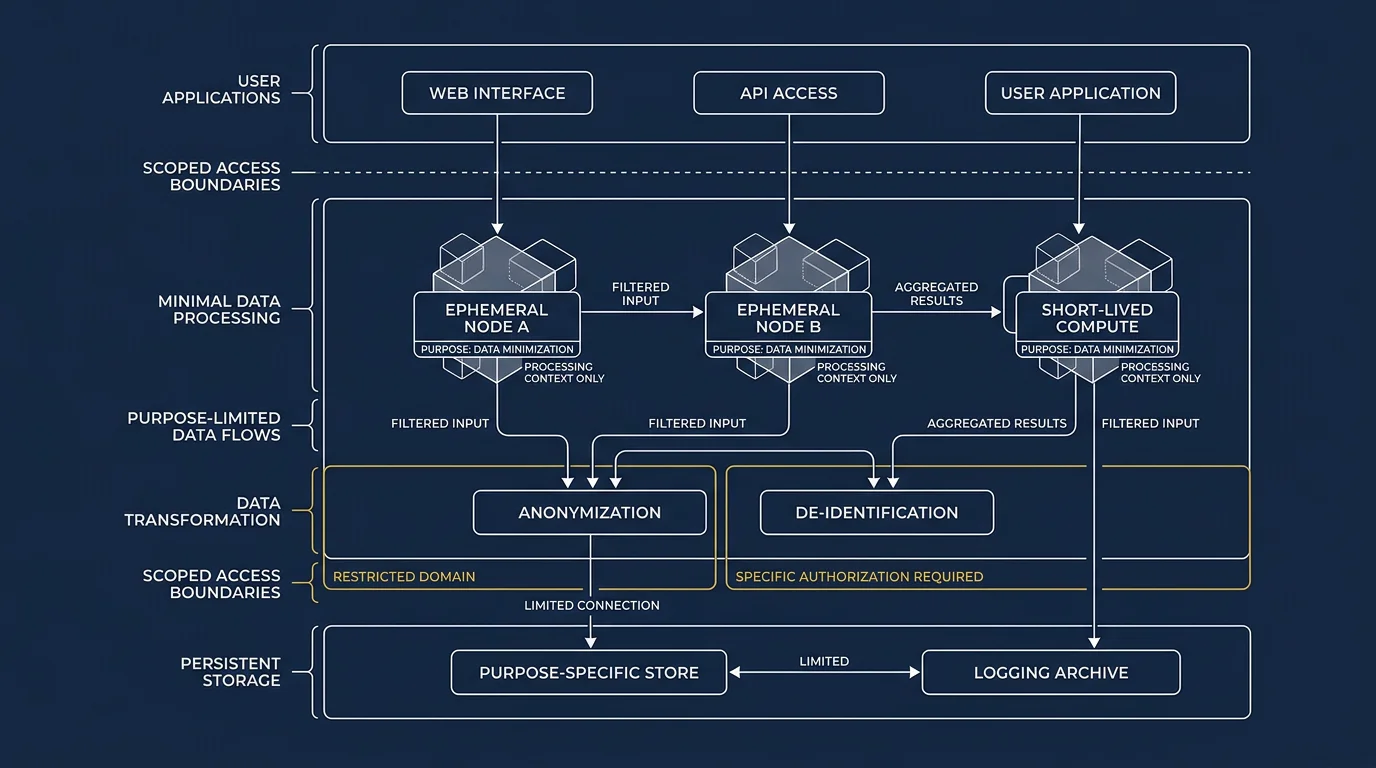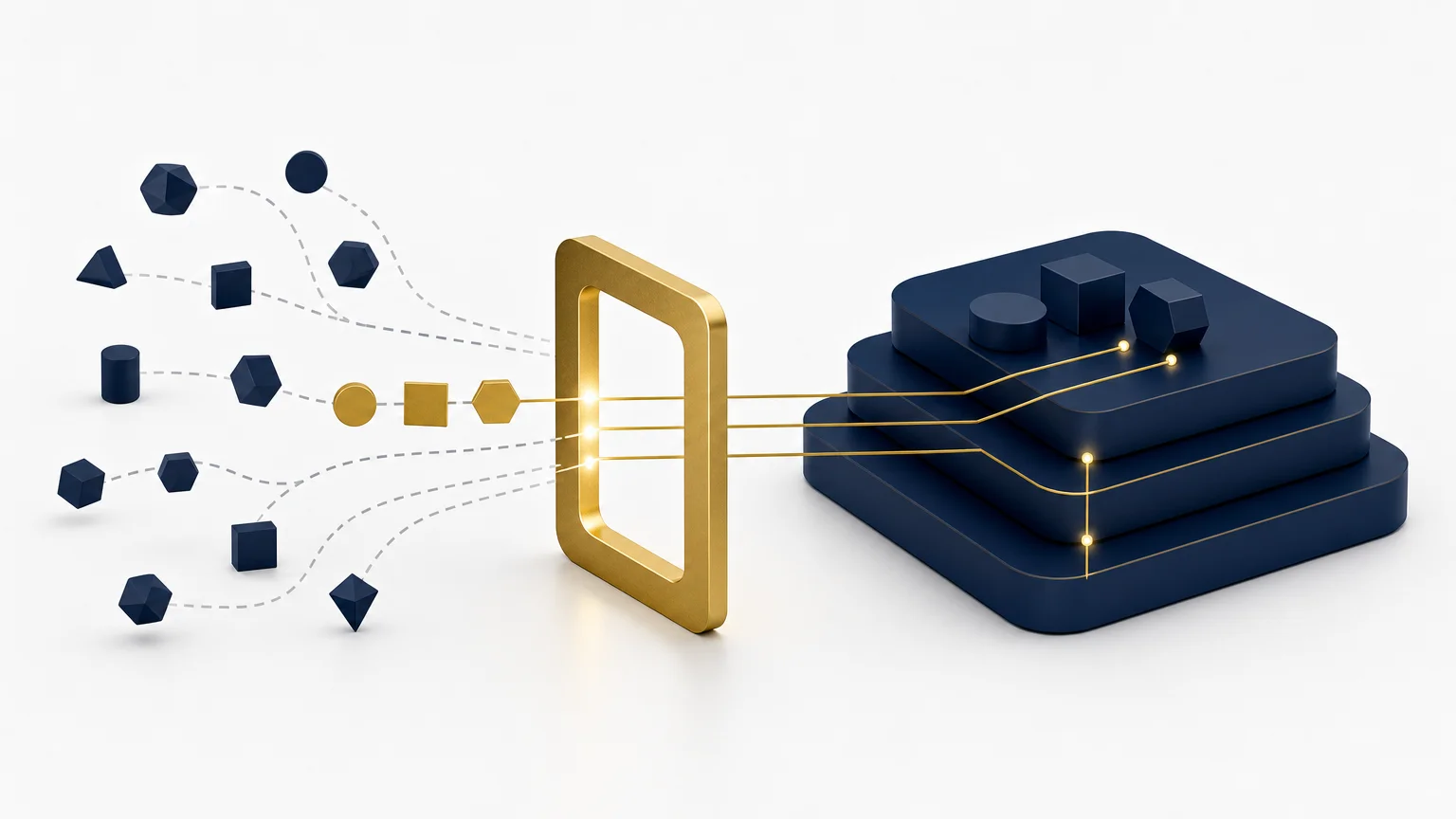

How much data should your organization collect when it can collect almost everything? The answer begins with data stewardship, not with a larger database or another policy document. It requires practical decisions about what information is necessary, who may use it, how long it should exist, and whether it may be reused. To make that principle practical, we apply our data protection by design principles to the architecture surrounding each data lifecycle.
AI makes these questions more urgent. In the 2026 UK Business Data Survey, businesses using AI reported data collection at 41%, analysis at 37%, and data sharing at 19%, with higher rates than businesses that did not use AI, according to the 2026 UK survey. Effective stewardship therefore has to protect data quality while also limiting unnecessary exposure and secondary use.
What is data stewardship?
Data stewardship is the set of roles, processes, and controls used to manage data responsibly in daily operations. It usually operates within a broader data governance program, translating policies into practical actions. Those actions include defining data quality rules, maintaining metadata, documenting lineage, classifying sensitive information, resolving inconsistencies, and supporting appropriate access.
The central objective is not simply to store data safely. It is to keep data fit for purpose. A customer record may be complete but outdated. A financial measure may be accurate in one system but defined differently in another. A dataset may be accessible to authorized users while still lacking enough context for responsible interpretation.
Stewardship addresses these problems by connecting business meaning with technical implementation. A steward may help a department agree on what “active customer” means, then work with engineering teams to ensure that definition is reflected in pipelines, catalogs, reports, and analytical models.
Good stewardship covers the full lifecycle, including:
- Data creation, collection, and ingestion
- Classification of personal, sensitive, confidential, and public information
- Data quality monitoring, validation, and remediation
- Metadata, business glossary, and reference data management
- Lineage documentation from source to destination
- Access decisions, usage monitoring, and purpose restrictions
- Retention, archiving, deletion, and defensible exceptions
This makes data stewardship both protective and enabling. It reduces the chance that poor data will distort decisions, while helping authorized users find information they can understand and trust.
How does data stewardship differ from governance and ownership?
Consider a company that adopts a policy stating that customer information must be classified, accessed according to business need, and deleted when the approved retention period ends. Governance defines that policy. Stewardship turns it into definitions, workflows, quality checks, access decisions, and documented evidence. Custodians then implement many of the technical safeguards in systems and infrastructure.
These responsibilities are related, but they are not interchangeable:
- Data governance establishes policies, standards, decision rights, and accountability structures.
- Data stewardship applies those policies through operational decisions and ongoing oversight.
- Data ownership provides strategic accountability for a data domain and approves important uses or access decisions.
- Data custodianship covers technical storage, maintenance, backups, security controls, and system administration.
For example, a data owner may approve the definition of a sensitive customer attribute. A business steward may document its meaning and acceptable uses. A technical steward may verify that the field is classified across connected platforms. A custodian may apply masking, permissions, encryption, and deletion controls.
Confusion appears when organizations assign a policy without assigning operational responsibility. A governance council may approve a standard, yet nobody monitors whether source systems follow it. Conversely, teams may make local decisions without shared governance, producing different definitions and inconsistent controls.
Clear accountability does not require every organization to create a full-time position for each task. In smaller organizations, stewardship may be distributed across analysts, engineers, compliance specialists, department leaders, and security teams. What matters is that responsibilities are explicit, documented, and reviewed.
What does a data steward do across the lifecycle?
A data steward works where business context, technical processes, and responsible use meet. The precise role varies by organization, but the work normally includes several recurring responsibilities.
Define data meaning and quality
Stewards help establish shared definitions for important fields, metrics, entities, and reference values. They also define quality dimensions such as accuracy, completeness, consistency, timeliness, validity, and uniqueness.
These definitions make quality measurable. For instance, a customer identifier may need to be unique, a transaction date may need to fall within a valid range, and a location code may need to match an approved reference list.
Manage metadata and lineage
Metadata explains what data means, where it came from, who owns it, how it changes, and where it is used. Without reliable metadata, users may find a dataset but misunderstand its origin, limitations, or permitted purpose.
Lineage adds a flow perspective. It helps teams trace an output back through transformations and source systems. This is valuable when an analytical report contains an unexpected result or when a model produces an answer based on outdated information.
Support security, privacy, and access
Stewards help classify information and apply rules for appropriate use. They may review access requests, identify sensitive fields, document purpose limitations, and coordinate with security teams when controls do not match the data risk.
Access is only one part of responsible handling. A user may be authorized to access a dataset, yet the dataset may still contain more information than the task requires. Effective stewardship therefore asks both who may access data and whether the data should be present at all.
Resolve issues and improve adoption
Stewards investigate duplicate records, missing values, conflicting definitions, broken lineage, and policy exceptions. They coordinate remediation with the teams that create, transform, store, and consume the data.
They also act as educators. When employees understand why a definition matters or why a field should not be copied into a new system, governance becomes part of normal work rather than an administrative burden.
Why should privacy-first stewardship begin before collection?

Traditional data programs often begin with information already inside the organization. Privacy-first stewardship begins with a more fundamental question: does this information need to enter the system?
This distinction matters because collection creates future obligations. Once personal or sensitive information enters a platform, teams may need to classify it, secure it, document it, answer access requests, monitor its use, control downstream sharing, and eventually delete it. Collecting less can reduce the number of decisions that must be managed later.
Zero Data Protocol presents this perspective through an emerging independent framework built on Zero Collection, Zero Retention, and Zero Exploitation. The framework is not a regulation, certification, product, or universal solution. It is an architectural way to ask whether information is necessary, whether it must persist, and whether it may be used for an unrelated purpose.
Its human consequence is Human Freedom Choice. When identity or personal data is not functionally necessary, the system should preserve the user’s freedom not to provide it. This principle is relevant to anonymous access, reduced tracking, consent, personalization, and privacy-by-design decisions.
For organizations developing this approach, our privacy engineering and data minimization blueprint provides a related way to examine necessity before data enters a processing chain. The goal is not to eliminate all data. It is to avoid creating data dependencies that do not serve a clear function.
The United States Census Bureau illustrates a similar logic in its 2026 description of privacy principles, which emphasizes necessity, openness, respect, and confidentiality. Those principles do not remove operational risk, but they show how responsible handling can begin at the point of collection rather than at the point of breach response.
What changes when AI becomes a data consumer?
AI systems consume more than approved datasets. They may process prompts, uploaded files, account information, metadata, retrieved documents, tool outputs, feedback, logs, embeddings, summaries, and action records. A data stewardship program that covers only structured databases can therefore miss important parts of the AI lifecycle.
In 2026, this issue is becoming clearer as organizations connect AI systems to business processes and external tools. Stewards should ask:
- What information enters the model or agent context?
- Which metadata persists even when request content does not?
- What connected systems can the agent query or change?
- Where are requests routed, processed, cached, or logged?
- Which outputs become reports, decisions, classifications, embeddings, or workflow records?
- Can temporary task context become session or persistent memory?
A 2026 commentary in the Journal of Medical Internet Research argues that governance may need to expand from data stewardship toward model stewardship. Its central concern is that AI training can create persistent, deployable artifacts that continue influencing future decisions after the original data use has ended.
This does not mean that every model requires the same controls. It means that stewardship should follow the consequences of data use. A dataset may be deleted from an operational store while derived outputs, model parameters, evaluation artifacts, or exported decisions remain elsewhere.
AI also changes the meaning of least privilege. Traditional least privilege limits what a user or process can access. AI-agent stewardship must additionally limit what context an agent receives, which tools it can invoke, which credentials it can use, and what actions it can perform without approval.
Data minimization and access control therefore address different risks. Least privilege limits what an agent can reach. Least data limits what information exists to be reached.
How can you build an effective data stewardship program?
A practical program should begin with a narrow scope and expand through evidence. Attempting to classify every asset, define every term, and map every lineage path at once often creates paperwork without accountability.
1. Select high-impact data domains
Start with domains where poor quality, excessive access, or unclear retention could create significant operational, privacy, security, or regulatory consequences. Common examples include customer, employee, health, financial, identity, and AI training data.
Assign a data owner and one or more stewards to each selected domain. Document the systems involved, the main users, the important definitions, and the decisions that require escalation.
2. Establish measurable quality rules
Choose a small number of quality measures that reflect actual business needs. A completeness score may matter for one dataset, while timeliness, validity, duplication, or reconciliation may matter more for another.
Each rule should have an accountable owner, a review frequency, and a remediation path. Quality metrics without action thresholds rarely improve the underlying data.
3. Create a usable metadata foundation
Record definitions, classifications, owners, permitted uses, sources, transformations, and retention expectations. A catalog can support this work, but a tool does not replace agreement about meaning or accountability.
Metadata should also cover AI-specific objects. Prompts, retrieval collections, agent memories, generated summaries, embeddings, and automated decisions may need different classifications and retention rules.
4. Connect privacy to architecture
Do not treat privacy as a notice added after system design. Determine which fields are necessary, whether identity is required, how long information should persist, and whether unrelated reuse is permitted.
Use external controls where appropriate. Permissions, network boundaries, isolation, sandboxing, credential handling, deletion workflows, and provider restrictions should not depend only on instructions inside an AI model.
5. Test deletion and exceptions
Deletion should be tested across normal requests, failures, retries, queues, timeouts, caches, backups, exports, and incident-response processes. A policy that covers only the primary database may not describe the real lifecycle.
Exceptions should be documented rather than hidden. Some records may need to remain for billing, security, legal, or operational reasons. Responsible stewardship explains those exceptions, limits their scope, and reviews them periodically.
Which data stewardship mistakes create unnecessary risk?
Many programs fail because they define stewardship as data cleanup alone. Cleanup is useful, but it does not answer whether the organization should collect the data, retain it, or reuse it for another purpose.
Assuming that access equals responsible use
Authorized access does not make every use appropriate. A team may have technical permission to view customer behavior, yet lack a legitimate reason to use it for unrelated profiling or advertising.
Treating user control as data absence
Placing information in user-controlled storage may change custody, but it does not automatically reduce volume, persistence, sensitivity, or exposure. Stewardship must still examine why the data exists and what happens downstream.
Assuming volatile processing is anonymous
Data processed in memory can remain identifiable and sensitive during the processing moment. Volatility may reduce persistence, but it does not remove access risk, inference risk, or the need for appropriate controls.
Measuring activity instead of outcomes
Counting catalog entries, completed reviews, or approved requests may show program activity. Stronger measures connect stewardship to reduced duplicate records, faster issue resolution, fewer unnecessary fields, clearer lineage, lower retention exposure, or more reliable AI outputs.
Unused data also creates ongoing cost and risk. Storage, security monitoring, access management, backup handling, discovery, and deletion obligations can continue even when nobody uses the information. Our analysis of hidden costs of unused data explores why retention should be justified rather than treated as the default.
The United Nations Statistics Division provides another useful perspective. Its working group on data stewardship addresses governance, equity and inclusion, sharing and collaboration, and a broader conceptual framework. This wider scope suggests that stewardship can involve institutional trust and responsible data relationships, not only database quality.
How should organizations balance minimization with operational needs?
Data minimization is not the same as refusing to retain information under every circumstance. Organizations may need records for security investigations, financial reconciliation, service continuity, safety, legal obligations, or accountable decision-making.
The important question is whether each exception is specific and proportionate. You should identify the purpose, define the minimum necessary fields, restrict access, set a retention period, and document what happens when the purpose ends.
There may also be a tension between short retention and operational learning. Removing logs too quickly can make debugging harder. Removing all feedback records can limit quality review. Avoiding persistent memory can reduce continuity for an AI agent.
These trade-offs should be evaluated explicitly rather than resolved through indefinite retention. Temporary task context, session memory, persistent memory, and derived memory have different benefits and risks. Each should have a separate purpose, access model, and deletion expectation.
Stewardship is strongest when it combines quality with restraint. It helps organizations retain information that has a defensible purpose while challenging collection, persistence, and reuse that merely reflect convenience.
Build stewardship around necessity and accountability
Privacy-aware data stewardship connects data quality, security, governance, and responsible use across the full lifecycle. It gives people clear responsibility for definitions, access, lineage, retention, and remediation, while recognizing that AI systems create additional contexts, outputs, and memory risks.
The most durable approach begins before collection, continues through processing and connected systems, and ends with tested deletion or a documented exception. By combining operational discipline with architectural restraint, you can make data more trustworthy without assuming that more data, longer retention, or broader access automatically creates more value.
Take action with Zero Data Protocol
If your stewardship program needs to examine more than data quality and access, consider the architectural questions behind collection, persistence, identity, connected systems, and secondary use. Zero Data Protocol presents an independent framework for evaluating those decisions through Zero Collection, Zero Retention, and Zero Exploitation.
To connect stewardship with privacy-first system design, explore our zero-data architecture for responsible data stewardship. The framework does not replace governance, legal advice, security engineering, or operational judgment. It provides a structured way to assess whether personal data is necessary, how long information should remain, and whether system design can preserve meaningful user choice.
Frequently Asked Questions
What is the main purpose of data stewardship?
The main purpose is to keep data accurate, understandable, secure, accessible to authorized users, and appropriate for its intended purpose. Stewardship also creates accountability for data quality, lineage, access, retention, and remediation.
Is data stewardship the same as data governance?
No. Data governance establishes policies, standards, and decision rights, while data stewardship applies those policies through daily operational work. The two functions are complementary and should share clear accountability.
Can one person be responsible for data stewardship?
One person can coordinate stewardship for a small domain, but effective programs usually require collaboration across business, technical, security, privacy, and compliance roles. The key requirement is clear responsibility rather than a particular organizational structure.
How does data stewardship apply to AI agents?
It applies to prompts, metadata, retrieved content, connected systems, tool permissions, logs, outputs, and different forms of agent memory. A responsible program also examines whether derived information or automated decisions persist after the original task ends.
How does Zero Data Protocol relate to data stewardship?
Zero Data Protocol is an emerging independent architectural framework, not a regulation, certification, product, or guarantee. Its Zero Collection, Zero Retention, and Zero Exploitation principles can help you examine necessity, persistence, secondary use, and the preservation of Human Freedom Choice.