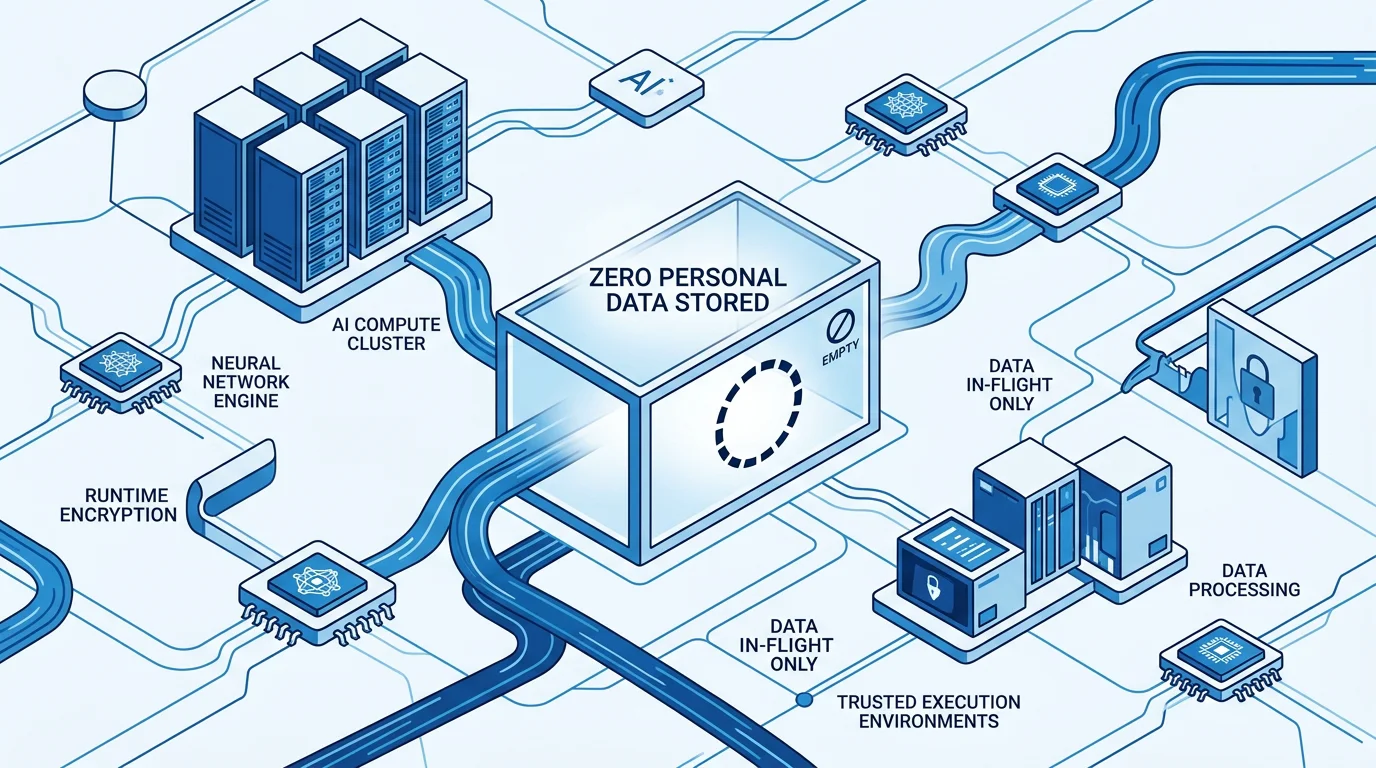

What would change if privacy were treated as an architectural requirement instead of a policy document? Data protection by design asks that question at the earliest stage of a system, from the fields collected to the data that remains after a task ends. Our Zero Data Architecture framework develops this perspective by examining whether personal information needs to enter a system at all.
For organizations subject to the GDPR, data protection by design and by default is a legal obligation under Article 25. The European Commission guidance explains that safeguards should be built into processing from the beginning, with only necessary data processed by default. In 2026, this principle also applies to AI systems, connected enterprise tools, metadata, and persistent agent memory.
What does data protection by design require?
What should a team decide before collecting its first personal data field? It should define the purpose, identify the minimum information needed, assess risks to individuals, and determine how the system will protect, limit, and eventually remove that information.
Data protection by design is therefore a method of making privacy part of requirements engineering. It affects product scope, database structure, identity flows, application programming interfaces, access rules, logging, vendor selection, retention schedules, and deletion procedures.
The principle is broader than encryption. Encryption protects information from unauthorized reading, but it does not decide whether the information should have been collected. A well-designed system asks both questions: how can necessary data be protected, and why does this data need to exist?
For organizations subject to the GDPR, Article 25 requires appropriate technical and organizational measures. These measures must account for the state of the art, implementation costs, processing context, purposes, and risks to people’s rights and freedoms. The obligation is risk-based, so the appropriate design will differ between a public information service, a healthcare application, and an AI assistant handling confidential documents.
The concept also covers the complete data lifecycle. A design review should consider collection, transmission, processing, temporary storage, persistent storage, sharing, analysis, archival, deletion, backups, caches, queues, and incident-response copies.
In its 2022 ENISA engineering report, the European Union Agency for Cybersecurity connected data protection by design with practical technologies and techniques. It highlighted challenges such as limited transparency, reuse, inference, re-identification, profiling, and automated decision-making.
Why does privacy by default change the system?
Consider a customer account form that requests a full birth date, home address, employer, phone number, and marketing preferences before the user can access a basic service. The system may have a privacy policy, but its default behavior still creates unnecessary exposure.
Privacy by default changes that starting position. The system should process only the personal data necessary for each defined purpose. Optional fields should remain optional, sharing should not be preselected, retention should be limited, and access should be restricted to people or services with a legitimate need.
Defaults matter because many users do not inspect every setting. A privacy-friendly architecture should not depend on constant vigilance, technical expertise, or repeated refusal. It should make the protective choice the ordinary choice.
This does not mean that every system must operate anonymously. Some services need identity for payments, regulated access, fraud prevention, safety, or continuity. Data protection by design requires a clear connection between the identity collected and the function it enables.
Where identity is not functionally necessary, Human Freedom Choice becomes relevant. This principle expresses the human consequence of minimization: people should retain the freedom not to provide personal information when the service can work without it.
Practical design decisions may include optional accounts, unlinkable session identifiers, local processing, selective disclosure, pseudonymous credentials, short-lived tokens, and separate storage for account data and task content. These patterns do not eliminate every risk, but they reduce unnecessary identity dependency.
Privacy by default also supports clearer consent and user control. Consent is more meaningful when the system does not collect excessive information first and explain its use later. A protective default cannot replace a lawful basis, transparent notice, or rights process, but it can reduce the amount of information that those processes must govern.
How does Zero Data Protocol extend the architecture?
A conventional privacy review often begins after a system has already been defined. Zero Data Protocol starts with a more structural question: does this information need to exist within the architecture at all?
We present Zero Data Protocol as an emerging independent framework built on three directions: Zero Collection, Zero Retention, and Zero Exploitation. It is not a regulation, certification, product, official standard, or guarantee. It is a way to examine how data enters a system, how long it remains, and whether it is reused for unrelated purposes.
Zero Collection asks whether each field, file, prompt, identifier, metadata element, and connected data source is necessary. If it is not necessary for a clear function, the system should not ingest it by default.
Zero Retention asks whether information must persist beyond the operational moment. A request may need to be processed without becoming a permanent record. This requires attention to temporary task context, session memory, logs, queues, retries, backups, caches, and incident-response systems.
Zero Exploitation asks whether information supplied for one legitimate purpose is later used for profiling, advertising, unrelated model training, behavioral targeting, or another secondary purpose. Purpose boundaries should remain visible and enforceable.
This broader scope distinguishes data protection by design from a narrow storage decision. A system can avoid retaining one category of request content while still collecting extensive metadata, retaining account records, accessing connected enterprise systems, or producing sensitive derived information.
Our AI agent data minimization guidance applies this reasoning to agents that retrieve information, use tools, take actions, and maintain memory. It encourages teams to review submitted content, metadata, provider routing, permissions, connected systems, outputs, summaries, embeddings, and exported workflow results.
The framework also recognizes a practical tension. Removing data can affect debugging, abuse investigation, quality review, personalization, and operational continuity. The answer is not to claim that all retention is harmful, but to define what is necessary, document the reason, limit access, and set an appropriate lifecycle.
Which controls make privacy principles enforceable?
The most effective design is not a promise made by an application. It is a set of controls that continues to operate when users make mistakes, services fail, providers change, or data moves through connected systems.
Start with data minimization at the collection boundary. Use field-level requirements, input filtering, redaction, selective disclosure, and local processing where appropriate. Do not send a complete record to an AI model when a smaller, purpose-specific context will perform the task.
Next, separate data according to function and sensitivity. Account information, billing records, authentication events, task content, security logs, derived outputs, and operational metadata should not automatically share one storage location or one access policy.
Access controls should apply the principle of least privilege. Users, services, agents, and vendors should receive only the permissions required for a defined task. Permissions should be time-limited where possible, reviewed regularly, and revoked when the task ends.
Security controls should also exist outside the model or application instructions. Network boundaries, sandboxing, credential isolation, approval gates, encryption, key management, rate limits, and monitoring can reduce the consequences of an incorrect instruction or compromised component.
Privacy-enhancing technologies can support these objectives. The 2026 GAO technology assessment explains that privacy-enhancing technologies may reduce risks linked to collecting, using, and sharing personal data. It also notes that some techniques require more time, resources, specialist skills, and implementation guidance than traditional controls.
Our zero-retention analysis treats retention as one architectural control rather than a complete security strategy. A zero-retention setting for a particular content type does not mean that no information exists elsewhere. Account, billing, configuration, security, aggregated operational, connected-source, and derived records may still persist.

How can you apply the approach to AI systems?
An AI assistant can create privacy risk before it produces an answer. A user may submit excessive context, a connector may retrieve unrelated records, metadata may reveal identity, and an agent may preserve a summary after the original request disappears.
Begin with the request boundary. Identify what the model actually needs to complete the task. Remove unnecessary names, identifiers, full documents, account histories, and sensitive details before inference whenever the function allows it.
Then map the complete AI data path. The review should cover the application, model provider, monitoring service, content filters, retrieval system, vector store, tool layer, connected enterprise systems, audit records, backups, and derived outputs.
Memory requires separate treatment. Agent memory may include temporary task context, session memory, persistent memory, or derived memory. Each category should have a defined purpose, owner, retention period, access rule, deletion behavior, and user-control mechanism.
Do not assume that volatile processing is automatically anonymous. Information can remain identifiable and sensitive while held in memory or processed in RAM. Similarly, user-owned storage can provide custody benefits without proving that the data is necessary, minimized, unlinkable, or free from secondary use.
Our GenAI privacy risks and safeguards material addresses these questions through a lifecycle perspective. It emphasizes that model instructions alone cannot establish complete security when agents can access credentials, networks, tools, or external data sources.
A practical assessment can follow five stages:
- Define necessity: document the purpose and identify the minimum data required.
- Reduce exposure: minimize prompts, retrieved records, identifiers, metadata, and tool permissions.
- Control persistence: distinguish temporary context from session, persistent, and derived memory.
- Restrict reuse: prevent unrelated profiling, advertising, training, or secondary activation.
- Test deletion: verify behavior across normal requests, failures, retries, timeouts, queues, caches, backups, and incident paths.
Evidence matters as much as design intent. In 2026, an ISACA privacy study reported that 58 percent of respondents said their organizations always or frequently practiced privacy by design when building new applications or services. That figure was 62 percent in 2025, suggesting that recognition of the principle does not automatically produce consistent implementation.
Organizations should therefore connect design reviews to measurable controls. Useful evidence includes data maps, retention configurations, access logs, deletion tests, vendor records, model-use registers, privacy impact assessments, exception approvals, and periodic reassessments.
Build privacy into the system’s structure
Data protection by design is most effective when it changes architecture before unnecessary information is collected. It combines purpose definition, minimization, protective defaults, access control, security engineering, lifecycle management, transparency, and user choice. For AI systems, the same discipline must extend to prompts, metadata, tools, connected sources, memory, logs, and derived information. You should treat Zero Collection, Zero Retention, and Zero Exploitation as useful design questions, while continuing to assess legal duties, operational needs, residual risks, and the safeguards required for your context.
Take action with Zero Data Protocol
If your organization is reviewing an AI workflow, digital service, or connected data architecture, you need more than a retention setting or a privacy statement. You need a clear way to examine what enters the system, what remains available, and what may be reused.
We provide an independent architectural framework that connects Zero Collection, Zero Retention, Zero Exploitation, data lifecycle analysis, and AI-agent security questions. Explore our zero-data architecture approach to support clearer system boundaries, reduced personal-data dependency, and more deliberate decisions about identity, memory, access, and secondary use.
Frequently Asked Questions
What is data protection by design?
Data protection by design means embedding privacy and data protection measures into systems, services, and processes from the planning stage. It covers collection, processing, access, sharing, retention, deletion, and user control.
Is data protection by design required by the GDPR?
Article 25 of the GDPR requires controllers to implement data protection by design and by default when determining processing means and during processing. The specific measures depend on the processing context, available technology, cost, and risks to people’s rights and freedoms.
What is the difference between privacy by design and privacy by default?
Privacy by design concerns how privacy is built into the system’s architecture and lifecycle. Privacy by default concerns the protective settings and processing choices that apply automatically, including limited collection, access, sharing, and retention.
How does Zero Data Protocol relate to data protection by design?
Zero Data Protocol is an emerging independent framework that applies Zero Collection, Zero Retention, and Zero Exploitation to digital architecture. It is not a regulation, certification, product, or guarantee, and it does not replace legal advice or a complete security program.
Does zero retention mean that no data exists anywhere?
No. Zero retention usually concerns a defined category of information and a defined processing path, while account, billing, security, configuration, metadata, connected-source, backup, or derived records may remain. A reliable review must state the scope, exceptions, lifecycle, and deletion behavior clearly.