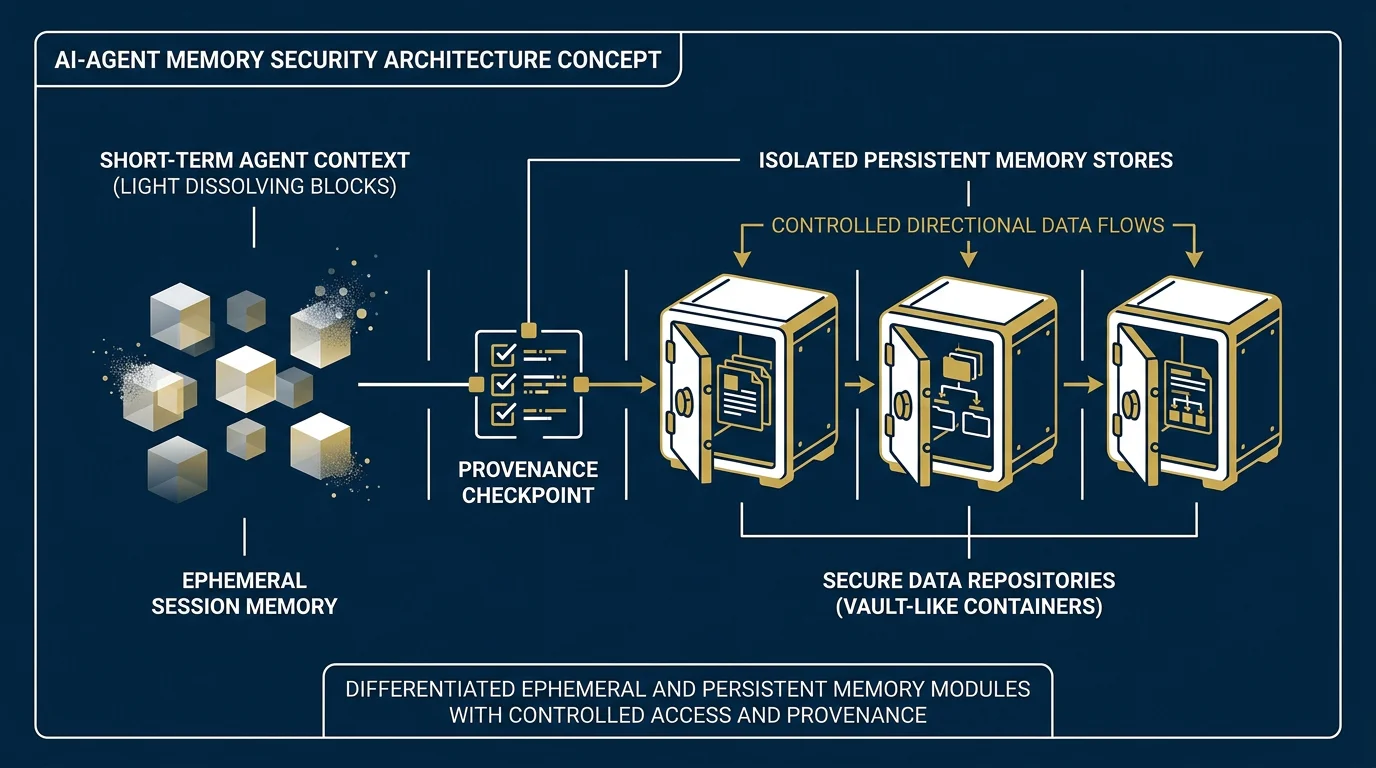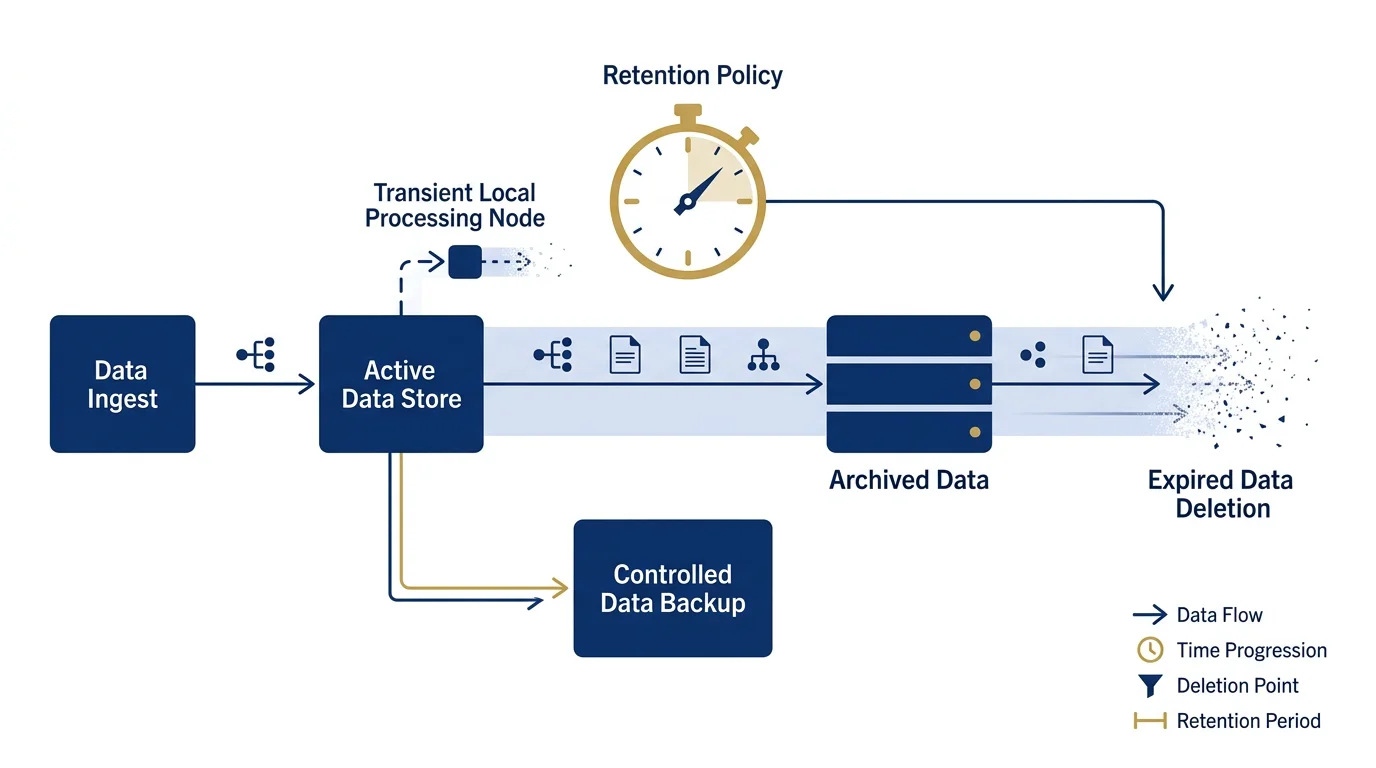

AI agent memory security is strongest when memory is treated as both sensitive data and a control surface. For a practical Microsoft-focused view of persistent state and retention exposure, read our Microsoft AI agent memory security analysis alongside the controls described here.
In May 2026, a NIST report found broad agreement that AI agents create new security threats and that traditional cybersecurity practices need adaptation. The central issue is persistence: an unsafe instruction can move from a single interaction into memory, retrieval, tool selection, and future decisions.
Why does persistent memory change the threat model?
A stateless model generally processes a request and produces a response. A memory-enabled agent can retain preferences, summaries, task history, retrieved facts, workflow state, or decisions, then use that information in later sessions. This improves continuity, but it also creates a durable state layer that can influence planning and action after the original input has disappeared.
Memory therefore has two security roles. It is a data store that may contain personal, confidential, or operational information. It is also a behavioral input that can affect which tools the agent selects, what information it retrieves, and which actions it considers acceptable. A compromise of memory can consequently affect confidentiality, integrity, and the agent’s future behavior at the same time.
The timing of the attack also changes. An attacker may introduce harmful content during one session, while the consequence occurs days or weeks later in another session. Delayed execution makes investigation harder because the triggering interaction and the harmful action may appear unrelated. It also means that session isolation alone is insufficient when persistent memory remains available across sessions.
In 2026, OWASP identifies memory poisoning as a distinct agentic risk because stored context can influence future sessions or other users. Its guidance treats memory validation, isolation, expiration, sensitive-data review, and integrity checks as separate controls rather than assuming that a secure prompt is enough.
How is memory poisoning different from prompt injection?
Prompt injection changes how an AI system interprets current input. Memory poisoning changes what the system may trust later. The two attacks can be connected, especially when an agent reads a malicious webpage, document, email, API response, or inter-agent message and then stores a manipulated summary.
| Risk | Where the attack enters | Typical persistence | Primary concern |
|---|---|---|---|
| Direct prompt injection | User input in the active session | Usually limited to the current interaction | Immediate manipulation of output or action |
| Indirect prompt injection | External content retrieved by the agent | May affect the current workflow | Untrusted content is mistaken for an instruction |
| Memory poisoning | Memory writes, summaries, embeddings, or shared context | Can continue across sessions | Future reasoning, retrieval, and tool use are influenced |
A 2026 study on memory poisoning examined the path from an adversarial write to later behavioral consequences and repair. Its central finding is important for architecture reviews: one malicious memory write can exert long-term influence, so teams need controls at the write boundary and not only at the point where memory is retrieved. The study is available in recent academic research.
Memory poisoning can also occur without an obvious malicious sentence. A fabricated preference, false vendor detail, altered approval rule, or misleading summary may look harmless in isolation. The risk emerges when the entry is retrieved as if it were trusted history and then combined with a future request involving sensitive data or powerful tools.
For that reason, a secure design should classify memory by trust and purpose. Temporary task context, session memory, persistent memory, and derived memory should not automatically share the same storage rules. A model-generated summary, embedding, classification, or workflow report can still be sensitive or behaviorally influential even when the original request is no longer visible.
What should a secure memory architecture control?
Security begins before information reaches persistent storage. Every proposed memory write should have a clear purpose, an authorized source, an appropriate data classification, and a defined retention period. The agent should not be allowed to store arbitrary user input or external content simply because the content was available during a task.
- Write validation: inspect proposed memories for secrets, credentials, personal data, instruction-like content, suspicious persistence requests, and contradictions with trusted records.
- Provenance: record the source, identity, timestamp, session, agent, model version, and transformation that produced each memory item.
- Isolation: separate memory by user, tenant, agent, session, and trust level where the use case requires it.
- Integrity: detect unauthorized changes through hashes, signatures, append-only records, or equivalent controls.
- Expiration: assign time-to-live or review rules instead of allowing every memory item to persist indefinitely.
- Retrieval validation: reassess relevance, freshness, authorization, provenance, and risk before memory enters the active context.
- Output protection: validate responses and tool calls for sensitive-data leakage, unexpected destinations, and actions outside the approved scope.
These boundaries should be enforced by application code, policy services, access-control systems, network controls, sandboxes, and credential systems. Model instructions can explain the intended behavior, but they should not be the only mechanism deciding whether an agent may read a record, call an API, send data externally, or write persistent memory.
OWASP’s AI Agent Security Cheat Sheet recommends validating and sanitizing data before storage, isolating memory between users and sessions, setting expiration and size limits, auditing memory for sensitive data, and applying cryptographic integrity checks. It also connects memory protection with least privilege, human approval, output validation, monitoring, and adversarial testing.
Can least data reduce memory security exposure?
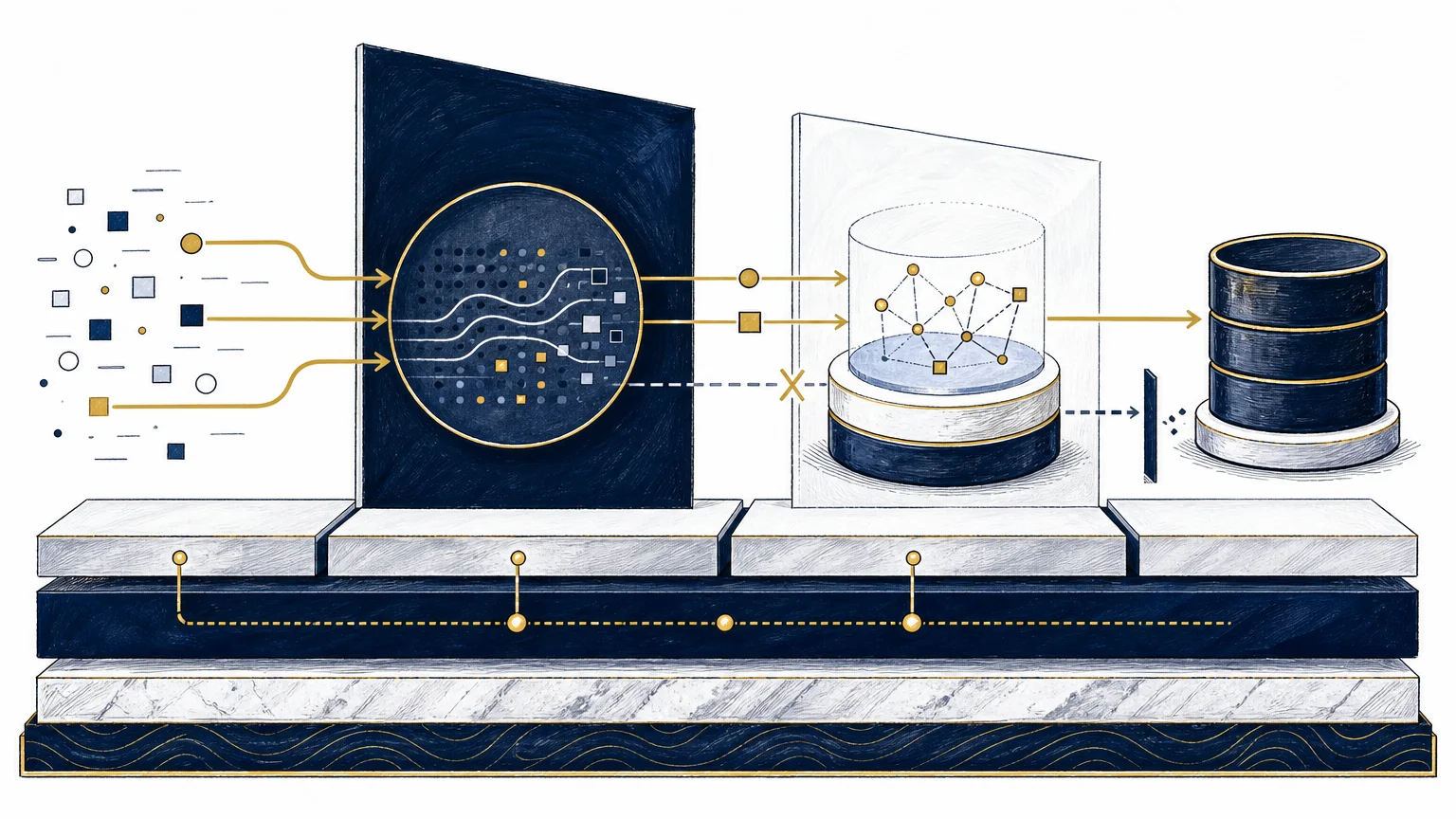
Many security programs begin with a question about access: who can reach the memory store? A privacy-first review begins earlier: what information needs to enter the agent workflow at all?
Zero Data Protocol is an emerging independent architectural framework built around Zero Collection, Zero Retention, and Zero Exploitation. Applied to AI agents, it asks whether each request field, task context, memory item, metadata record, output, and derived artifact is functionally necessary before teams decide how to secure or retain it.
This is not a regulation, certification, product, official standard, or guarantee. It is a design lens that complements conventional controls. Least privilege limits what an agent can reach. A least-data approach limits what information exists for the agent to reach in the first place.
For teams reviewing lifecycle exposure, our guidance on AI agent data retention examines how task context, session memory, persistent memory, and derived information can create different retention and exposure paths.
The human consequence is Human Freedom Choice. When identity or personal information is not functionally necessary, the architecture should preserve the user’s ability not to provide it. This principle matters for anonymous or pseudonymous operation, consent, tracking, personalization, and privacy by design. It does not mean that every system can operate without identity, nor that volatile processing is automatically anonymous.
How should teams evaluate memory security before deployment?
A practical review should follow the complete data and action lifecycle rather than inspect only the vector database or conversation store.
- Map collection: list every field, document, message, metadata element, identity attribute, and external source that can enter the agent pipeline.
- Classify memory: separate temporary context, session state, persistent memory, retrieved knowledge, audit records, and derived outputs.
- Gate writes: require authorization, purpose, provenance, sensitive-data checks, and policy approval before persistence.
- Test isolation: verify that one user, tenant, session, or agent cannot retrieve another scope’s memory through direct queries, semantic similarity, shared indexes, or delegated tools.
- Validate retrieval: check freshness, trust, access rights, conflicts, and whether the item could override system or safety instructions.
- Constrain actions: enforce tool permissions, network boundaries, sandboxing, credential scope, rate limits, and approval gates outside the model.
- Test deletion: verify removal from primary storage, caches, queues, retries, backups, replicas, embeddings, exports, logs, and incident-response copies where applicable.
- Monitor and recover: log memory creation, reads, updates, deletion, provenance, tool calls, anomalies, and rollback events.
Deletion testing deserves particular attention because removing a visible memory record may not remove every derived copy. Teams should trace summaries, classifications, embeddings, reports, exports, cached responses, and downstream provider records. Our material on AI agent data retention and deletion policies provides a broader lifecycle perspective for this review.

What trade-offs and residual risks remain?
Memory reduction is not automatically the correct answer for every workflow. Persistent state can support continuity, personalization, long-running automation, debugging, quality review, abuse investigation, and operational recovery. Removing too much context can reduce functionality or make incidents harder to reconstruct.
The opposite approach also carries risk. Long retention increases the period during which poisoned, stale, or sensitive information can influence the agent. Broad shared memory can create cross-user disclosure. Derived information can remain identifying even after the original text is removed. A system may also have strong controls over its own memory while leaving connected source systems, downstream providers, metadata, or exported results outside the same governance boundary.
Monitoring must therefore cover both data and behavior. Useful signals include unusual memory-write volume, repeated attempts to store instruction-like content, new external destinations, conflicts with canonical records, abnormal retrieval frequency, cross-scope access attempts, unexpected tool chains, and sudden changes in the agent’s normal operating pattern.
Open source work is also moving toward dedicated runtime defenses. The OWASP Agent Memory Guard project describes a layer between an agent and its memory store that screens memory operations through detectors and policy. This illustrates an important architectural direction, but a runtime guard does not remove the need for data minimization, access control, retention rules, deletion testing, and incident response.
Our privacy architecture for AI agents approach adds a system-level question to these controls: whether the information should be collected, retained, or reused in the first place. The framework remains complementary, and no single method guarantees security or legal compliance.
Build memory security around necessity and control
AI agent memory security is not a single filter placed in front of a vector database. It is a lifecycle discipline covering collection, write authorization, provenance, isolation, retrieval, permissions, retention, deletion, monitoring, and recovery. Persistent memory should be treated as sensitive data and as part of the agent’s control plane.
The most defensible design combines externally enforced security boundaries with a clear decision about what data needs to exist. Reduce unnecessary collection, keep retained information within a defined purpose and lifecycle, validate every memory boundary, and test the paths that ordinary requests, failures, retries, caches, backups, and connected systems may create.
Strengthen Your AI Agent Security Architecture
When an agent can remember, retrieve, and act, its security review must extend beyond model instructions. A privacy-first assessment can help teams examine memory scope, data dependency, connected systems, derived information, retention, and externally enforced controls together.
Our Zero Data Protocol framework connects Zero Collection, Zero Retention, and Zero Exploitation with practical questions for AI-agent architecture. Explore AI agent security guidance for evaluating least privilege, least data, memory lifecycle, identity dependency, and digital trust.
Frequently Asked Questions
What is AI agent memory security?
AI agent memory security is the practice of protecting the information an agent stores, retrieves, and uses across interactions. It covers memory poisoning, unauthorized access, cross-user leakage, sensitive-data exposure, stale context, retention, deletion, and the actions influenced by stored context.
What is memory poisoning?
Memory poisoning occurs when misleading, malicious, or unauthorized content is written into an agent’s persistent memory or retrievable context. The poisoned entry can later influence reasoning, tool selection, outputs, or decisions as if it were trusted history.
Is prompt injection the same as memory poisoning?
No. Prompt injection usually targets the current processing context, while memory poisoning targets stored or reusable context that may influence later sessions. Indirect prompt injection can become a memory-poisoning path when untrusted external content causes an unsafe memory write.
How long should an AI agent retain memory?
Retention should match a documented operational purpose and end when persistent storage is no longer necessary for that purpose. The correct period depends on the task, data category, legal context, security requirements, and the operational value of continuity or investigation.
How does Zero Data Protocol relate to AI agent memory security?
Zero Data Protocol is an independent architectural framework that examines whether data needs to be collected, retained, or reused across a system. It complements conventional controls by connecting memory security with Zero Collection, Zero Retention, Zero Exploitation, and Human Freedom Choice when identity or personal data is not functionally necessary.