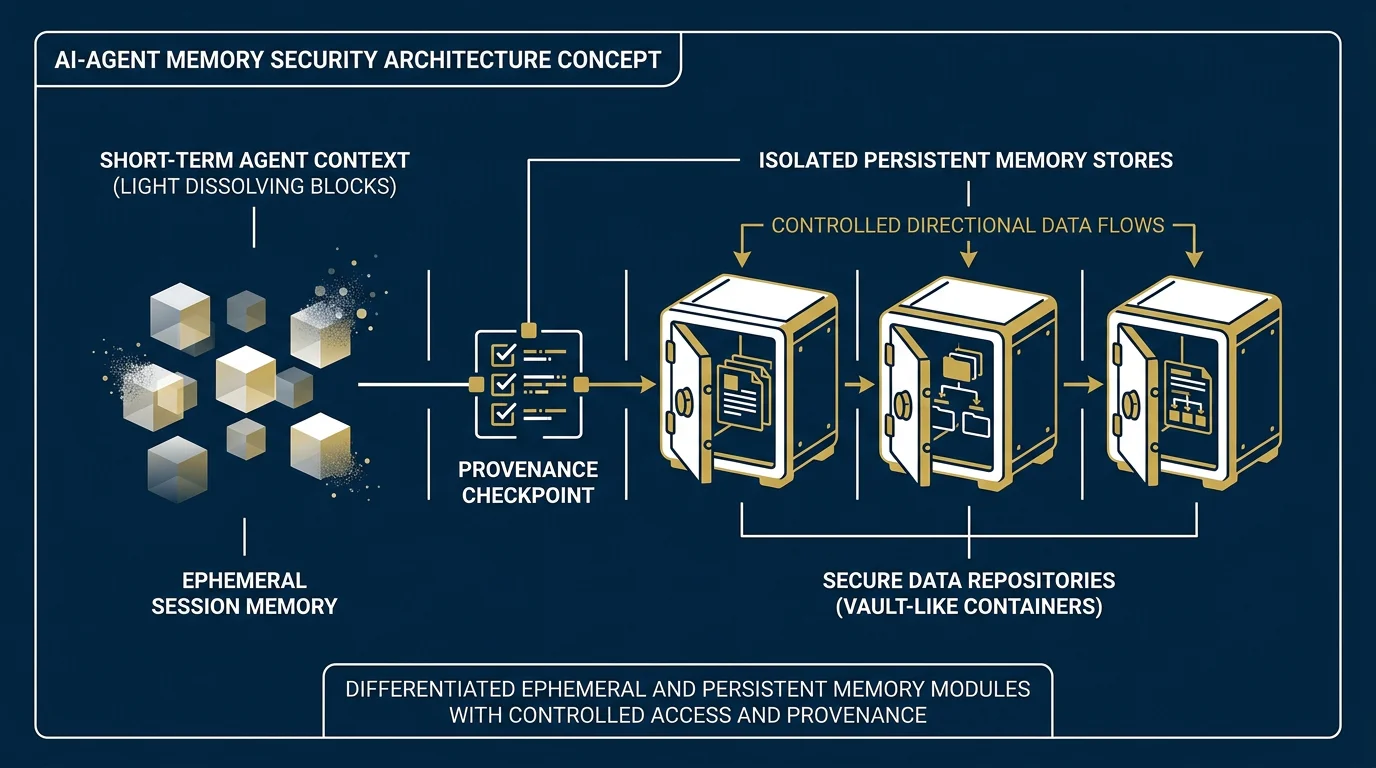

What happens to your organization when an AI assistant remembers the wrong thing? Persistent memory converts a single manipulated input into a durable liability that resurfaces sessions later. As agents evolve from stateless chat into learning collaborators, the discipline of Microsoft AI agent memory security has become a board-level concern rather than a niche engineering detail. Before you scale agents across a tenant, it is worth reviewing How to manage retention for safer AI agent memory.
The threat is no longer hypothetical. According to Microsoft red-teaming research published in June 2026, memory poisoning was observed at high frequency and frequently combined with cross-domain prompt injection during a full year of adversarial testing. A single successful injection can seed persistent memory that the agent then propagates across later, unrelated conversations.
Why Persistent Memory Becomes a Security Surface
Memory is what allows an agent to improve with use. It retains preferences, records task outcomes, and builds durable domain knowledge across sessions. That persistent state is also precisely what expands the attack surface. In a stateless interaction, the direct effect of a prompt injection is generally bounded to the current context unless the application writes state elsewhere; in a memory-enabled system, the malicious content waits in storage to be retrieved later.
Academic work confirms this shift. A 2026 systematic study of memory poisoning presented at an ICML workshop describes how adversarial content can enter, propagate, and persist inside agent memory, creating a new class of vulnerability with no principled defense baseline yet established. The core problem is trust: an agent treats its own stored memories as legitimate history, so poisoned entries flow straight into its reasoning chain.
Anatomy of a Memory Poisoning Attack
Consider a delayed-execution scenario. A user opens a shared document containing hidden instructions intended for an AI assistant. Nothing visible happens. Days later, in an unrelated conversation, those dormant instructions trigger and cause the assistant to write attacker-defined content into memory. The power of the attack lies in the temporal gap between exposure and execution, which lowers defenses and complicates forensics.
This class of manipulation is now catalogued in threat frameworks. As reported by Microsoft, the MITRE ATLAS knowledge base classifies the behavior as AML.T0080: Memory Poisoning, and researchers have documented a commercial variant. In a Microsoft investigation into AI Recommendation Poisoning, hidden prompts pushed assistants to treat specific companies or services as trusted, influencing later recommendations in domains where accuracy genuinely matters, such as health and finance.
How Microsoft Frames Memory Security for AI Agents
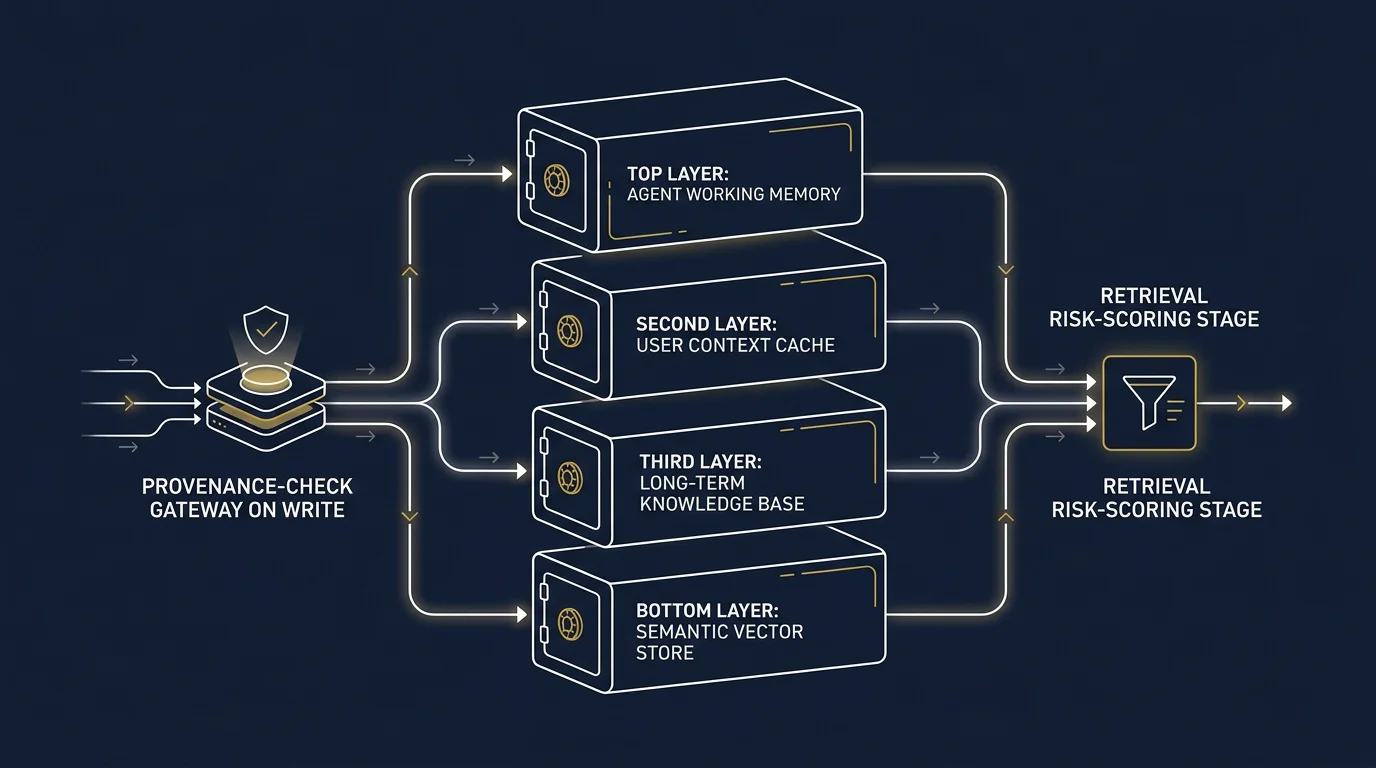
Microsoft applies a defense-in-depth model spanning storage, retrieval, model interaction, and user control. Several design principles anchor that approach. Memory should carry clear provenance and reflect legitimate user intent before it is ever persisted. Access boundaries should be enforced by deterministic systems outside the model, because prompting alone is not a reliable security boundary. Retrieval itself is treated as a risk decision, since content that was safe to store may become stale or tampered over time.
Two further pillars complete the framework: full lifecycle visibility for security teams and meaningful user control to review, edit, and delete memory. In its agentic guidance, Microsoft also emphasizes agent identity and role-based access control for multi-agent environments. These map cleanly to a principle you can act on today, which we describe as Least privilege and least data to reduce agent-memory risk. Scoped identity limits what any single agent may read or write, containing the blast radius of a poisoned entry.
From Least Privilege to Least Data to Zero Retention
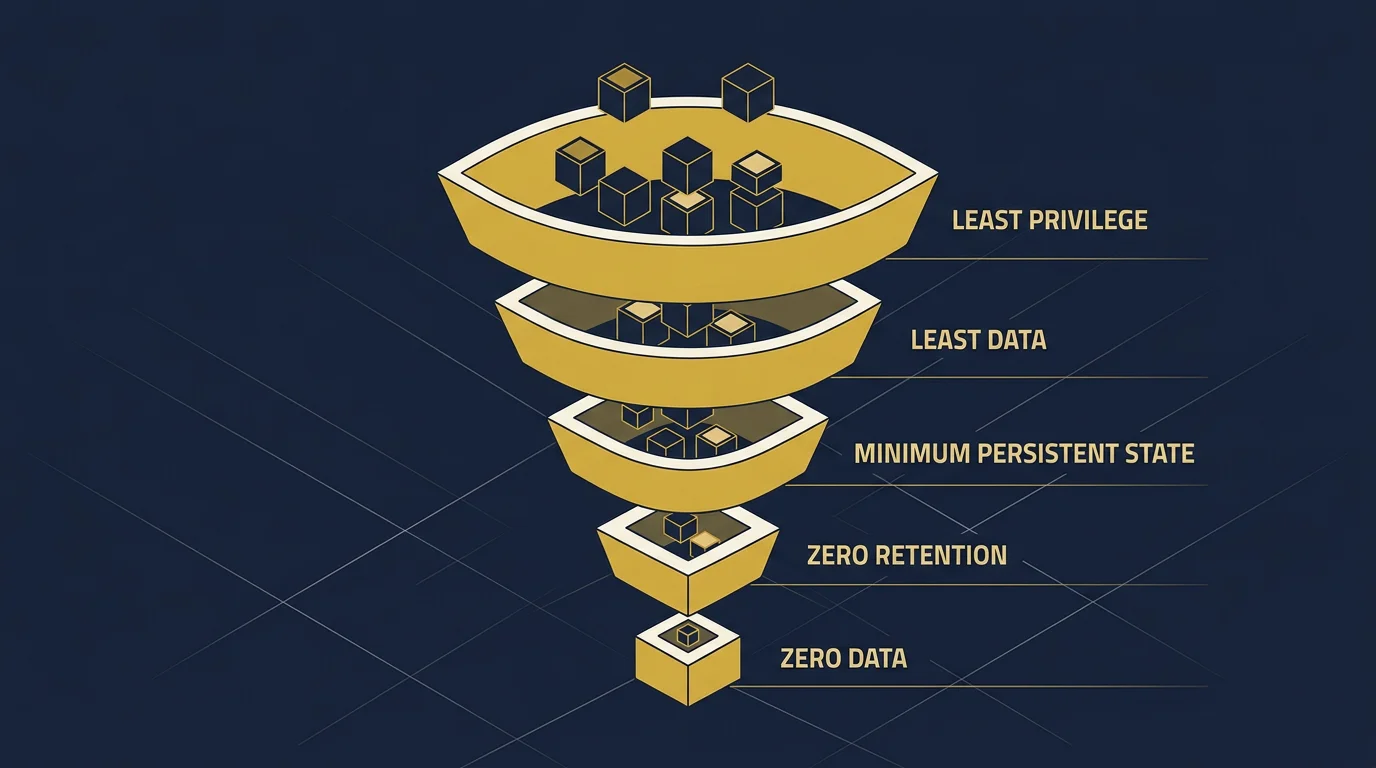
Microsoft's controls harden the memory you keep. Our independent position is that you should also question how much memory needs to exist at all. We propose a progression. First, least privilege: scope every agent identity narrowly. Second, least data: extract and store only what a function genuinely requires. Third, minimum persistent state: prefer short-lived working context over durable records wherever the task permits.
The final steps push further. Where retention serves no functional purpose, aim for zero retention, letting time-to-live policies expire entries and bound the window any poisoned record can survive. This direction culminates in the Zero Data Protocol, our structural approach built on Zero Collection, Zero Retention, and Zero Exploitation. The human consequence of this principle is what we call Human Freedom Choice: when identity or personal data is not functionally necessary, the user should remain free not to provide it. If you want the underlying model, you can Standardize AI agent memory/data with the Agent Data Protocol. To be explicit and avoid any confusion: Microsoft does not endorse, implement, or certify the Zero Data Protocol. It is our independent framework, presented alongside Microsoft's guidance as a complementary architectural direction.
Comparing Memory Risk Reduction Strategies
Different strategies reduce risk at different points in the lifecycle. The table below contrasts common postures on the data they retain and the residual exposure they leave behind.
Strategy | Data persisted | Poisoning window | Residual exposure |
|---|---|---|---|
Harden stored memory (isolation, provenance) | Full memory retained | Bounded by detection and audit | Moderate: stored state remains a target |
Least privilege identity + RBAC | Full memory, scoped access | Contained per agent scope | Moderate: valid scopes still writable |
Least data + short TTL retention | Minimal, time-limited | Narrow, auto-expiring | Low: little to corrupt or exfiltrate |
Zero Data Protocol (our approach) | None where not functionally required | Effectively removed for non-retained data | Reduced through structural minimization where data is not functionally required |
No single row is sufficient in isolation. In practice you layer them, and the more you reduce what is persisted, the less any downstream control has to defend.
Retention, Deletion, and Lifecycle Governance in Practice
Governance turns principles into operational controls. Log every memory write, read, update, and deletion with the actor, timestamp, session, and agent involved. Apply TTL policies so stale or poisoned entries expire automatically. Support search and removal so data-subject requests and incident response can expire memory reliably. Managed services increasingly expose these controls: item-level create, read, update, and delete operations, plus store-level default retention, are now surfaced in preview agent-memory offerings.
Regulatory pressure reinforces the case for restraint. Reporting from OECD.AI in February 2026 noted that rapid agent adoption has produced real attack campaigns exploiting agent memory, exposing organizational vulnerabilities and prompting calls for stronger governance. Avoiding unnecessary persistent storage removes later retention-related exposure, including some breach and memory-poisoning opportunities, which is why minimizing persistent state is both a security and a compliance advantage.
Bringing Memory Security and Data Minimization Together
Effective AI agent memory security is a layered discipline, not a single toggle. Microsoft's guidance shows how to protect the memory you keep through scoped identity, isolation, provenance, and lifecycle visibility. The complementary move is to keep less: apply least privilege, then least data, then minimize persistent state and retention. Start by auditing what your agents actually need to remember, expire the rest on a defined schedule, and treat every stored record as a future target rather than a free convenience.
Take action with Zero Data Protocol
You have seen that the strongest way to shrink memory risk is to reduce the personal data your agents ever retain. If your teams are building or governing Microsoft-style agentic systems, the next step is to align identity, retention, and architecture around minimal data dependency rather than after-the-fact controls.
We connect privacy, cybersecurity, AI governance, and system design into one structural direction: collect less, retain less, exploit less. Explore our approach to AI agent security for Microsoft-style AI systems and learn how designing for zero dependency on personal data lowers exposure, liability, and the surface an attacker can ever reach.
Frequently Asked Questions
What is an AI agent memory poisoning attack?
It is a manipulation in which an attacker plants instructions or fabricated experiences into an agent's persistent memory. Once stored, those entries are retrieved as trusted history and can shape the agent's behavior in later, unrelated sessions. The MITRE ATLAS framework classifies this as AML.T0080: Memory Poisoning.
How does Microsoft protect AI agent memory?
Microsoft applies a defense-in-depth model across storage, retrieval, and user control. Key measures include establishing provenance before persistence, enforcing access boundaries outside the model, treating retrieval as a risk decision, and providing lifecycle audit visibility for security teams.
Is short-term memory safer than long-term memory?
Short-term working memory typically exists only for the current session, so it presents a narrower persistence window. Long-term memory retains distilled knowledge across sessions, which is more useful but also more exposed. Applying time-to-live policies to long-term entries helps bound the risk.
How does data minimization reduce memory risk?
Reducing unnecessary collection and retention narrows the amount of persistent data that can later be poisoned, exposed or subject to disclosure obligations. Our Zero Data Protocol applies this structurally through Zero Collection, Zero Retention, and Zero Exploitation, so agents depend on system function rather than accumulated personal data.
Does Zero Data Protocol replace Microsoft's memory controls?
No. Microsoft does not endorse or implement the Zero Data Protocol, and the two are complementary. Microsoft's controls harden the memory you keep, while our approach reduces how much memory needs to exist in the first place.