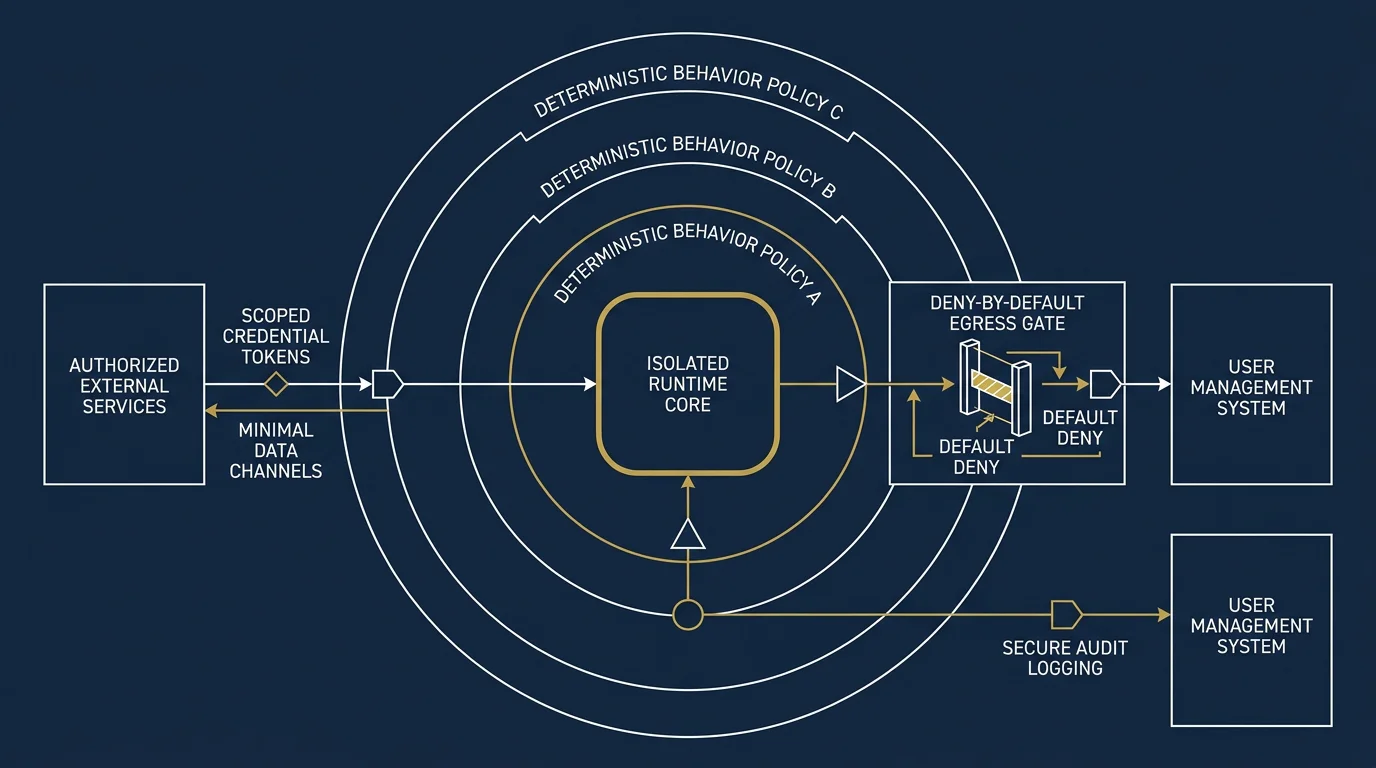

When an autonomous agent gains enterprise credentials, a single successful manipulation can cascade across tools, memory and downstream systems. This is why practitioners increasingly argue that securing autonomous AI agents cannot rest on asking the model politely to behave. The reliable boundary must live outside the model, in the runtime and the infrastructure. To ground that idea in a structural approach, our Agent Data Protocol for safer agent operations frames how agent behavior can be constrained by design.
The stakes are practical, not theoretical. NVIDIA's own red team reports that prompt-based defenses fail against determined adversaries, and that hard controls remain necessary. According to NVIDIA's technical blog, fully autonomous systems holding enterprise credentials are inherently risky and must be carefully secured through deterministic mechanisms enforced outside the model.
Why autonomous agents rewrite the security model
Traditional AI safety assumed stateless exchanges: a prompt goes in, a response comes out. Agentic systems break that assumption entirely. The topic of NVIDIA AI agent security matters precisely because these agents plan tasks, invoke tools, persist memory and execute code over long horizons. Each new capability widens the attack surface.
The consequence is that risk no longer lives only at inference time. It extends across skills, tools, memory stores, execution environments and the agent's own decision logic. A prompt injection that would once produce a bad sentence can now trigger an unintended tool action, a data exfiltration, or a privilege escalation. Prompt-level or static controls alone should not be treated as the sole security boundary for agentic systems.
Deterministic controls: the core of NVIDIA's guidance
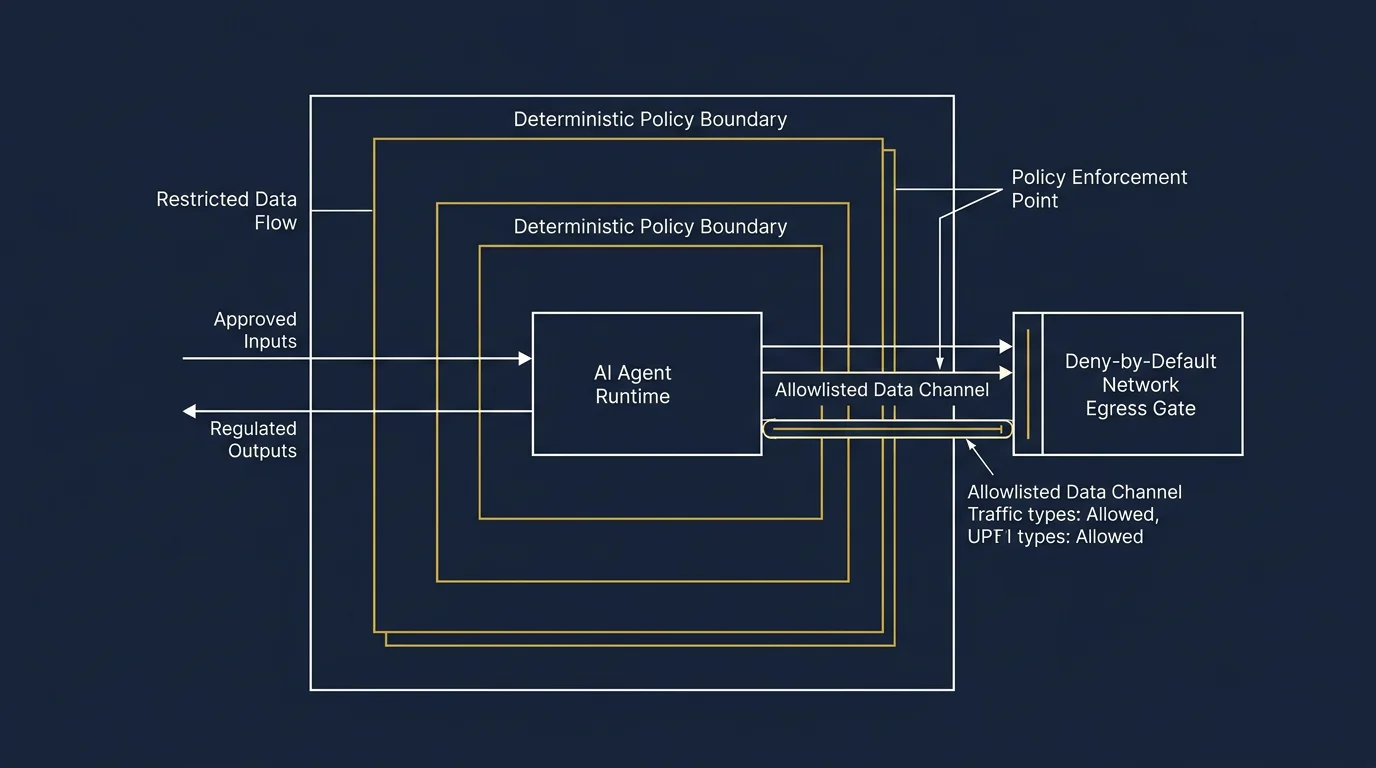
NVIDIA’s guidance emphasizes deterministic infrastructure controls as a stronger enforcement layer than prompt-based defenses alone. Their red team found that prompt-based and LLM-as-a-judge defenses proved unreliable against adversarial techniques such as social engineering and misdirection through legitimate workflows. As a result, they conclude that deterministic controls must be enforced outside the model's control plane.
Concretely, NVIDIA recommends a small set of hard measures. These include strong access controls limiting interactions to authenticated users, sandboxed command execution, default-deny network egress bound to a tightly scoped allowlist, exclusion of persistent secrets from agent environments, and strict validation of package sources and tool permissions. Independent engineering guides echo the same architecture; a 2026 Northflank sandboxing guide describes a zero-trust model where every agent action is explicitly allowed rather than implicitly permitted.
Sandboxing, credential isolation and scoped access
Sandboxing is the workhorse of this model. Arbitrary command execution should run only inside an isolated, hardened environment, so that the effects of an agent's actions are contained rather than trusted. The goal, in NVIDIA's framing, is to limit the blast radius of any compromise.
Credential handling follows the same discipline. According to NVIDIA's practical sandboxing guidance, secrets should be provisioned only for the current task, never as the full set of credentials available on the host. Ephemeral, task-specific tokens ensure that a subverted agent inherits the narrowest possible reach. This is least privilege applied at the level of every tool call and every secret.
These principles map cleanly onto governed design. When you decide what an agent may touch, you are also deciding what it can leak. Our guidance on Least privilege and least data for AI agents connects scoped access with a parallel discipline for the data itself.
From least privilege to least data: an independent progression
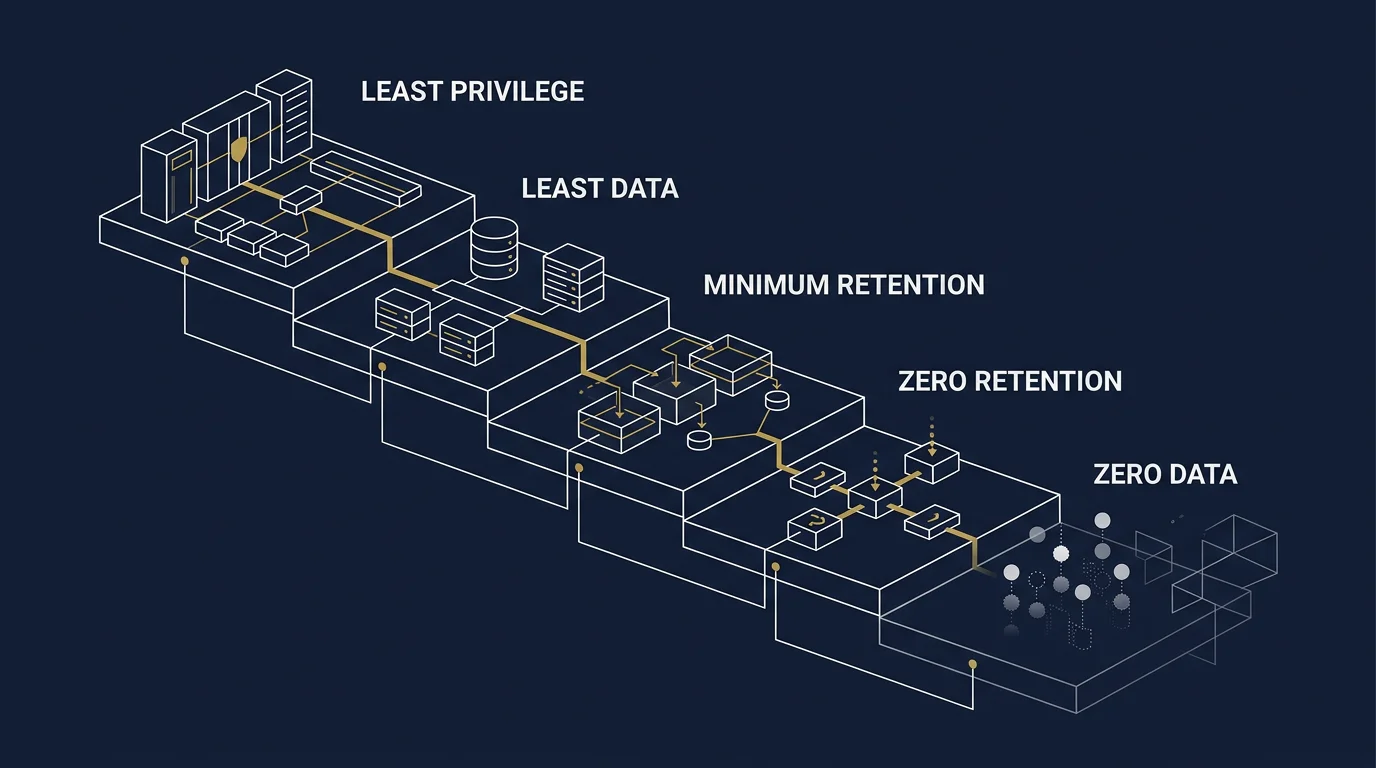
Here we extend the NVIDIA reference logic with an independent progression of our own. Least privilege limits what an agent may do. The natural next step limits what data even exists to be exposed. If a token restricts reach, then reducing the data an agent collects, retains and processes shrinks the target itself.
We describe this direction as a sequence: least privilege, then least data, then minimum retention or zero retention, then zero data wherever a function does not require it. The final layer is what we call Zero Data Protocol. Each step lowers exposure independently, so that even a fully successful compromise finds less to steal. The connection to broader Generative AI security risks is direct, because inference and profiling risks scale with the data an agent can reach.
It is important to be precise about attribution here. This progression is our independent framework. NVIDIA does not endorse, implement or reference Zero Data Protocol, and none of the NVIDIA guidance cited above claims to eliminate risk. We avoid absolute security claims for the same reason NVIDIA does: nearly any system can be subverted given sufficient time and expertise.
Zero Data Protocol as an independent framework
Zero Data Protocol is a structural approach built on three principles: Zero Collection, Zero Retention and Zero Exploitation. Rather than promising protection through policies or consent banners, it treats trust as an architectural outcome. The reasoning is simple: Data that is never collected removes an entire category of retention and later-exposure risk.
Applied to agentic systems, this complements deterministic controls instead of replacing them. NVIDIA's hard controls constrain agent behavior; a minimal-data architecture constrains agent reach. When identity or personal data is not functionally necessary, we hold that users should remain free not to provide it. This human consequence is what we call Human Freedom Choice. Less retention means less exposure, less liability and fewer future targets.
Comparing control layers for agentic systems
The two approaches operate at different points in the stack and reinforce one another. The table below situates them without overstating any single layer.
Control layer | What it constrains | Primary origin |
Sandboxed execution | What an agent can run and escape | NVIDIA deterministic guidance |
Deny-by-default egress | Where data can travel | NVIDIA deterministic guidance |
Scoped credentials | What an agent can reach | Least privilege practice |
Least data and zero retention | What data exists to expose | Independent ZDP progression / minimal-data architecture |
Zero Collection by design | Whether data is captured at all | Zero Data Protocol (our framework) |
The GTC 2026 direction reinforces this layered view at the runtime level. A 2026 Futurum analysis notes that NVIDIA's secure runtime introduces sandboxing, least-privilege access controls and a privacy router that directs sensitive data to local models, keeping certain data flows off external paths.
Building agent security in defensible layers
Effective protection for autonomous AI agents is not a single feature but a set of reinforcing layers. Begin with NVIDIA's deterministic controls: sandbox execution, deny egress by default, isolate credentials and scope every permission. Then extend the discipline to the data itself, collecting and retaining less so that a compromise finds a smaller target. No layer is absolute, and you should treat none as a guarantee. What they offer instead is depth, so that a failure at one boundary is contained by the next.
Take action with Zero Data Protocol
You have hardened the runtime and scoped every credential. The remaining question is whether your agents still touch personal data they never needed in the first place. That is the gap architectural discipline closes.
At Zero Data Protocol, we help teams design digital systems around Zero Collection, Zero Retention and Zero Exploitation, so trust comes from architecture rather than promises. Explore our structural approach to zero-dependency agent design to reduce exposure, liability and future target surface across your agentic deployments.
Frequently Asked Questions
Why are prompt-based defenses considered unreliable for AI agents?
NVIDIA's red team found that adversaries can bypass instructions through social engineering, misdirection and gradual manipulation. Because these defenses live inside the model's control plane, a determined attacker can subvert them. Deterministic controls enforced outside the model provide a firmer boundary.
What are deterministic or "hard" controls?
They are infrastructure-level enforcement mechanisms that do not depend on the model's cooperation. Examples include sandboxed execution, deny-by-default network egress, scoped credentials and validated package sources. They contain the effects of a compromise rather than trying to prevent the manipulation itself.
Does NVIDIA endorse Zero Data Protocol?
No. Zero Data Protocol is our independent framework built on Zero Collection, Zero Retention and Zero Exploitation. NVIDIA does not endorse, implement or reference it, and we cite NVIDIA only as an external technical reference for deterministic agent controls.
How does data minimization strengthen agent security?
Least privilege limits what an agent can reach, while least data limits what exists to be exposed. By collecting and retaining less personal data, you shrink the target so a successful compromise finds less to exfiltrate. Our least privilege and least data guidance explains the progression.
Can any of these controls guarantee an agent is secure?
No responsible framework claims absolute security. NVIDIA notes that nearly any system can be subverted given enough time and expertise. The goal is layered defense, where each control contains the failures of the others and reduces overall exposure.