
How much damage can a single hijacked AI agent cause when it holds broad standing credentials and connected tools? As autonomous agents reach into data stores, SaaS systems and APIs, the security question shifts from what a model says to what an agent is actually permitted to do. A durable answer begins with our Agent Data Protocol for secure agent operation and a disciplined view of permissions, identity and data flow.
According to Gartner, 40% of enterprise applications will be integrated with task-specific AI agents by the end of 2026, up from less than 5% in 2025. That expansion multiplies the attack surface faster than most governance programs mature. This is why securing AI agents on Cloudflare now centers on authorization, isolation and data minimization, rather than clever prompt wording alone.
Why Prompt Guardrails Cannot Be the Only Boundary
Effective Cloudflare AI agent security treats prompt guardrails as one layer among many, never as the perimeter itself. Large language models cannot reliably separate trusted system instructions from untrusted content pulled in during normal work. A carefully crafted input, or a poisoned document retrieved by the agent, can override the intended behavior.
Prompt injection remains a material concern for agentic systems because untrusted content can influence models that also possess tool access and delegated authority. When an agent can email, transfer, delete or escalate, a single injected instruction can convert a helpful assistant into a data-exfiltration path. Guardrails reduce that risk, but they cannot be the last line of defense.
Authorization Outside the Prompt
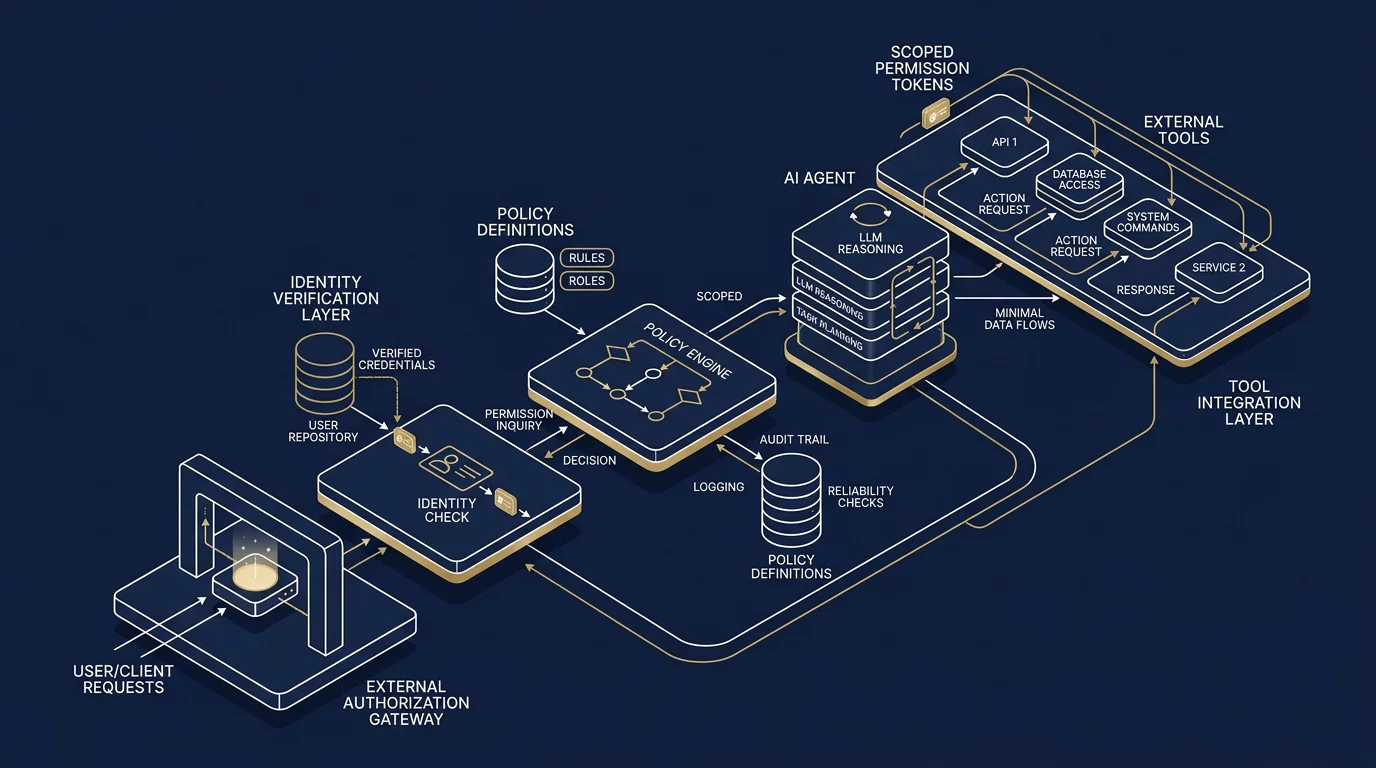
The most reliable controls sit in the infrastructure, where the agent cannot argue with them. Cloudflare positions this around identity, scoped access and a single point of policy enforcement. Its AI Security suite brings model traffic, MCP servers, AI applications and data controls into one platform designed to work together.
Several primitives matter here. Zero Trust Network Access authenticates and authorizes every request before it reaches an AI tool. MCP server portals centralize agent-to-tool connections, so access to corporate resources stays governed and visible. An AI Gateway centralizes model requests, adds rate limits, caching and guardrails, and its Authenticated Gateway feature enforces a required token before any call proceeds. The principle is consistent: authorization lives outside the prompt, expressed as policy rather than persuasion.
Sandbox Boundaries and Restricted Outbound Access
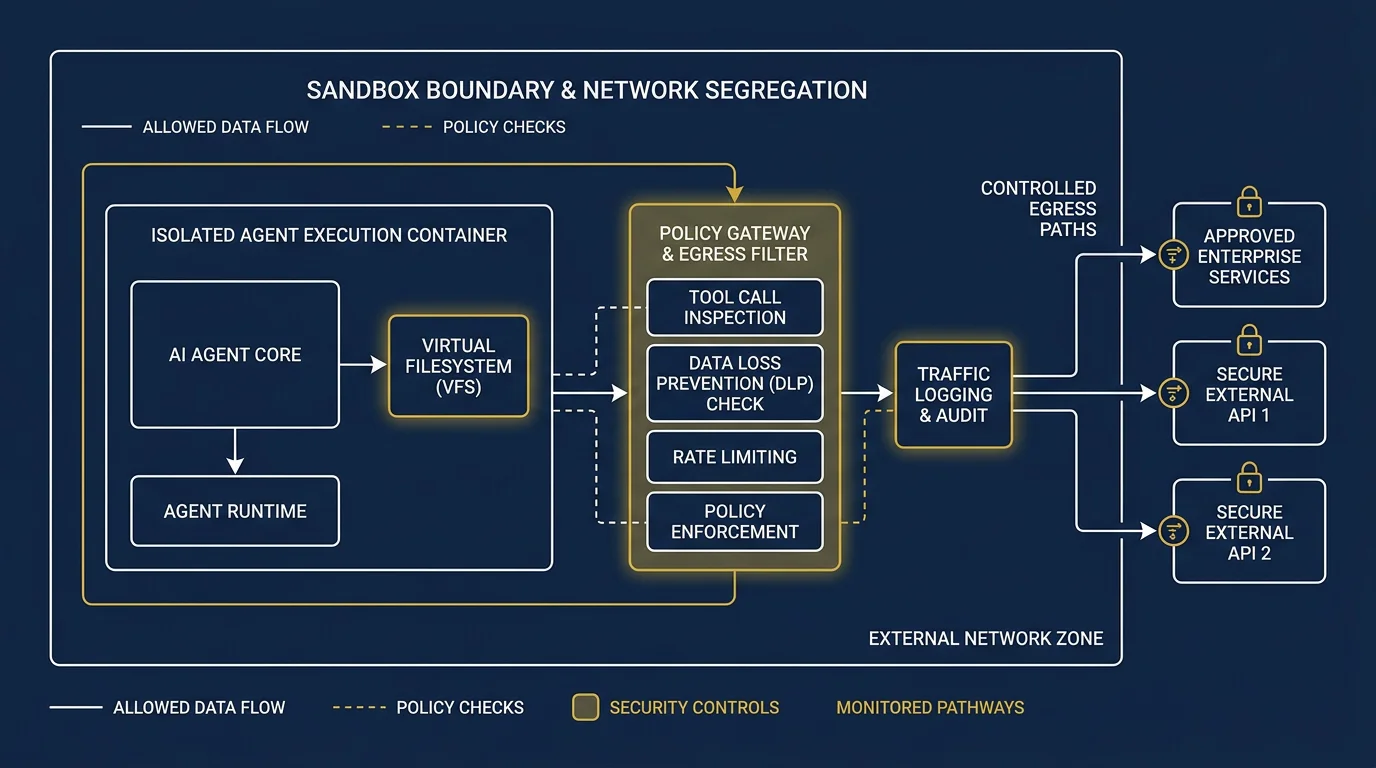
Consider an agent that generates and runs code. If that code executes with open network access, one poisoned instruction reaches your internal systems. Cloudflare Agents can combine durable agent state with isolated sandbox execution. Cloudflare’s Sandbox SDK provides an isolated filesystem and command-execution environment, while outbound connectivity can be restricted through explicit policy. Generated code stays contained, and outbound access can be constrained deliberately.
Browser isolation extends the same logic to risky AI browsing, keeping untrusted content away from endpoints. A practical Cloudflare tutorial shows how to wrap an agent behind Access, enforce Data Loss Prevention profiles on prompts, and run sessions in an isolated browser. Restricted egress and containment do not guarantee safety, but they shrink the blast radius when something goes wrong. For teams designing these boundaries early, our Zero-data AI agents architecture offers a complementary blueprint.
Centralized Governance and Visibility
You cannot govern what you cannot see. Shadow agents, spun up by individual teams without central review, are a recurring source of exposure. Consolidating agent traffic through a gateway gives you logs of prompts, model responses, token usage and cost, alongside Access events and DLP detections that can be exported to external systems.
From Least Privilege to Least Data
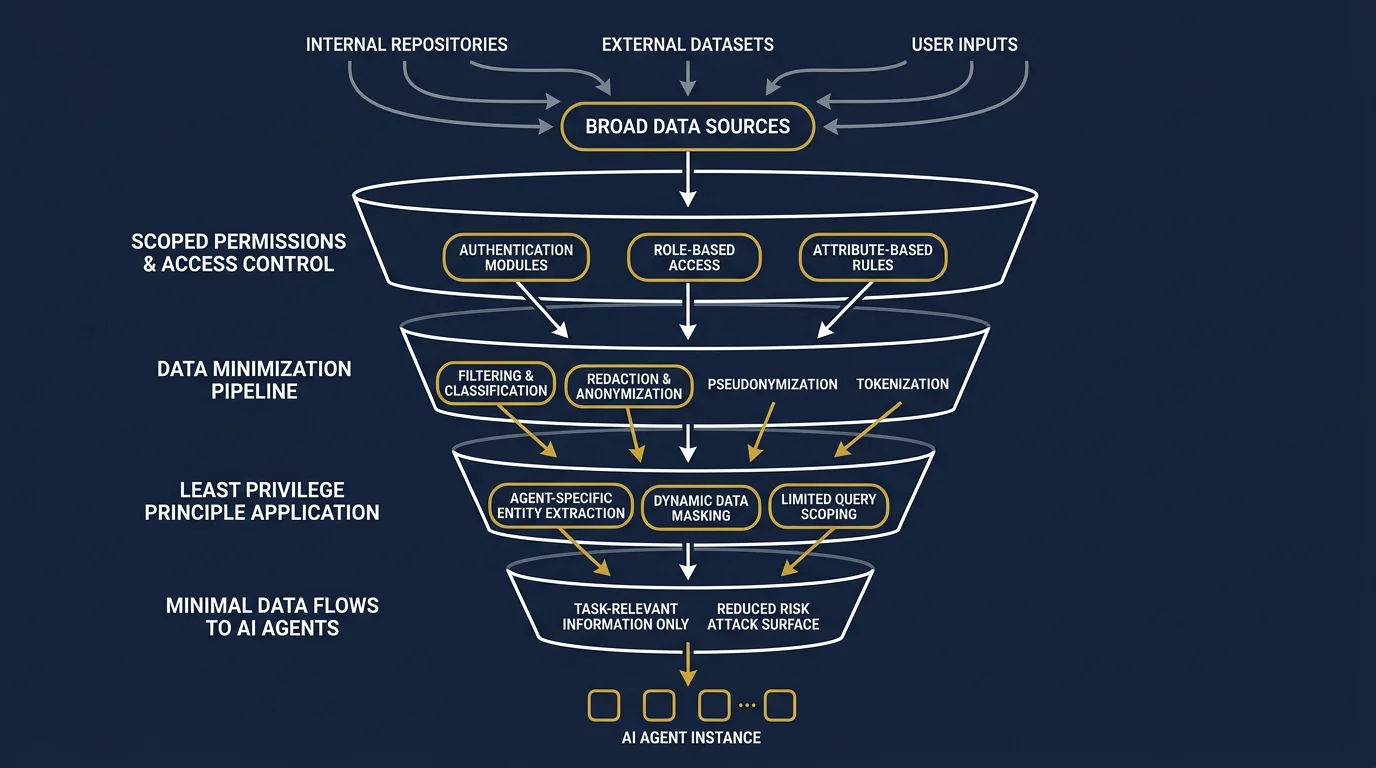
Least privilege is the accepted starting point: grant an agent only the scopes it needs, per operation, rather than a full capability set. This mirrors how OAuth evolved from broad grants toward granular consent. It is necessary, and it remains incomplete. An agent constrained to the right actions can still collect and retain far more personal data than the task requires.
The next step is least data. If an agent does not receive unnecessary sensitive attributes, direct exposure and exfiltration opportunities are reduced, although inference risks may still remain. Reducing what an agent touches lowers liability and shrinks the future target surface at the same time. For the broader risk landscape that motivates this shift, our enterprise guide to generative AI security risks maps the exposure categories worth prioritizing.
Least Data, Minimum Exposure and Zero Retention
The logical endpoint of least data is a structural one. The human consequence of this principle is what we call Human Freedom Choice: when identity or personal data is not functionally necessary, the user should remain free not to provide it. This is the direction behind the Zero Data Protocol: build systems where value comes from function, not from extraction. Less retention means less exposure, less liability and fewer targets for the next attacker.
It is worth being precise here. Cloudflare provides the access, isolation and governance controls described above, and it does not endorse or implement the Zero Data Protocol. We present that progression independently, as a design philosophy that sits above any single vendor's tooling. The table below situates each layer without overstating any of them.
Approach | Personal data collected | Retention | Residual exposure |
Prompt guardrails only | Unchanged | Unchanged | Depends on implementation |
Least privilege (scoped permissions) | Unchanged | Unchanged | Reduced access exposure |
Least data | Reduced | Reduced | Reduced data exposure |
Zero Data Protocol (our approach) | Minimal by design | Zero where not necessary | Reduced by structural minimization |
Adoption is running ahead of readiness, which sharpens the case for structural controls. The 2026 Gartner CIO survey found that only 17% of organizations had deployed AI agents so far, while more than 60% expected to within two years. That gap is where governance debt accumulates. Designing for minimal data now avoids retrofitting privacy onto systems that already hold too much.
Bringing the Layers Together
Strong protection for AI agents on Cloudflare is layered by design. Authenticate and authorize every request outside the prompt, scope permissions per operation, contain execution in sandboxes, restrict outbound access, and centralize logging so nothing operates unseen. Treat prompt guardrails as a useful filter, not a perimeter. Then push further than access alone: the less personal data an agent collects and retains, the smaller the consequences of any single failure. Least privilege reduces what an agent may do; least data reduces what it can lose. Together they turn security from a set of promises into an architectural property.
Take action with Zero Data Protocol
If you are designing agent systems and want fewer sensitive records to defend, the most resilient path is to depend on less personal data from the start. Access controls and sandboxes limit exposure, yet the data you never collect is the data you never have to protect.
We connect privacy, cybersecurity, AI governance and system design into one direction: collect less, retain less, exploit less. Built on Zero Collection, Zero Retention and Zero Exploitation, our approach frames trust as an architectural outcome rather than a consent banner. Explore our Zero Data Protocol for minimal-data agent design to reduce exposure, liability and future target surface across your agent deployments.
Frequently Asked Questions
Are prompt guardrails enough to secure an AI agent?
No. Guardrails filter unsafe prompts and responses, but models cannot reliably separate trusted instructions from untrusted content. You should combine them with authorization, scoped permissions, sandboxing and restricted outbound access enforced outside the prompt.
What does authorization outside the prompt mean?
It means access decisions are enforced by infrastructure, not by the model's own reasoning. Identity checks, Zero Trust policies, token-authenticated gateways and per-operation scopes decide what an agent may reach, regardless of how the prompt is phrased.
How does MCP change AI agent security?
The Model Context Protocol connects agents to tools, so every connected resource becomes a potential injection or over-permission point. Centralizing MCP traffic through governed portals and applying scoped, incremental consent helps limit what any single tool can expose.
What is the difference between least privilege and least data?
Least privilege limits what actions an agent can perform. Least data limits what information it can touch in the first place. Both matter, but reducing data collection shrinks the consequences of a breach more directly than permissions alone.
How does Zero Data Protocol relate to Cloudflare's controls?
They operate at different levels and are not affiliated. Cloudflare provides access, isolation and governance tooling, while our Zero Data Protocol is an independent architectural direction built on Zero Collection, Zero Retention and Zero Exploitation. You can apply the protocol's principles on top of any secure agent platform.